Jill's Lobster

Sunday, 20 February 2022

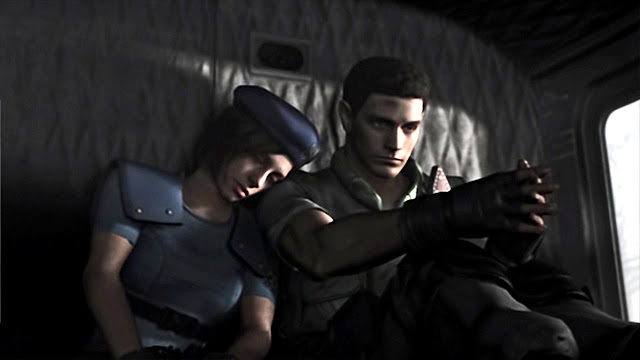
There has been a lot of speculation and theories about Jill Valentine's love life, as is the case anyway with most fictional heroes and heroines who do not appear to have a predetermined or potential partner or match; although Jill has always been a very special case, since she has more often than not been depicted as someone who mostly focuses on her work and her duties, leaving little - if at all - space for anything else in her life. There is a general conception, which is extremely popular among fans - and quite possibly this also appeals to members of the Resident Evil development teams - that Jill has feelings for Chris Redfield and vice versa; Chris, however, always seems even more focused on duties and work than Jill, and we never had the chance to see him dealing with anything directly connected to the game of love, at least as far as his female partners are concerned. 
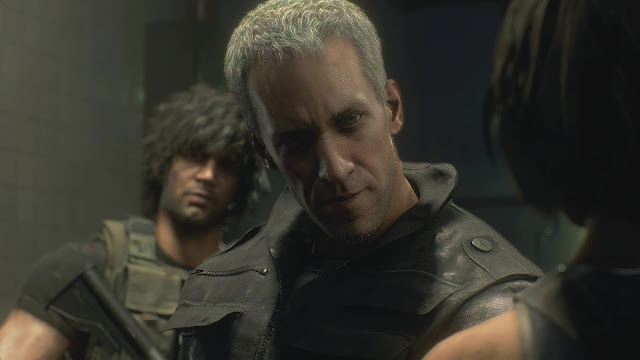
Jill is the main protagonist of Resident Evil 3, a game that recently underwent a revamped remake which may have failed to do justice to certain aspects of the original, what with the omission of emblematic puzzles and iconic environments, but on the other hand it offered a lot of character-related insight, focusing on its protagonists, deuteragonists and antagonists in a way that shed light on their personalities, thus highlighting their motives, intentions and actions a lot more. The game itself, as concept, story and development, seems rather straightforward and easy to follow, but in fact it has traits that give it an identity that is quite different from other titles of the saga. Jill finds herself in a nightmarish, zombie-ridden Raccoon City, just having lost Brad, her only ally, in an overall hostile environment. She is forced to work with a group of soldiers who belong to Umbrella, the company that Jill knows very well and is aware of their evil doings. As the story proceeds, Jill realizes that most of the soldiers are clean and completely ignore the truth about Umbrella - except for one. 
If you think about it, the condition in Resident Evil 3 is the opposite of Resident Evil 1, the other game where Jill was a protagonist: in the first game, Jill had to work with her team mates, all of whom she unquestionably trusted until one of them turned out to be a traitor. In Resident Evil 3, she begins by mistrusting and hating her unlikely partners, until she finds out that most of them are trustworthy. In both cases, she is part of a group of people one of whom at the end proves to be a traitor, but while in Resident Evil 1 they are all innocent until one of them stands out as the bad guy, in Resident Evil 3 they are all guilty until the innocent ones become known and only one of them remains on the antagonist side. Before all this happens though and she learns to respect and trust the soldiers that deserve it, Jill has to fight alone, always reminding herself that what she is doing is for the sake of the civilians whom she wants to secure. It is one of the not so usual cases in the Resident Evil saga where the protagonist is completely by themselves, in a setting where they believe everyone is working against them. Claire in Code Veronica had Steve as an ally right from the start; Leon in Resident Evil 4 had Ashley, Luis, and even Ada in the background. Claire and Leon in Resident Evil 2 had each other, Chris in Resident Evil 5 had Sheva and Josh, Ethan in Resident Evil 7 had Zoe Baker. It is not before several unfortunate events happen that Jill realizes she can actually trust the three out of the four people in her group - although sadly one of them is killed as soon as she finds out that he is clean. 
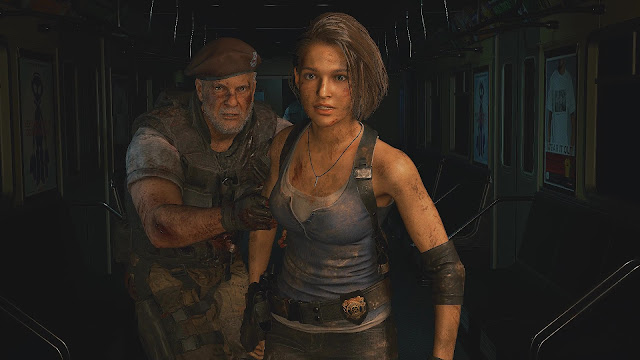
This takes place in a very pivotal sequence of events, where in fact more revelations also are made. Jill goes with Carlos down to the subway platform, after having restored the power and temporarily defeated the ferocious Nemesis. This instance is the one and only in the whole game where all the members of Jill's group appear together, so technically it is the best time for everything to come into place. Earlier, Jill had found out by chance that Nikolai is a ruthless, cruel man, and she probably suspected already that his role in the group was anything but honest. But as soon as the train departs, she witnesses a brief dialogue among him and Mikhail, the leader of the group, which reveals two things: one, it proves that Nikolai is indeed a traitor, and two, it clearly shows that Mikhail is on the side of the good guys, therefore one more that could be trusted.
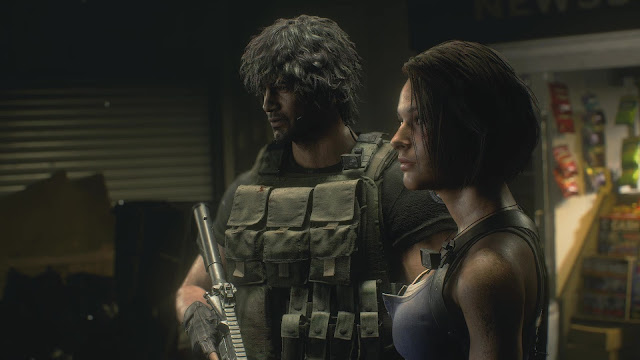
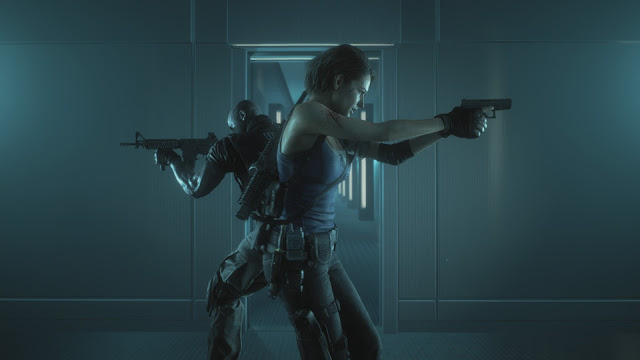
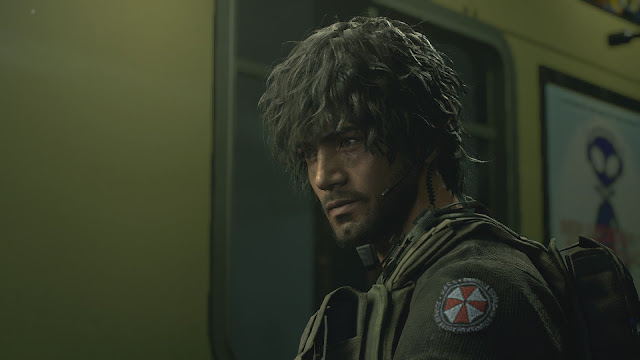
Mikhail's subsequent and violent death, however, sadly limits that side to only two people, Carlos and Tyrell. The latter, being a good friend and partner for Carlos, gained Jill's respect almost automatically, during the aforementioned pivotal scene, moments before the train set off its dramatic route, thanks to the more than obvious friendly and trusty interaction between Carlos and him. As for Carlos, Jill had already changed her heart about him; surely her unmistakable instinct had made her trust him soon enough, but on the one hand she did not want to admit it to herself and on the other, she definitely wanted to be one hundred per cent sure before allowing him to see that she viewed him in a positive light. 
 

For a character like Jill, who goes through such tough and morale-challenging situations on a regular basis, things like flirting and romancing are more or less secondary. Carlos's early attempts to awkwardly flirt her, albeit out of time and place, all fall through because, like he confesses to Tyrell at some point, Jill "is not like anybody", probably referring to all the girls he had known up to then, who would easily fall for a silly, stereotypical flirting. Quite possibly Jill's view of a romantic lover filters through his overall attitude concerning loyalty, trust and bravery, but even after this "test" is clear, maybe it is not enough to own her heart. In Carlos's case, though, this unorthodox, atypical test has double value. Not only he proves that he is clean and trustworthy, but he is also someone his employers can rely on, since, until he has blatant proof that they are rotten, remains loyal to them, something that, however, does not prevent him from going against their wishes when he realizes their evil intentions. 
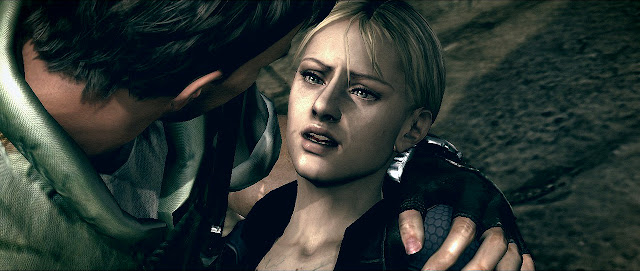
We never had the chance to know what happened in Jill's life after the events in Raccoon City, until we unexpectedly learned about her presumed death in Resident Evil 5. Through a dramatic flashback story, we got to know that, during a nasty encounter with Wesker in Spenser's estate, Jill attempted to save Chris's life by pushing her former captain out of a high window, but she fell all the way down together with him in the process. She remained presumed dead for a while, but Chris found her later alive and heavily brainwashed by Wesker. He was forced to fight with her before finally being able to release her of Wesker's control and bring her back to her senses. After that incident was over, however, we lost her again - save for an appearance in the overcrowded and rather chaotic Revelations

The remake of Resident Evil 3 ends with Jill and Carlos leaving the bombarded Raccoon City for good on a helicopter, and Jill giving an oath to herself to stop Umbrella's evil plans. In the original, however, there is a bonus end screen showing Jill and Carlos gazing at the ocean from a ship, at what could probably be an off-duty holiday escape for the two of them. Could this mean that, after the events in Raccoon City, they met again and maybe bonded romantically together? This could have been an indication back then, which may have not been included in the remake, but there is something else to consider in the new version of the game, that has a similar nuance.

In one episode of the popular sitcom Friends, Phoebe, a character who is notorious for her outrageous way of thinking, tries to prove to the others that two of their common friends, Ross and Rachel, are in fact destined to be together. To do so, she describes how the pairs of lobsters mate, getting tied to each other with unbreakable bonds until the end of their lives, concluding later that Ross is Rachel's lobster. Although this whole lobster theory has little to do with reality, it soon became a standard joke in popular culture, being often featured in media as an easter egg, like so many things today. In the pivotal scene on the underground platform in Resident Evil 3, just as the train is about to depart, Jill expresses her worries about this maybe being the subway's last route. Mikhail then assures her that the train will be back again to collect more civilians. Although Jill is honestly concerned about the latters, part of her worries are directed towards Carlos, who has orders to go to the Police Department with Tyrell. Carlos tells her that he doesn't plan to leave her "in a cold, cruel Carlos-less world", while just to the side of him there is the poster of a local restaurant, Jim's Crabs. The poster depicts a huge lobster, with the name of the species in big lettering below it. This could be random, but it could very well be an easter egg, hinting that Carlos is in fact Jill's lobster.
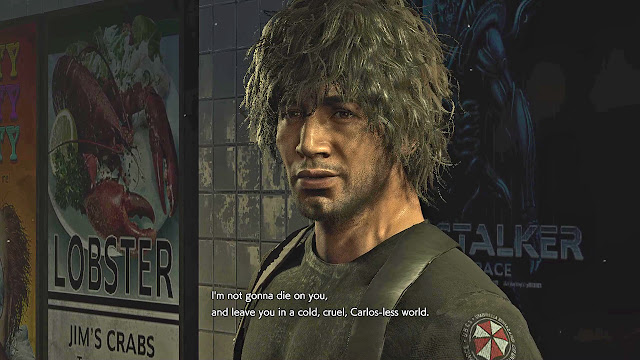
Under that light, we can see Jill's long absence with a different perspective. Obviously she did take part in missions and went on with her police work, but maybe she did find love with Carlos, after all. Given that we haven't heard of Carlos all this time either, it could be that Jill helped him free himself from Umbrella and offered him shelter for a while, before he would be safe again to go on with his life, this time by her side.

Supporting Characters As Friends That Define The Protagonists

Thursday, 30 December 2021

Supporting characters are, in video games as in movies, the often unseen heroes. With the term "supporting characters", I refer to those who are less prominent, in terms of plot and screen time, than the secondary characters or the deuteragonists, but they still may play an important role in the development of the leads, albeit this may not be always obvious on first look. Many times, such characters are friends or allies of the protagonists, but the weight of the presence in their lives varies. Usually supporting characters are not offered the chance to unfold their personality in full, which is why they may be equally underrated or overrated. Their interactions with the protagonists, however, can tell us a lot of things about them if explored carefully. They sometimes affect, directly or indirectly, the emotional and intellectual development of the lead characters, although on a first level their conduct may be misleading. In this article, I will focus on interesting supporting characters from five video games that deal with different themes and the protagonists of which follow completely different paths in their individual stories, therefore the influences that they may receive are also varied.

Lyla Park in Life Is Strange 2

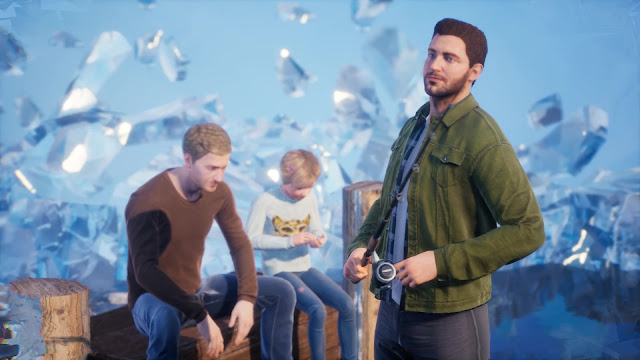
In spite of being a fan favorite, Lyla is, in fact, a rather dark character. Lyla appears in the first episode and her role is overall quite brief, yet you can see, even from that limited appearance, that her influence in Sean's life is not exactly a good one. Lyla is introduced as one of Sean's best friends at school and although she seems to genuinely care for him, her attitude, surprisingly, has several layers. Taking advantage, albeit subconsciously to a degree, of Sean's mild and shy temperament, she has the tendency to always push him towards doing things the way that only she thinks is the best. Lyla obviously suffers from mood swings, and can easily fall into depression, but tries to hide her insecurities behind a supposedly confident facade. In reality, though, she is authoritative, manipulative and lacks self-esteem, but puts forward a loud, seemingly careless persona in order to be able to survive. On top of that, her biggest problem seems to be the crush that she clearly has on Sean, which makes her obsession to hook him up with Jenn, his initial love interest, marginally creepy. Lyla is an extremely toxic person, and her presence in the first episode sort of represents Sean's stagnant life in the dull and depressing suburb where he lives. Sean is obviously a lot more close to his Latin heritage than the much younger Daniel; and he has an artistic side that always wants to find expression. Daniel is the one with the "obvious" diversity (his superpower), but it is in fact Sean who is the real "rebel". Lyla is, for Sean, the balancing power that keeps him collected, but at the same time she is also the chain that holds him tied down to a life that is clearly not made for him. Breaking away from this life (albeit in a tragic way), and from Lyla as well, gives him the chance to claim his freedom and find himself, no matter the cost.

Cor Leonis in Final Fantasy XV

Cor may not have a direct impact on Noctis's development but his influence is clearly defining. He has an imposing personality and an impressive (to say the least) background story. When he was just fifteen years old, he fought against a ferocious warrior and managed to come out of the battle alive, an achievement that won him the moniker "The Immortal"; yet he never ceases being down to earth, thus being the perfect mentor and instructor for Noctis and his friends. He used to be a trusted companion of Noctis's father, and he remains close to the boy as well, offering his valuable expertise and advice when needed. Noctis has grown up somewhat isolated, having only his three close friends by his side, but his rebellious character often makes him appear cold and distant towards them, although he loves them so much. However he treats Cor with respect and always listens to him and his advice. Cor is tough and brave but he is also gentle and wise. His presence in Noctis's life has only positive things to offer, especially after Noctis's father is killed. Not so much a father figure, but more like an older brother, Cor guides Noctis to face difficulties and take responsibilities, gradually making him grow into a kind and caring man, even when he is not there to openly support him. It is not random that when Noctis wakes after his long sleep inside the crystal, Cor is among the very few people from Noctis's past, along with his three friends, who is physically there to help him fight the monsters.

Sofia in Rise Of The Tomb Raider

When Lara first meets Sofia, it is not under the best circumstances; and their second meeting is also eventful. However their relationship gradually gets better and they become good friends after a while. Although Lara's character is more or less already formed and she is confident enough to not need any particular influence, still Sofia's faith and her genuine struggle to help her people offer our heroine an extra boost of inspiration to keep going. Through Sofia's bond with her father, Lara subconsciously "sees" her own relationship with the late Lord Croft, and in that sense she kind of identifies with Sofia, becoming herself, for Jacob, a daughter that will be equally willing to help him unconditionally, somehow making up for all the time that she has lost, and will be losing, after her own father died and she missed every chance to live her life by his side. In Sofia, Lara partly sees her own self and in Sofia's relationship with Jacob she sees reflected how herself and Lord Croft could have grown together, had he not lost his life so unjustly. It is more of a personal development for Lara, but it unavoidably affects her attitude as well, and her decisions that define her connections with other people.

Luis Sera in Resident Evil 4

Luis is, in the essence, more than just a supporting character, since he plays a major role in the development of the story, although his appearance is quite limited. Initially a mysterious man, obviously keeping many secrets, Luis is revealed to hold the key to Leon's infection. Leon seems to be fond of Luis right from the start, in spite of his inexplicable attitude. But Leon is known for his unerring instinct, which means that when he likes someone, it is for a good reason. Luis is a native, and his family has a long story connected to the case of the Plagas. His knowledge of the the subject and his involvement in Saddler's plan cost him his life in the end, and he literally dies in Leon's hands, but not before he manages to give him the pills with which Leon will be able to keep his infection under control until he has access to the antidote. Luis becomes a very close friend of Leon's despite the very short time that they know each other, and he functions both as Leon's life-saver, and as the cause that gives him an additional motive to want to stop Saddler, since he was obviously devastated by Luis's death. Luis kind of stands for all the partners, friends and comrades that Leon has lost, and would keep on losing in the future, during his life as an agent, and by swearing to avenge his death, Leon claims justice not only for Luis and all those lost friends, but for himself as well. 

Francis Pritchard in Deus Ex: Human Revolution

Francis is, at the beginning of the game, rather bitter towards Adam, tending to degrade and underestimate him, but as the story progresses there is a big change in their relationship. A programming and hacking expert, Francis seems to think low of Adam at first, but as Adam proves that, apart from being physically powerful, he is also very smart, he manages to gain Francis's respect and, progressively, his friendship, although Francis is too proud to openly express it with words. Francis is, in reality, probably the only absolutely clean and sincere person in Adam's environment, and he is the one to secretly guide him towards important revelations regarding either himself or Sarif on more than one occasions. While Adam is out in the world investigating or dealing with criminals, Francis is like his eyes inside the Sarif corporation. This may also have a dual interpretation since Adam has enhanced sight, which may help him see farther, but it may prevent him from identifying what is close to him. Francis has only had one optional augmentation to better his programming skills, and in that sense he can maintain his technically enhanced side and his human one in a relative balance, since his human self is almost intact. Adam's humanity is at a very high level in spite of the many augmentations that he has received, which makes him also highly perceptive of the people he interacts with, but his intimidating appearance prevents him from forming close relationships with them. Francis sort of connects him to the world, albeit discreetly and from the shadows, and his pointed, often sarcastic input acts as a reminder for Adam of human interactions that are not based almost entirely on enhanced means.

Sometimes You Have To Let Go (But Do You Ever Really Let Go?)

Friday, 10 December 2021

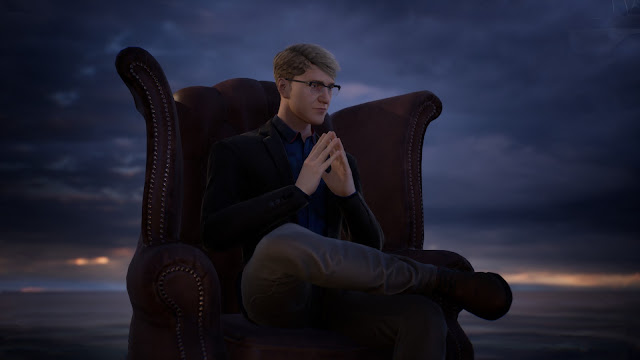
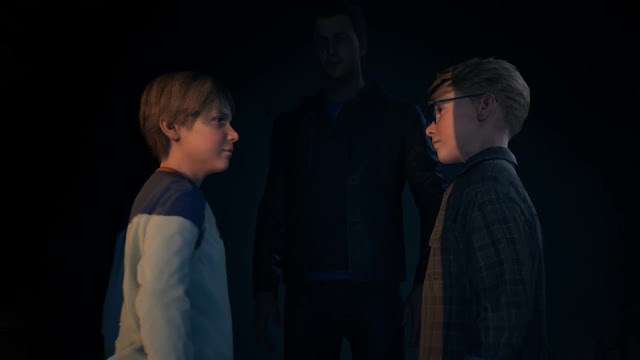
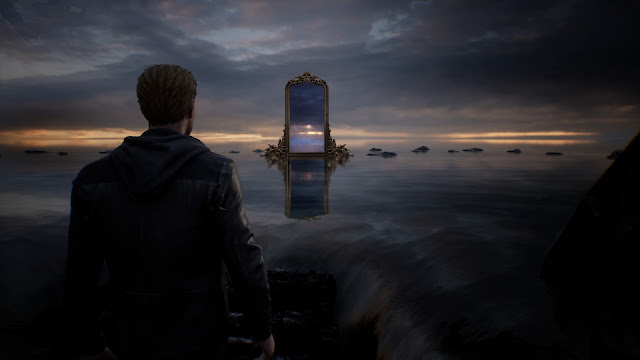
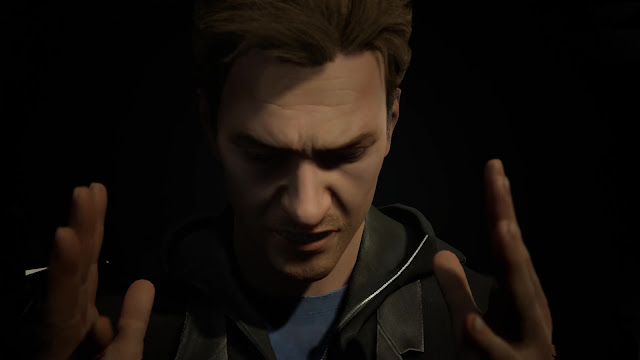
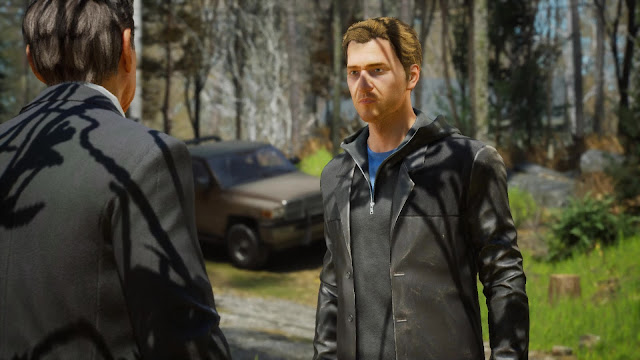
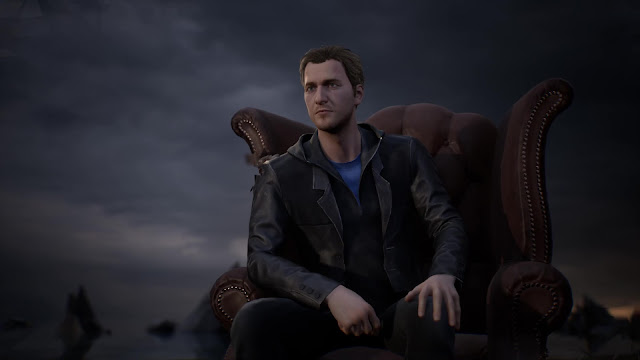
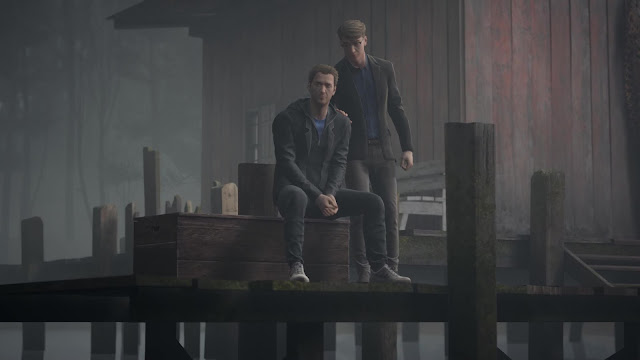
Twin Mirror is the latest game by Dontnod, the team that was responsible for the first two Life Is Strange games as well as Tell Me Why. The main element that the four games have in common is the metaphysical factor: in the first Life Is Strange Max could manipulate time, in Life Is Strange 2 Daniel had telekinesis, in Tell Me Why Alyson and Tyler were able to communicate with their minds, and in Twin Mirror we have Sam Higgs who can enter and navigate in his own grey matter. But whereas in Max's and Daniel's cases their gifts were more or less superpowers, in Sam's case, like in Tyler and Alyson's, his ability is more like the development of a process through which he used to go from a very young age, being a lonely, marginally antisocial child with high perception, who preferred to keep to himself and seek comfort in the presence of an imaginary friend. Having the full support of his father but facing the doubts of his mother, Sam grew up as a loner, summoning his imaginary friend through a mirror every time things got tough. Soon enough, this imaginary friend crossed the line that separated him from Sam (the mirror glass) and became part of his own reality and his daily life. Being the contrary of what Sam was, the unnamed friend, who looks like a clean-cut version of Sam and is referred as "Him" in the game (for this article's consistency, by the way, I will call him Imaginary Sam from now on), would offer Sam advice on how to act and react in society, since he was a social and friendly guy who could easily adapt to any situation while, at the same time, being totally accepted by his surroundings. Except one little detail, he didn't literally exist, so it was actually Sam who, thanks to his friend's guidance, was able to go through situations that would otherwise be unbearable for him.


Naturally we get to know all this as the story progresses, but from the start we become aware of Imaginary Sam's presence in Sam's life and his major role in it. Sam has the ability to evoke memories and feelings by entering his mind at will, which mind is presented as a fragmented space called "Mind Palace". Once in there, Sam is not only able to revive scenes from his past, but also predict the development of situations that lie before him. Imaginary Sam is tightly connected to Sam's Mind Palace, since he was literally born within that space, but he is not always part of it. Once he moved through the mirror into Sam's reality, he immediately adapted to the real world, being constantly Sam's guardian angel since then.

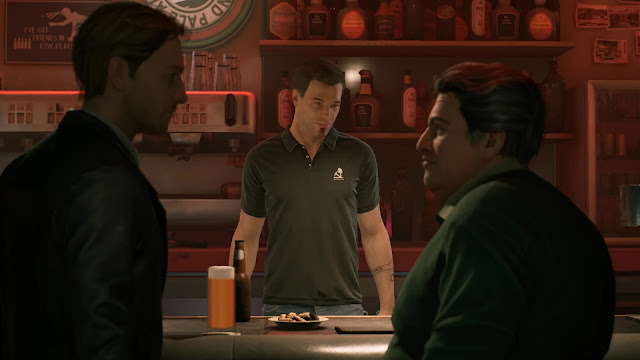
We do not know much about Sam's life as the game begins; we only get to know that he is a journalist who had left his isolated hometown in West Virginia a couple of years ago, supposedly because Anna, his then girlfriend, refused to marry him, and now he is on his way back to attend the funeral of his best friend Nick, who was killed in a car crash. Sam is late for the funeral, but he is in time for the wake that follows. Nick's friends and several other residents of the town have gathered to honor his memory at the local bar, where Sam finds out that he is not exactly welcome. It is revealed that two years before, Sam wrote an article in the town's paper, exposing the local mine where a severe accident had taken place, due to which the mine was soon closed. Since it was the main source of income for most of the town's residents, all the workers lost their jobs and ended up hating Sam for causing the closure of the mine. This along with Anna's refusal made Sam leave abruptly, not wanting to ever come back. At the wake, Nick's daughter, Joan, expresses her suspicions that her father's death was not an accident. Since Nick was a journalist too, Sam decides to look into the matter, sensing that his friend might have been working on exposing something big, which might prove that Joan's instinct was right. 

Like in the Life Is Strange games, and also in Tell Me Why, here too the choice system is dominant and is very much connected to how Sam decides to act in accordance or not with Imaginary Sam, who, more often that not, will attempt to lead him towards the more socially accepted path. Sometimes it is his advice that is more effective, other times Sam should better follow his own instinct. Usually there is a very thin line between the two options, and picking one choice over the other may have a dramatic consequence. At the bottom of all this, however, it is actually Sam battling with himself, or rather with the version of himself that had taken shape years ago in the form of Imaginary Sam, about which path he truly wants to follow in his life. 

Being social, like Imaginary Sam, feels and looks cool, but it does not always prove a good choice for the living and breathing Sam who may be an antisocial, misanthropic and cynical sociopath, almost completely void of sentiments, but is able to see through people and actions and view the world as it is, no matter how ugly it may be. Imaginary Sam is a diplomat in his interactions, while Sam is bluntly and sometimes painfully sincere. Sam does not care about being happy, therefore he does not care about getting along with other people. In reality, Sam is an unconventional human being who prefers to observe the world around him without necessarily participating in it. On the contrary, Imaginary Sam wishes to be in the company of others, even if this means burying hurtful truths and secrets. While Sam's view is more universal, Imaginary Sam is focused on the small world of Sam's circle of friends and acquaintances. Throughout his life so far, probably Sam tried to adapt to society in ways that were not fitting for him; proposing to Anna was one such instant. Anna wasn't interested in getting married, which is why she refused, but her refusal simply made Sam understand that doing what you are supposed to do is not always the correct choice. 

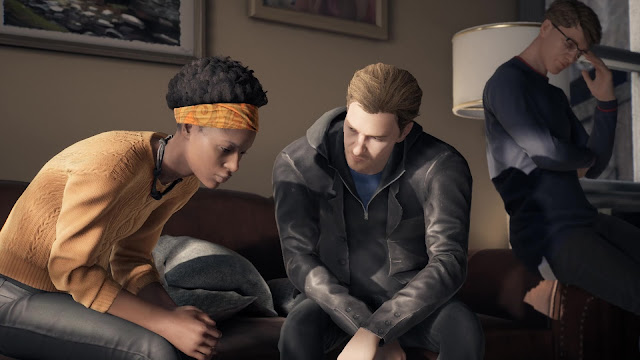
The contrast between Sam and Imaginary Sam is highlighted by two supporting characters, Anna and Joan. Anna is more or less like Imaginary Sam; although she seems to be a free spirit, she is well-adapted in society and gets along with almost everyone she knows. Little Joan, on the other hand, is like Sam: she is an unconventional, difficult child who, however, expresses her feelings far more loud than he does. Anna and Joan, albeit in very different positions in Sam's life, are like two opposite poles. As far as Anna is concerned, Sam's decisions will not affect much his connection (or not) with her. But if in the course of the story Sam decides to follow Imaginary Sam's advice on most important dilemmas, his relationship with Joan will dramatically change, escalating into almost complete deterioration, save a small light of hope in the end. This practically means that, following the accepted path of society, Sam rejects his intuitive side, aka his inner child, which is represented by Joan in human form.

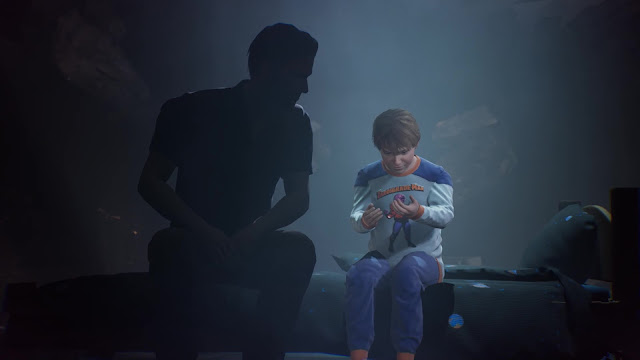
Imaginary Sam was formed in Sam's mind during an age when he felt vulnerable and helpless. Growing up, his imaginary friend grew along with him, both of them gradually distancing themselves from their common childhood. Nick was an essential part of this process, being the solid link between Sam and the world around him, especially after Sam's father died. In fact, both Sam and Imaginary Sam were able to sentimentally grow up thanks to Nick's presence. With Nick gone, Sam was thrown back to his nightmarish, lonely childhood again. Except this time Imaginary Sam was unable to accompany him there. The social, imaginary Sam had already adapted to society, while the antisocial, real Sam had bounced back to the origins of his Mind Palace. His reunion with Joan automatically connected him to both Nick and his inner child - the original self that part of him was trying to eliminate. During an important climax, Sam takes a long and painful walk in the depths of the maze of his Mind Palace and manages to reach its root: a memory of his father giving him a small tortoise made of glass. Little Sam is amazed at how clear it is and how he can see both all of it, as well as through it. 

The glass tortoise clearly symbolizes Sam, how he is and how he sees the world. Like the tortoise, he has secured himself within a (metaphorical, in his case) shell, but just like the tortoise's glass substance, equally he can see both within himself (by traveling in his Mind Palace) and analyze the reactions of others so as to get to the essence of things. This becomes solid reality close to the end, when Sam has to choose between keeping or abandoning his imaginary friend. If he decides to keep Imaginary Sam in his life, he will be in good terms with most of the people around him, but he will only be able to get to a small part of the truth concerning Nick's murder. If however he chooses to say goodbye to Imaginary Sam and go on with his life on his own, he will be able to proceed much further and get to the real mastermind behind not only Nick's assassination but also a network of drug trafficking, organized by a seemingly unscrupulous resident of the town.

So does Nick become more social if he keeps Imaginary Sam in his life? Probably yes, but mostly because Imaginary Sam will always be there to guide him and point him to the "right", socially acceptable path. And does this mean that if Sam chooses to continue on his own, he will remain a cynical sociopath? Partly yes, but it seems like he has meanwhile learned a lot from his social self, and is now able to somehow adapt to his environment, albeit this may not be impressively obvious. In reality, Sam never truly lets go of his imaginary friend, he simply places him back to where he initially was, in the (literal and metaphorical) mirror of his childhood. The moment that Sam chooses the "Mind Palace" against "Him", he becomes more self-aware and ceases to depend on his imaginary friend for sentimental support and comfort, marking a coming-of-age point which, in his case, has more to do with coming to terms with his inner child and less with sentimentally growing up. Because he does need his inner child to always be there for him, but without being dominant in his adult life. Adult Sam is now far more capable to deal with the world and face it head-on, in his very own anti-social and cynical way.

Twin Mirror is fantastic as far as its metaphysical / psychological aspect goes, and Sam is a solid protagonist, presented with great precision and realism as the cold sociopath that he is. Where the game is somewhat weak is when it comes to the mystery story that backs it up, while one of the supposedly important people around Sam feels like an unnecessary addition that offers almost nothing to the development of the plot: his ex-girlfriend Anna had a lot of potential, but she appears simply as a neutral ally who could practically have been any other person in the small town. The fact that she became Nick's girlfriend during Sam's absence does not add even the slightest tension or intrigue, because on the one hand Nick is already dead when Sam returns and on the other, Sam loved his friend so much that any traces of jealousy towards him are unable to survive. This means that, on the romantic side, there is absolutely no conflict present. Not that there needed to be any romantic conflict, but its lack practically cancels Anna's role as the person who used to date first Sam and then Nick. She could have been any other friend, co-worker or whatever. She could have been a woman or a man and it would make absolutely no difference. Even her dialogue lines with Sam are neutral from that aspect, no matter whether you decide to let Sam form some kind of bond with her or not.

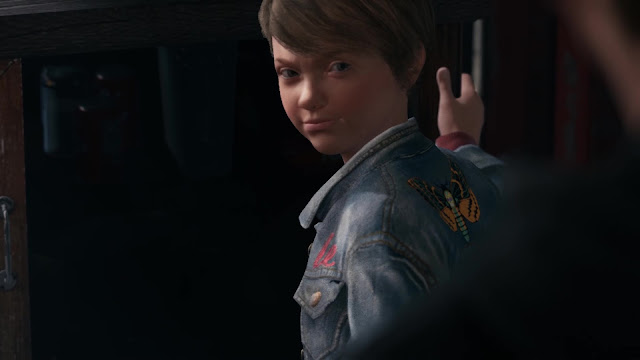
Joan, on the other hand, is the plot's strongest weapon. As I mentioned a few paragraphs above, the most dramatic twist that happens concerns Sam's relationship with her. With Nick gone, Joan basically represents all the things that made her father stand out, while at the same time sharing character elements with Sam. It is Joan who is the true and essential connection between Sam and Nick, and not Anna. Sam's memories that involve Anna are not always pleasant, while the memories where Nick, Joan and himself participate, are happy, careless times. Joan has less screen time than Anna (which becomes even less if certain decisions are made), but her presence never stops to loom over Sam in a rather ominous way. Joan is a constant reminder of Nick, and she is also the one who literally pointed Sam's attention into details that made him start investigating the accident that caused his friend's death. Joan is obviously a gifted, intelligent child with strong instinct; she loves bugs and even has the Death's Head Hawkmoth stitched on the back of her jean jacket. Just like Sam, Joan is unable to deal with the stagnant life of the province, but while he chose to shut himself within his "shell" and thus find a way to survive, Joan shouts and protests and makes her feelings and intentions more than clear. Joan is intuitive like Sam but has her father's gift of easily blending in society, something that she may not be fully aware of yet. In fact Sam has a lot to learn from Joan, who is like an updated version of Imaginary Sam.

As far as the other characters are concerned, some of them, like Ethan or Walter, desperately needed more screen time. Ethan especially, the barman, is a very interesting character with whom, unfortunately, you only get to talk on two occasions, and there may be a very brief dialogue scene with him much later if you choose to go for one of the bad endings of the game. Very early in the story, if you make a certain choice, Ethan will talk to Sam about his family, and in particular his sister, who has apparently left home and now lives in a commune of outcasts in the outskirts of the town. This is in fact Sam's very first hint about the case he is investigating, although at that early point in the game there is no indication of its importance. Similarly Walter, the editor-in-chief of the newspaper where Sam used to work, and where Nick also worked until his sudden death, although being a rather stereotypical character (big and loud with a heart of gold, a cat lover who adores his mother), he is presented in such a way that makes him stand out and become instantly likeable. Anna's father, Joe, is also a solid, imposing character who could probably deserve a bigger role in the game, given that he was also one of the tragic victims of the mine accident that Sam exposed in his infamous article.

With Life Is Strange 2, the Dontnod team reached a peak that is very hard - if not impossible - to surpass. Like Tell Me Why, Twin Mirror is based on an extremely interesting idea which however seems to not be fully developed, although Twin Mirror is far more complex and elaborate than Tell Me Why. Speaking of which, the mystery story that I mentioned before carries out in a rather smooth and expected way, although parts of it involve intense moments of investigation thanks to Sam entering his Mind Palace to reach certain conclusions. There are very few people involved, so you can, more or less, easily deduce who may be the culprit, even if Sam chooses to keep Imaginary Sam, and therefore leave the case partly unresolved. Regardless the investigation is simply a background story, the main and prominent  theme being Sam's spiritual and sentimental development, which also happens to be the game's most interesting aspect. 

Life Is Strange 2 was also about the spiritual and sentimental development of its main characters, but additionally had an intense and powerful story to back it up. Twin Mirror lacks the latter, although its "realistic" story did have potential and the game could have been much longer if certain aspects were developed more and if some characters had a bigger role in the events. For example, I would have loved to see more of Nick, either via Sam's memories or through flashbacks; and maybe get more details about Sam's obviously close bond with his understanding father. For what it's worth, Sam's father was an essential supporting figure during the hero's troubled childhood, and it looks like, after his death, both Imaginary Sam and Nick kind of replaced him in Sam's adult life.

Resident Evil 6 In Restrospect

Saturday, 11 September 2021

 
Now that the classic Resident Evil saga - that is, from the very first game until the sixth, including the side games - has seemingly come to a halt, for the time being at least, it looks like a good time to view the highly underrated Resident Evil 6 in retrospect, and under a different light. I had written an extensive review several years ago, but now that it's been almost a decade since it's initial release, and taking the remake of Resident Evil 2 into consideration - since this is very important, as I will explain in the article that follows - I feel that I have more specific feedback to offer, seeing how I also came to realize a few things which did bug me from the start that I couldn't exactly distinguish back then, although I loved the game and it still is one of my favorites of the series.
 
Resident Evil 6 is, on first look, an impressive game with a stellar cast, featuring four characters that belong to its classic core: Leon, Chris, Ada and Sherry come from the long past of the series, each one of them being connected to some of the most memorable stories of the saga. We could also include Ingrid Hunnigan in this dream team, since she is also a character who has appeared in Resident Evil 4 alongside Leon and established herself as a memorable part of the cast. But the four aforementioned characters, since they are protagonists in their own plotlines, are the ones who star, and inevitably attract most of the limelight. Each of them has a different story to tell, although at certain points their paths cross and they experience the same things from a slightly different aspect. Technically, this has its pros and its cons, but I am not going to go there in this article, since I will focus exclusively on the story from a "literary", so to speak, point of view.
 
What happens in the game plot-wise is that we have one main story which is split in four parts. Its core is a linear development of a series of events, while the additional storylines offer extra insight concerning certain characters and sub-plots. The very essence of the game's plot revolves around Jake Muller and Sherry Birkin, who find themselves stranded in war-torn Edonia after Sherry tracks Jake down among other mercenaries that are fighting in the civil war that is gradually devastating the region. Jake is Albert Wesker's son, and thanks to this heritage he has antibodies that can help fight the C-virus. Sherry has been sent to find him and bring him to her boss, Derek Simmons, naively believing that the latter wants Jake so as to use his blood for the development of an antidote for the virus. At some point they fall in a trap set by Carla Radames, a mad scientist who has cloned herself into an Ada Wong lookalike and whose intent is to use Jake's antibodies in order to make the virus stronger for her own gain. After spending six months imprisoned in a luxurious facility in China, Jake and Sherry manage to escape, at which point Sherry finds out the evil plans of her boss and decides to ignore all orders so as to save Jake and prevent the bad guys from taking advantage of his precious blood. 


In their long journey, Jake and Sherry come across Chris and his men, first in Edonia and later in China, Leon with his partner Helena and Ada who, however, never reveals herself to them. The campaigns of Chris, Leon and Ada explain how the three of them got involved in Jake and Sherry's story, each one of them following a very different path up to the point of each reunion. 

Stripping Resident Evil 6 off its many plotlines and focusing on the core of its story, all loose ends basically lead to Jake: he is Albert Wesker's son, which automatically makes him an extremely intriguing character, and he carries the antibodies that can help eliminate the virus. Simmons wants him in order to kill him or maybe keep him under control so as to prevent the discovery of a potential cure, Carla wants him so as to experiment on his antibodies and make the virus stronger and Sherry has been tasked to accompany him throughout his dangerous journey, putting her own life into great risk. All the surrounding stories eventually lead up to Jake one way or the other; Carla has even created a specially trained monster, Unstanak, that is able to sniff out and locate him. People die and sacrifice their lives for him, even unbeknownst to them. Chris himself crosses paths with him many times, helping him out on several occasions and eventually rescuing him from Carla's underwater facility. Ada literally watches over him, intervening whenever it is necessary to offer a hand. Leon, with his valuable intel, provides information about him that helps push the story forward, and he as well aids him in practice at a certain point. Jake is the leading key character in the game, he is essentially its driving force. His part of the story is the most important, and in my opinion it deserved more screen time and needed to be more complex and elaborate than the others. Leon's story is great and brings back memories of the older games, Chris's story is powerful, touching and heart-breaking, Ada's story has a mildly interesting plot with excellent gameplay - all of them have something to offer to the main story, but it is actually Jake's campaign that is to the point, it is the one where the "hot-stuff" happens, and Jake is the character who basically leads almost everyone's steps, although most of the times he is unaware of it and the game is structured in such a way as to (un)intentionally conceal it. When there is so much to do in the other three campaigns, it is inevitable that the main focus is lost, and Jake's story is considered on the same level of importance as the others - or less, even.

I could perfectly see an extended version of Jake's campaign, maybe with flashbacks of his childhood, his mercenary past and memories of his father, as the main game with all the other three stories as accompanying DLCs; and moreso since now we have more insight concerning certain of the characters involved.
 
 
The release of Resident Evil 2 remake put Leon and Claire's relationship in a new path. The emergence of a more than notable amount of fanart featuring the two of them as a "couple" after the remake, is on its own a strong proof of the impact that this unexpected but welcome change had. I don't know if this was done intentionally by the developers or it just happened randomly in the making of the game, but it looks like the remake simply highlighted what has always been there but the creators ignored, for some mysterious reason: Claire has always been the perfect choice of a female love interest for Leon, and not only because they look so good together on screen: Claire is the sister of Chris Redfield, a character as strong, charming and fascinating as Leon, and she has gone through a series of extremely dangerous adventures that she has carried out with impressive bravery and skill. So she is pretty much like Leon on that matter, their only difference being, up to a point, their social status: before Claire joins Terra Save, she is a civilian, while Leon is introduced to her as a police officer before he becomes a government agent. 
 
As much as I like Ada, I always felt that, excluding Resident Evil 2 where she made her first appearance, she was thrown in the stories mainly as a plot device and much less as an independent character. Although she did have her separate plots in Resident Evil 4 and Resident Evil 6 plus a small part in The Umbrella Chronicles, her mysterious and constantly vaguely explained (if at all) intentions seemed to be simply a cover-up for her real role: she was there as a distraction for Leon, acting the same way towards him every single time, secretly helping him in a way (although, in practice, her help was not really of much use, unless you take the infamous Rocket Launcher drop into consideration), and always disappearing in the end. Even in Damnation, the second of the CGI movies starring Leon, her role, albeit seemingly crucial, was in fact nothing more than a series of expected stunts; and although there is a mention at some point of "something" that she and Leon started but never finished, this stays in the air and, considering that Damnation took place just before Resident Evil 6, we cannot even be sure that it was indeed the real Ada in the movie, or if it was Carla, her evil "clone"; on the contrary, the story focused discreetly on Leon's connection with Alexander, something that became more and more obvious as the movie progressed, and especially in the finale.

Claire has always been there by Leon's side, obviously the ideal companion for him but constantly ignored by her own creators. Just think of Degeneration, the first CGI movie: Leon would flirt with Angela as if this was the only expected prospect for him, while Claire would again be his "buddy". Not surprisingly, this changed in the brand new series, Infinite Darkness, which came right after the Resident Evil 2 remake: you can definitely catch the undertones in the interactions between Leon and Claire, and although there is another female character in the story, Shen May, Leon has no romantic interest in her, nor her in him;  she seems to be quite smitten with the ill-fated Jason, although she expresses it a bit too late; and in fact the one who ends up fascinated with Leon is Patrick, the young agent whom Leon saves early on from the attack of a bloodthirsty zombie.
 
 
I have the impression that in their attempt to establish Ada as a main character in Resident Evil 6, the developers came up with the whole part involving Simmons's obsession with her which eventually led to the creation of her evil twin and his own tragic fate. Because this way, Ada would be essential for the story, and where she would simply appear and disappear again as a supporting character, like so many times before, instead she became the one who actually caused the evil mastermind's outrageous actions (albeit without her knowing), gaining more power as a character compared to her co-protagonists. This could have been an interesting standalone plotline, had Ada a game of her own. But in the whole context of Resident Evil 6, it is as if this specific story is there to minimize the importance of Jake's part and shift to Ada the focus that should have been all on him. In a different context, had the whole story been more elaborate and differently structured, Ada's "interlude" with Simmons could have been an ideal red herring. This basically means that if Simmons was "just" an evil guy without any interest in Ada, there would have been no need to create her clone; Carla would have simply been a genious-turned-crazy scientist (like Sherry's father), aiming at taking over the world (like Jake's father); and if Ada still appeared in the game, her role would have been very limited, and additionally Helena's story in the game would also have been unnecessary, at least as far as her sister's part was concerned. 

Chris's story, on the other hand, was more than strong enough to get a separate game on its own. For what it's worth, Chris deserved it. We have witnessed instances showing the strong bond that he shared with his comrades - like in the first game with Richard, for instance, but never before have we seen our beloved marksman in action with a group of soldiers under his command, until Resident Evil 6.

This was the first time that we saw him as a leader of his team, and his relationship with Piers was very intriguing, to say the least. Most of us have noticed the desperate subtle confession that Piers mutters to Chris at the tragic finale of the story, and how sad and devastated Chris is in the concluding scenes. It would have been extremely interesting if the ending was extended, and we, as Chris, could get to choose between two possible endings a-la Life is Strange with a dramatic "Save Piers or Save the world" kind of moral dilemma. I confess I would have chosen to save Piers without the slightest remorse.

Speaking of which - and this is something I have mentioned also in my review - I love the character development in this game, although now, after having replayed it recently, I wish it stood out a bit more. We see Helena becoming more compassionate thanks to Leon's influence; Jake ends up far less cynical thanks to Sherry, and Sherry gains more confidence in herself because of Jake; Chris gradually frees himself from the ghosts that haunt him thanks to Piers's support, while his unexpected meeting with Leon seems to play a highly important role in him admitting that he was indeed trying to hide from his past: Leon somehow connected him with his "original" self, the "legendary Chris Redfield" like Piers calls him, since Leon came from a time in his life when everything was different. It is not random that it is after this specific encounter that he comes completely to his senses; and then bumping onto Jake, his archenemy's son, brings out his real, heroic and just character. Piers and Leon, for their own part, are by default positive and balancing characters, with their sense of duty and kind heart always showing, never losing their nerve and constantly being ready to face any situation with calm and insight. Only Ada seems to be totally detached throughout the whole story, just momentarily showing a hint of emotion during her meeting with Leon, and then going back again to her cold self. The sole moment when she really seems emotionally overwhelmed is at the end when she destroys Carla's lab; but this is probably due to the fact that Carla stealing her identity was something that personally affected her deeply.

What is more interesting, however, is that in spite of the presence of so many known characters, it is actually Leon who represents the spirit and essence of Resident Evil (the whole first chapter of his story is a tribute to classics like Resident Evil 2 and Nemesis), while at the same time being the link that connects all main characters: he personally knows Sherry, Chris and Ada and he is the one who sends Chris to rescue Jake and Sherry. Leon functions as an invariant in the Resident Evil saga, much more than the other classic characters, and this is something that becomes much more evident in Resident Evil 6, if you view the game with the distance of time and taking into consideration the power and gravity of Leon's presence and his emotional and intellectual development throughout the games.


Related articles: 

» Resident Evil 6 Review

» A Love Undercover


The Tragic Fate of Ethan Winters: In the Aftermath of Resident Evil: Village

Monday, 5 July 2021

Resident Evil: Village concludes the story of Ethan Winters in a most dramatic way, or at least this is how it seems with the data that we have so far. For this is Resident Evil, after all, a universe where we have seen characters come back from the dead enough times so as to have hope that maybe this wasn't the last that we saw of the saga's latest lead hero.

Ethan Winters has been (and possibly still is) a curious case; we only had the chance to accompany him in two games, after he was introduced to us quite abruptly in Resident Evil 7, a game which, moreover, drove the series to a new path. To begin with, Resident Evil 7 was in first person. Excluding the on-rails games that were The Darkside Chronicles and The Umbrella Chronicles, this was the first time that a title of the saga was in first person. Personally I didn't mind that; some of my most favorite games happen to be in first person, so playing a Resident Evil story in such a mode was quite enjoyable. What I didn't like much was how the developers, probably following the example of Outlast, insisted in never showing Ethan's face to us, even making his in-game model headless. This was a strange condition for a Resident Evil game, coming from a series where the characters always played an important part, their personality being an essential element of the stories. Code Veronica, for instance, would have never been the same if we were unable to actually see Claire's reactions on screen, the feelings that her facial expressions would betray. Or if we were never able to witness Leon's thoughtful face as he was approaching the village in Resident Evil 4, or his emotional state as he watched innocent people being eaten alive by zombies in Resident Evil 6. Specifically I am talking about the cutscenes - even if Ethan never showed his face in-game, he could very well appear normally in the cutscenes, like it usually is the case in first person games.

In Resident Evil 7, this was not so much of an issue, of course. Almost until the end, we were in the process of adapting to the game's new tactics and of getting to know the cast, including its protagonist. All this changed with Resident Evil: Village. This time around, Ethan's story became a lot more personal, focusing on his close family and the two most beloved people in his life: his wife and his baby. It was unavoidable that the time we got to spend with Ethan in Village, brought us much closer to him and we got to know and like him more. 

The story takes place a few years after the Baker house incident. Ethan and Mia, who now have a baby, a girl called Rosemary, are under the protection of Chris Redfield who, incidentally, has meanwhile differentiated himself from the BSAA for unknown reasons. I'd like to think that he was so heartbroken after Piers's death, that he couldn't go on working in the same environment any more. At some point, Chris bursts into Ethan's home, inexplicably shoots Mia dead and kidnaps Ethan and the baby. Something goes wrong however, and Ethan ends up alone at the snowy outskirts of a mountainous village in Eastern Europe, where he begins a desperate search for his baby, while at the same time trying to figure out why Chris, who was so caring and protective over him and his family, killed Mia in cold blood.

With the help of a local merchant, the Duke, and with his own investigation, he discovers that Rosemary has been abducted by Mother Miranda, a weird woman who poses as a prophet in the area and has the villagers worship her as some kind of god. Miranda has four prestigious residents of the region under her command, treating them as her "children" and giving them orders on a regular basis. As it turns out, Miranda, as well as her children, are all mutated; Miranda has been carrying experiments in order to be able to resurrect her dead daughter, by making use of a parasitic organism that grew deep in the mountains of the area, and found the perfect host in Rosemary. This is not what is important, however. It is not the first time that we see such a scenario in a game (The Evil Within 2 comes to mind, and I'm sure there's many more). An unexpected revelation happens when Chris confesses to Ethan that the Mia he killed was not the real one; it was actually Mother Miranda, who apparently was able to shape shift; and he did not even kill her, as she was able to come back to life soon after. But even this is not the clue of the story. 


After we witness Ethan's shocking death in the hands of Mother Miranda, we see him wake up in a cold place where he is greeted by a familiar face. It is Eveline from Resident Evil 7, who informs him that he actually died back in Louisiana, during his very first encounter with Jack Baker: the patriarch of the family of creeps beat him to death in the attic, minutes after his arrival, but since he was infected with the Mold he was able to resurrect, never realizing his actual state. That is why he could re-attach his cut hand or leg, and could never die no matter how badly he got hit. So Ethan was in fact dead all along, and moreover, thanks to his unwilling mutation, was potentially extremely strong. His altered DNA was passed on to his daughter, making Rosemary practically a super-weapon, which is why Miranda so ardently wanted to take advantage of her. In the end, Ethan sacrifices himself after sending Chris away with Rosemary, in a scene that is very similar to Piers's sacrifice in Resident Evil 6.


I was truly hoping that, in the sequence where Chris finds Ethan's unconscious body after Miranda rips his heart out, the developers would sort of reward us with a revealing view of his face at last. But of course this didn't happen. I like to believe that maybe in a future game they will introduce a seemingly new character - maybe a bad guy - who will actually be Ethan, but since we have never seen him, we probably won't be able to recognize him. And yes, I know we have seen Ethan's model in full, but we have never seen his in-game face, how his features change with every emotion, how he looks when he is happy and how when he is sad. The developers claim that they did it this way so that the players could identify better with the protagonist, but I don't think it can work this way. This is not Outlast where emphasis is put on the horror factor. This is a game where the character has a serious backstory that we know very well; he has a personality and he has his own place in this fictional world. 


Although I can't say that Ethan was one of my favorite characters in the saga, I still liked him a lot and especially in this game I grew to feel him like a friend of sorts. We've been through thick and thin with him, after all. His personality was highlighted more, we were able to form a more precise idea about his character and his attitude. Truth is, however, that it was the lead baddies, Miranda's four "children", that stole the spotlight. 

Lady Dimitrescu, the unnaturally tall vampire with the extending nails and the three bloodthirsty daughters, was the first to catch out attention. A beautiful woman with an attractive figure, but at the same time terrifying due to her height and her cannibalistic habits, however turned out to be a minor boss with the least important role in the story, despite the incredibly enchanting atmosphere of her castle which brought back memories of Ramon Salazar's residence.


Then it was Donna Beneviento, one of my favorites. Hiding behind a black veil, always carrying her horrific doll, she looked like a female mock version of Ethan: like with him, we could never see her face (except in a portrait and, after she died, we had the chance to briefly catch a glimpse before she dissolved), and she was holding on to her doll, just like Ethan was desperate to hold his daughter again. Interestingly enough, the House Beneviento incident is not only the most compelling part of the plot (its atmosphere and setting remind me a lot of The Evil Within, by the way), but moreover is the one that is most closely connected to Ethan's story. House Beneviento is a huge and complicated puzzle, created mostly by hallucinations, where all the parts are related to Ethan and his family: his wedding song, films from his life, a giant doll depicting Mia, a gruesome gigantic embryo that hunts him around mocking his baby daughter. The code to open a locked door is his wedding anniversary with Mia, and even Angie, Donna's creepy doll, is dressed like a bride, malevolently nodding to Ethan's wife, and also nodding to the ghostly Miss Havisham in Charles Dickens's "Great Expectations".

Dr Moreau is a weird, fish-like mutant whose posture and movement remind me a lot of the old beggar in Francisco Goya's painting of "Old Beggar with a Maja". There is no intriguing interaction between him and Ethan, apart from random attacking attempts as our hero is trying to do what is necessary in order to weaken and defeat him. Dr Moreau is the most neutral of all Mother Miranda's children; he seems indifferent towards Ethan, his main concern being to appear as a good son in Miranda's eyes. His area is a secluded part of the village where everything is working with hydro-power via a rather elaborate but old-fashioned system involving windmills, that seems to have been lost in time. 


Last but not least, Karl Heisenberg is, along with Donna, one of the most interesting lead enemies of the game. Unlike Dr Moreau, he openly hates Mother Miranda and is determined to stand against and eliminate her. Obsessed with engineering and machinery, he runs a factory where he produces super-powerful mechanical soldiers, hoping to form an army big and strong enough to defeat Miranda. His aim is to use Rosemary in order to get to his goal, and he keeps trying to persuade Ethan to join him in his ambitious plan. Heisenberg keeps talking to Ethan as our hero wanders around the factory, sometimes degrading him and other times confessing his own impatience to get rid of Miranda. Although he is one of the coolest characters in the saga, his part of the story is unfortunately ruined by the ridiculous mutation that he goes through in the end, where he transforms into a tank-like machine, a tangle of magnets, buttons, iron bars and God knows what else. 

Notably, all of the four lead bosses seem to be obsessed with something: Heisenberg is obsessed with his machines, Donna with her dolls, Dr Moreau with his water, Lady Dimitrescu with her prestigious bloodline. Quite possibly Miranda used their obsessions in order to manipulate them and make them part of her experiments. That said, Mother Miranda, in spite of being the evil mind behind everything, is not so memorable, and the final confrontation with her feels more like a chore and much less like an imposing boss fight. On the contrary, the brief scene where Ethan is lying inside Duke's cart with the merchant driving him to the altar, and then gets out and we see the black horse that was actually leading the cart, bringing to mind a Victorian hearse, is one of the strongest and most blood-chilling of the game.

With Village, the Resident Evil series took an interesting turn, but I feel that somehow the potential of both the story and the characters were not fully explored. The ending left me with a bitter taste, and not only because of the unexpected twist that was Ethan's death. There were characters in the game, like Donna or Heisenberg, that should have had a bigger role. I feel that Donna's past and the backstory of her lineage, for instance, should have been presented in more detail, and in more sections of the game; and same goes for Heisenberg. Unlike Lady Dimitrescu or Dr Moreau who seem to be secluded in their personal spaces, both Donna and Heisenberg have a looming presence in many parts of the village. As I mentioned a few paragraphs above, Donna in particular seems to reflect Ethan and his quest in a morbid, creepy way. 


In my humble opinion, this is a feature that should have been highlighted a lot more. Moreover, Donna somehow embeds certain familiar enemies from the previous games, namely Ramon Salazar from Resident Evil 4 and Alfred and Alexia Ashford from Code Veronica, and also nods to the Victoriano family from The Evil Within (like Salazar and the Ashfords, also conceived by Shinji Mikami), characters that share a series of common elements: all of them bring an aura of Victorian decadence about them, both with the way they are dressed and their attitude; they are deranged, their life is a tragedy, and they seem to have emerged from a vintage fairy tale, never being able to adapt to the modern world, reminiscing the glory of past days, at the same time reminding us that the stories they are involved in also belong to a world of magic and fancy.