Showing posts with label life is strange 2. Show all posts

Life Is Strange 2' s "Faith" As A Major Turning Point Of No Return

Saturday, 21 March 2026

Most of us old school video game lovers are quite familiar with the term "point of no return" which, in the games that we played in the past (and still play, for that matter!), was used to describe a pivotal moment in the course of the gameplay that marked the final one-way route towards the culmination of the adventure. This practically meant that, from that point and on, it would be impossible to go back to areas you had visited or explored up to then, and it could happen equally in both adventure and action games. Simply put, it is a gameplay - and sometimes plot - device which warns the player that they are moving towards the end of the game, and if there is something that needs to be done in stages visited before, it has to be done now, before passing the point of no return as after that, going back will be impossible. As a gameplay device, it is still being used quite extensively, although in open world games it is not always terminal: in the new generation of the Tomb Raider games, for example, you reach a point of no return after which you cannot go back to previously explored areas, but when you complete the game you can roam the full map as much as you want. In the remake of Resident Evil 2, you reach a point of no return when you leave for the secret NEST lab: up to that point, you can explore the sewers and go back to every single area of the Raccoon Police Department as many times as you want; but once you get on the funicular that leads to the lab, you can never go back. Resident Evil 4 and its recent remake feature several points of no return, each one corresponding to an extended area of the map, progressively locking previously visited stages. 

Life is Strange 2 has a very different logic as far as its gameplay is concerned, as it features separate chapters that get completed within their own map, and the limitations that may affect the outcome of each episode stem from the different decisions that we are called to make in order to proceed. In each chapter, there is a dramatic event that causes the initiation of the next episode, but there is a specific one, namely the fourth chapter with the title "Faith", that is, in practice, the story's actual point of no return. As an episode, "Faith" may not seem too impressive at first, especially if you consider the terrific "Wastelands" that precedes it and the emotionally wrenching "Wolves" that follows it. Excluding the agonizing finale, on first look it feels rather slow-paced, and even the appearance of Karen, the long-lost mother or the protagonists, is set up and presented as quite toned down and neutral. All this on a first level; because on a second level things are much more complicated and interesting.

After being separated from Daniel during the dramatic events at the end of "Wastelands", Sean finds himself heavily wounded but still alive in a hospital, under guard and getting regular visits from a therapist, all in an attempt to make him recall and describe what actually happened in Merrill's farm where Daniel, in a state of uncontrolled confusion, let loose the full extent of his power. Devastated for not knowing Daniel's fate, Sean refuses to co-operate, mainly because he cannot tolerate the one-sided views of the people who oversee him, but most importantly because he is unable to bring himself together - and naturally so - to reveal Daniel's power which was the cause of everything. Regardless, Sean gets his sketchbook back, and while going through it, he notices a cryptic message from Jacob, one of his companions of the previous chapter, which basically gives him a valuable clue concerning Daniel's current whereabouts. He manages to escape without being noticed and begins a long journey so as to reach the place where Daniel hopefully is and get him back.

The place in question turns out to be a private church, run by Lisbeth Fischer, a charismatic but intimidating Pastor with a dubious past, who exploits Daniel's powers, presenting him to her flock as some kind of modern prophet and healer. Sean painfully discovers that Daniel has been brainwashed by Lisbeth, which means that the process of freeing him from her and getting him back will be anything but easy. Karen shows up at just the right moment, but instead of stepping forward to resolve things, she only offers Sean moral support in a twist that may seem strange at first, but in reality it is just the right option: Sean needs to do everything himself, and Daniel needs to realize how harmful Lisbeth is for him and see it with his own eyes. For both brothers, it is a complicated and tough process that will, however, help them find themselves and grow up emotionally and spiritually.

Karen's role as the mother is, in this episode, mostly a typical one, highlighting the figure of the parent who might have been absent throughout the lives of her sons up to that point, but is still holding some degree of moral and emotional power that can affect them, even indirectly. Even so, I admit I initially expected her to take action and save Daniel from Lisbeth, subsequently rescuing both her sons and offering them the protection that she failed to provide all these years. Karen however chooses to stay back and give Sean all the space to act on his own. A rather unexpected development - given that Sean, in spite of being more mature than his age, is still a young boy - but in the full course of the events, it turns out to be the right one. With her stance, Karen allows Sean to follow his instinct and employ his inner strength, because she believes in personal freedom and will. Partly, though, she may feel inadequate to handle things because family life was never her forte; she literally does not know her sons, she would practically be unable to bring Daniel back the way Sean eventually does. At this point, her maternal instinct is only mildly developed, and she too follows her intuition in simply supporting Sean and his choices. On another level, script and plot-wise, it would have been quite unfair for Sean to have Karen save the day, after all the tragedies and troubles that he had to go through up to that point.

The church environment, prominent and looming throughout the whole episode, proves to be a setting of major importance, both as an actual setup and as a symbolic feature. Lisbeth herself carries a dark past, possibly hinted as early as in episode 2: in one of the documents that are scattered around in the cabin where Sean and Daniel have taken temporary shelter in the forest, there is a letter signed by a certain Dr Fischer, reminding a patient of a programmed chemotherapy session that would take place at a clinic named Hope Patient Center.


Whether it is actually Lisbeth herself who wrote the letter is not made clear at any point throughout the development of the plot, however since stuff that we find in games of this kind is rarely (if at all) random, this document is most likely connected to the Pastor's past, revealing that she may have been a doctor once, quite possibly having failed to save a patient and thus losing her faith in science and resorting to other means to try and save people, subsequently losing her mind and becoming obsessed with her newfound faith. With these facts under consideration, the subject of faith becomes a factor of high importance in this part of the story, that goes a lot deeper and further than the chapter's title, applying to nearly all the characters who appear in it.  
 

First of all it is Lisbeth's obvious faith in her calling, which however is distorted and pretentious. Contrary to it, is Jacob's innocent and sincere faith in the divine power, which in turn gets shattered as he gradually opens up to Sean, revealing shocking details about his "treatment". Then it is Daniel's controlled faith which is a result of severe brainwashing. There is also Karen's faith in Sean's will and power of mind and, most prominently, Sean's faith in himself and all that he can achieve. In an unexpected twist of the plot, the key phrase that subsequently unlocks Sean's decisiveness and gives him the ultimate urge to do whatever it takes to save Daniel comes from no one else than Lisbeth herself: when they first meet, and realizing that Sean cannot get tricked like Daniel did, the Pastor turns him away, refusing to accept him in her church. As her goon Nicholas throws him out, she yells "You need to have faith!", hinting that she may allow him in her church if he admits her divine gift and does not interfere with her handling of Daniel. At this point, all seems lost; but Sean is able to turn this phrase around and make it work to his own benefit: he regains faith in himself and moves forward instead of stepping back, determined to never stop until he brings Daniel back, achieving it with his own human power of mind and heart.


Although in every chapter Sean makes huge steps forward towards his full emotional and spiritual development, it is at the end of "Faith" that he literally leaves his old self behind and becomes a new person, similarly how Daniel snaps out of his false prophet persona and it is as if he is reborn. It is a dual transformation that begins simultaneously at the beginning of the chapter's final part and is established and completed as soon as the two brothers step out of the church together. Having this dramatic sequence take place inside the main hall of the church, turns it into a dramatic but unavoidable rite of passage. No matter of the actions that we need or decide to take - depending on our choices at the end of the third chapter - the essence of the outcome is the same: Sean and Daniel leave the church grounds as two completely different people, having achieved both emotional and spiritual growth. 

On another level, lies the conflict between the two mother figures, neither of which is actually a complete one. Karen, the biological mother of the brothers who is connected to them with blood ties, only now makes a physical appearance, gradually and discreetly gaining back all that she had lost during her absence. For Karen, it is mainly about her confirming her role in the lives of the boys, and much less about them connecting with her with family ties. Lisbeth, on the other hand may be a false mother figure for Daniel, but at the same time she had somehow filled a gap in his life, that of the protection and guidance that he needed during the time when he was separated from Sean. This was on a superficial level, of course; because Lisbeth's guidance was all wrong and the protection that she seemingly provided for Daniel was in reality a well masked exposure to many kinds of danger. At the end of the episode, the real mother figure defeats the false one, a development that even has a literal depiction in the version where either Sean or Daniel kill Lisbeth: this extreme twist, which essentially turns them into murderers, also symbolizes the death of their innocent selves and the painful beginning of their new life, reminding both them and us that everything comes with a cost.

While every chapter's conclusion marks the completion of a full circle, "Faith" is the one from which there is literally no turning back: after leaving the church with Karen, the brothers follow her to her camp in the Nevada desert, from where the next phase of their journey - no matter which one it will be - shall begin. The start of the final chapter finds Sean and Daniel somehow settled for a brief period of time, and about to confront the consequences of all their actions and decisions that led them there. Throughout the first three chapters, there are still connections with their past lives, but all bonds appear to have already broken with the start of "Faith". This is something that does not only have to do with the plot or the gameplay, but with the overall atmosphere, the environments and even the physical appearance of the two protagonists. We find Sean with his luscious black hair nearly totally shaved, and later Daniel shows up with a nasty haircut, courtesy of the Pastor herself. The cutting of hair in both cases, as simple as it may seem, in fact carries considerable weight: it acts as some sort of ritual that symbolizes the transition of both Sean and Daniel to new directions in their lives. It is as if they are stripped of all the elements that constituted their personalities up to that point, and in the aftermath they are both reborn.

As far as the visual aspect and the ambience are concerned, with the exception of the tumultuous finale of the chapter, everything before that point is moving at a slower pace; even the darker sequences feel more like bad dreams and less like reality. Then at the church grounds there is this suspicious serenity that cunningly conceals all the evil that lies beneath it. The finale is an explosion, not unexpected but still shocking; and the fact that Sean leads Daniel to realize what is going on by himself instead of forcing him out of the sick situation where Lisbeth had placed him, makes that sequence even more powerful, and highlights its importance for the events that will follow.

One element that foreshadows the fourth chapter's unique place in the story is the transition to it. Each episode ends with the brothers being on a means of transportation, something that indicates the urge to be constantly on the move and run away: at the finale of the first chapter, they are on a bus (notably, the chapter even begins with Sean stepping off a bus); the end of the second chapter finds them jumping on a freight train, again escaping. As episode four reaches its conclusion, they are inside Karen's car, heading to the Nevada desert; and in the game's dramatic finale they are attempting to cross the border to Mexico in a car that Sean is driving. Between chapter three and chapter four however, there is no such transition: the final scene of "Wastelands" is the aftermath of Daniel's rage in Merrill's house - a static situation from where there seems to be no way out. This change marks the start of the painful but necessary switch towards a new approach to things, especially for Sean: it is now time to stop looking for ways to escape, but instead stand on his feet and face things directly. Falling down - and literally doing so, as it happens at the end of "Wastelands" - is part of the process, as then, with the opening of "Faith", he is already on the route to take his life in his own hands, even if he does not know it yet.

Supporting Characters As Friends That Define The Protagonists

Thursday, 30 December 2021

Supporting characters are, in video games as in movies, the often unseen heroes. With the term "supporting characters", I refer to those who are less prominent, in terms of plot and screen time, than the secondary characters or the deuteragonists, but they still may play an important role in the development of the leads, albeit this may not be always obvious on first look. Many times, such characters are friends or allies of the protagonists, but the weight of the presence in their lives varies. Usually supporting characters are not offered the chance to unfold their personality in full, which is why they may be equally underrated or overrated. Their interactions with the protagonists, however, can tell us a lot of things about them if explored carefully. They sometimes affect, directly or indirectly, the emotional and intellectual development of the lead characters, although on a first level their conduct may be misleading. In this article, I will focus on interesting supporting characters from five video games that deal with different themes and the protagonists of which follow completely different paths in their individual stories, therefore the influences that they may receive are also varied.

Lyla Park in Life Is Strange 2

In spite of being a fan favorite, Lyla is, in fact, a rather dark character. Lyla appears in the first episode and her role is overall quite brief, yet you can see, even from that limited appearance, that her influence in Sean's life is not exactly a good one. Lyla is introduced as one of Sean's best friends at school and although she seems to genuinely care for him, her attitude, surprisingly, has several layers. Taking advantage, albeit subconsciously to a degree, of Sean's mild and shy temperament, she has the tendency to always push him towards doing things the way that only she thinks is the best. Lyla obviously suffers from mood swings, and can easily fall into depression, but tries to hide her insecurities behind a supposedly confident facade. In reality, though, she is authoritative, manipulative and lacks self-esteem, but puts forward a loud, seemingly careless persona in order to be able to survive. On top of that, her biggest problem seems to be the crush that she clearly has on Sean, which makes her obsession to hook him up with Jenn, his initial love interest, marginally creepy. Lyla is an extremely toxic person, and her presence in the first episode sort of represents Sean's stagnant life in the dull and depressing suburb where he lives. Sean is obviously a lot more close to his Latin heritage than the much younger Daniel; and he has an artistic side that always wants to find expression. Daniel is the one with the "obvious" diversity (his superpower), but it is in fact Sean who is the real "rebel". Lyla is, for Sean, the balancing power that keeps him collected, but at the same time she is also the chain that holds him tied down to a life that is clearly not made for him. Breaking away from this life (albeit in a tragic way), and from Lyla as well, gives him the chance to claim his freedom and find himself, no matter the cost.

Cor Leonis in Final Fantasy XV

Cor may not have a direct impact on Noctis's development but his influence is clearly defining. He has an imposing personality and an impressive (to say the least) background story. When he was just fifteen years old, he fought against a ferocious warrior and managed to come out of the battle alive, an achievement that won him the moniker "The Immortal"; yet he never ceases being down to earth, thus being the perfect mentor and instructor for Noctis and his friends. He used to be a trusted companion of Noctis's father, and he remains close to the boy as well, offering his valuable expertise and advice when needed. Noctis has grown up somewhat isolated, having only his three close friends by his side, but his rebellious character often makes him appear cold and distant towards them, although he loves them so much. However he treats Cor with respect and always listens to him and his advice. Cor is tough and brave but he is also gentle and wise. His presence in Noctis's life has only positive things to offer, especially after Noctis's father is killed. Not so much a father figure, but more like an older brother, Cor guides Noctis to face difficulties and take responsibilities, gradually making him grow into a kind and caring man, even when he is not there to openly support him. It is not random that when Noctis wakes after his long sleep inside the crystal, Cor is among the very few people from Noctis's past, along with his three friends, who is physically there to help him fight the monsters.

Sofia in Rise Of The Tomb Raider

When Lara first meets Sofia, it is not under the best circumstances; and their second meeting is also eventful. However their relationship gradually gets better and they become good friends after a while. Although Lara's character is more or less already formed and she is confident enough to not need any particular influence, still Sofia's faith and her genuine struggle to help her people offer our heroine an extra boost of inspiration to keep going. Through Sofia's bond with her father, Lara subconsciously "sees" her own relationship with the late Lord Croft, and in that sense she kind of identifies with Sofia, becoming herself, for Jacob, a daughter that will be equally willing to help him unconditionally, somehow making up for all the time that she has lost, and will be losing, after her own father died and she missed every chance to live her life by his side. In Sofia, Lara partly sees her own self and in Sofia's relationship with Jacob she sees reflected how herself and Lord Croft could have grown together, had he not lost his life so unjustly. It is more of a personal development for Lara, but it unavoidably affects her attitude as well, and her decisions that define her connections with other people.

Luis Sera in Resident Evil 4

Luis is, in the essence, more than just a supporting character, since he plays a major role in the development of the story, although his appearance is quite limited. Initially a mysterious man, obviously keeping many secrets, Luis is revealed to hold the key to Leon's infection. Leon seems to be fond of Luis right from the start, in spite of his inexplicable attitude. But Leon is known for his unerring instinct, which means that when he likes someone, it is for a good reason. Luis is a native, and his family has a long story connected to the case of the Plagas. His knowledge of the the subject and his involvement in Saddler's plan cost him his life in the end, and he literally dies in Leon's hands, but not before he manages to give him the pills with which Leon will be able to keep his infection under control until he has access to the antidote. Luis becomes a very close friend of Leon's despite the very short time that they know each other, and he functions both as Leon's life-saver, and as the cause that gives him an additional motive to want to stop Saddler, since he was obviously devastated by Luis's death. Luis kind of stands for all the partners, friends and comrades that Leon has lost, and would keep on losing in the future, during his life as an agent, and by swearing to avenge his death, Leon claims justice not only for Luis and all those lost friends, but for himself as well. 

Francis Pritchard in Deus Ex: Human Revolution

Francis is, at the beginning of the game, rather bitter towards Adam, tending to degrade and underestimate him, but as the story progresses there is a big change in their relationship. A programming and hacking expert, Francis seems to think low of Adam at first, but as Adam proves that, apart from being physically powerful, he is also very smart, he manages to gain Francis's respect and, progressively, his friendship, although Francis is too proud to openly express it with words. Francis is, in reality, probably the only absolutely clean and sincere person in Adam's environment, and he is the one to secretly guide him towards important revelations regarding either himself or Sarif on more than one occasions. While Adam is out in the world investigating or dealing with criminals, Francis is like his eyes inside the Sarif corporation. This may also have a dual interpretation since Adam has enhanced sight, which may help him see farther, but it may prevent him from identifying what is close to him. Francis has only had one optional augmentation to better his programming skills, and in that sense he can maintain his technically enhanced side and his human one in a relative balance, since his human self is almost intact. Adam's humanity is at a very high level in spite of the many augmentations that he has received, which makes him also highly perceptive of the people he interacts with, but his intimidating appearance prevents him from forming close relationships with them. Francis sort of connects him to the world, albeit discreetly and from the shadows, and his pointed, often sarcastic input acts as a reminder for Adam of human interactions that are not based almost entirely on enhanced means.

Elements of Classic and Contemporary Culture in Life Is Strange 2

Friday, 7 August 2020

Apart from its extensive references to JD Salinger's novel The Catcher in the Rye and its Resident Evil easter eggs, which I covered in two separate articles (here and here), Life is Strange 2 features many more references to both classic and contemporary culture, which are also worth exploring, as all of them are not simply there for the sake of it, but are moreover connected to the game's story and its characters in several ways. Some are more obvious while others require a bit more observation and search.

Finn's name nods to Huckleberry Finn, Tom Sawyer's best friend from Mark Twain's famous novels The Adventures of Tom Sawyer and The Adventures of Huckleberry Finn. Huckleberry, best known as Huck, is a young boy who lives in the margins of society; son of a drunkard, abusive father, he found it was better to live in the streets. He is smart and cunning, sometimes gets misguided, but he has a heart of gold. Pretty much like Finn from the game, that is.

Finn with Sean (left) and Huck with Tom from a recent film adaptation of Tom Sawyer

Additionally, Finn's full first name is Finnegan, referencing Finnegan's Wake, the novel written by James Joyce which is considered the most complex work of fiction of British literature and the hardest to interpret. It is written in a bizarre, complex style which consists of puns, made-up words and idioms and its story is like a maze. Something which, to some extent, applies to Finn who may have an extrovert attitude and social charisma, but he is also multi-dimensional, with many secrets and unexplored paths in his character.

This is not the only case where James Joyce comes into play in the game. When Sean and Daniel enter Karen's room at the end of episode 2, they find one of her toys, a bear called Ulysses. Ulysses may be the legendary hero of Homer's Odyssey, but it is also the title of one of Joyce's most famous novels. Both the Odyssey and Ulysses narrate numerous adventures that their main heroes go through, just like Sean and Daniel do during their journey.

By the end of episode 3, Sean is seriously injured and loses his left eye. Later in episode 4, Karen gives him an eye patch to cover it with. Interestingly enough, James Joyce used to wear an identical eye patch over his left eye, since he had many problems with his vision and had undergone several operations for this purpose.

Sean (left) and James Joyce with their eye patches

Sean and his destroyed eye also allude to Carl Grimes from The Walking Dead, who lost his right eye after being shot. From that point and on, Carl is always seen wearing a bandage over his eye, just like Sean during the months after his injury.

Sean (left) and Carl, both with bandaged eyes

This resemblance alone might have been random, but it is not, as it is related to a few more Walking Dead easter eggs.

While Sean and Daniel reside in the abandoned cabin in the woods in episode 2, they (well, most probably Daniel!) carve the message "Keep out, Wolves inside". In the first episode of The Walking Dead, Rick Grimes wakes up from a coma at a hospital and, while wandering around the deserted, bloody halls, he arrives outside the Cafeteria, where someone has written "Don't open, Dead inside" on the padlocked doors. Since Daniel's fascination with zombies is well known, we can easily assume that he wrote the message on the cabin wall, inspired by the one in the series.


Additionally, after Sean escapes from the hospital to find Daniel in episode 4, he comes across two hostile locals in the desert, one of whom is particularly violent and when he realizes that Sean is Mexican, he attempts to humiliate him in any way he can think of. If you choose to obey to him to avoid trouble, in the end he forces Sean to sing a song in Spanish. This scene reminds of one in The Walking Dead, where the bloodthirsty villain Negan forces Carl to sing a song for him in private. Although Negan's motives are different from the evil guy's in the game, the sequence plays out in a similar way.


The scene from Life is Strange 2


The scene from The Walking Dead

When episode 3 starts, we do not know much about Finn yet, but as the story unfolds, we have the chance to learn about him and his habits. While exploring his friend's tent, Sean spots a copy of The Lord of the Flies, the famous novel by William Golding. The book tells the story of a group of students who find themselves stranded on a tropical island after their plane crashes, and are forced to find means to survive in an environment where the wild and the unknown are not the most dangerous enemies. Apart from the book's literary significance, it also relates to the story of the game as the group of drifters led by Finn live a solitary life out on the road and are called to face several dangers every day.


That said, there are also references to Jack Kerouak's novel On The Road, where the main characters are in the course of a road trip that follows a route similar to the one Sean and Daniel take, which also ends in Mexico. The drifters' bohemian lifestyle, smoking weed, traveling through the desert, getting to California, all this alludes to Kerouak's story, which is, to a high degree, autobiographical, although he has altered the names of the real people who correspond to his fictional characters.

Kerouak (top left) and his friends in Mexico City

One of them is Dean Moriarty, whose real life counterpart was Neal Cassady. Cassidy's name is partly a tribute to him, since her own attitude is laid back and carefree like his was. Her most significant reference, however, is to Eva Cassidy, a singer and guitarist who used to play and sing in the streets for a good amount of her life, but died very young. Since the game's Cassidy is a talented singer and guitarist, we can assume that she used to sing from an early age, and probably adopted her nickname to honor the famous but ill-fated musician. Or maybe her friends called her that way because she would always sing and play her guitar.

Cassisy (left) and real-life musician Eva Cassisy

Pennywise took his nickname from the penny he is wearing as a pendant, as a reminder of the dear friend that he lost and is desperately trying to find. If we attempt to analyze his nickname more thoroughly, it hints at his street wisdom, since he tends to express philosophical questions several times during the game. The nick itself, however, nods to It by Stephen King and its main evil character Pennywise. Of course the game's Penny is anything but evil; sharing a name with such a terrifyinh character is pure irony. Maybe he was a fan of King's horror stories, and besides he is the kind of person who tends to believe in conspiracy theories and urban legends.

Having a copy of The Lord of the Flies is not Finn's only exhibition of literary interest. If we take the time to look around the drifters' camp in the forest, we will come upon a tree with the words "Bonjour Tristess" (sic) sprayed on them. We can be sure it is Finn who wrote them, as they are made with the same style and the same colours that he used to spray the target on the tree near the lake, so that Daniel could practice knife-throwing. The words allude to the novel Bonjour Tristesse by Françoise Sagan, which tells the story of a frivolous teenager who unwillingly causes a family tragedy. Though not directly related to Finn as a theme, the book and his life's story do have the tragic factor in common, only in his case the drama was caused by his father. But it's very likely that Finn didn't care much about the story of the book, and was more attracted to its pessimistic title (Hello sadness) which he liked to use as a quote, albeit he did misspell it on the graffiti. Or maybe he was directly quoting Paul Éluard's poem À peine défigurée, from which the phrase originally comes.


The scissors in the middle of the graffiti are also one more proof this was made by Finn, as he uses actual scissors a bit later in episode 3 to cut Sean's hair.

Kerouak also has written a novel titled Tristessa, which narrates the story of a real-life prostitute from Mexico whom the writer had met, and gave her the name Tristessa in the book. See Mexico is ever present in the game, from the very beginning; and several reminders show up as we proceed.
 
A rather unforgettable sequence in episode 3 is right after Cassidy, Finn and Jacob find out about Daniel's power and they swear to Sean that they will keep it a secret. When all are back at the camp, the sub-section that begins is titled Paradise Lost, and it is when Sean has to decide whether he and Daniel will agree to go to Merrill's house to rob his money. The title of this section is borrowed from John Milton's famous poem which tells the biblical story of the fall of man. In this case however its significance is not religious but rather literal. It foretells how the drifters, and together with them Sean and Daniel, are about to lose their freedom, and subsequently the relatively happy days that they were living in the camp, since the heist is going to happen anyway.

The whole episode 3 is titled Wastelands, taken from TS Eliot's masterpiece The Waste Land, a long poem full of symbols and allegories which is one of the most important works of literature of the 20th century. The whole structure of the poem bears some resemblance to the specific episode from Life is Strange 2, but also to the game overall: it deals with themes such as disorientation, distress and disillusionment, it features several characters who talk about various themes in turn and in the end comes judgement. Additionally, it is split in five parts, like Life is Strange 2 has five episodes, and there is imagery in each of them that can be related to the game's story sequences.


Resident Evil Easter Eggs in Life Is Strange 2 - Rules

Saturday, 14 March 2020

The second episode of Life Is Strange 2 looks like it is an extended tribute to the Resident Evil saga. I don't know whether this is intentional or random (although I'm pretty sure that some of the references were included on purpose), but still it is very interesting to point out those elements that seem to connect Rules with Resident Evil: Code Veronica in particular. Additionally there are several other easter eggs that nod to more games of the saga, always in direct or indirect relation to Code Veronica and its references in Rules.

The grandparents

Noticing something about Sean and Daniel's grandparents was what triggered my Resident Evil radar and then I started discovering all the other things. The grandparents are Claire and Stephen Reynolds, and as soon as I saw them together, it struck me.

Stephen and Claire are a loving couple

I immediately thought about Claire Redfield and Steve Burnside from Resident Evil: Code Veronica, which is the game where they also met. They are way younger than the grandparents of course, but apart from the names, they have a few other things in common with them. Their hair color is similar - well, at least when Stephen actually had hair and Claire's wasn't white, as we can tell from their wedding photo that is found in their bedroom. They also have the same eye color - all four have blue eyes. Moreover, the grandparents' surname starts with RE, just like Claire's. RE also could reference the Resident Evil initials, often used as an abbreviation for the series. A long shot this last one, but it makes sense nonetheless.

Steve and Claire's romance tragically ended before it even had the chance to bloom

Captain Chris

In the same episode, we get to meet Daniel's future buddy, little Chris from the house next door. Chris has an impressive creative imagination and likes to think he has super powers, having adopted the secret identity of his own imaginary super hero, Captain Spirit.

Chris is a Captain in his own merit

Claire's brother in the Resident Evil games is named Chris; and in Resident Evil 6, he is the Captain of his team. He also makes an appearance in Code Veronica, alongside his sister Claire and Steve.

Captain Chris Redfield could sometimes use a little help from Captain Spirit Chris

Raccoons

In his sketchbook, where he likes to depict people as animals, Sean draws Chris as a raccoon.

Chris is the raccoon and Daniel is the little wolf

One of the most memorable Resident Evil games is Resident Evil 2, which takes place in Raccoon City; one of the main protagonists there is Claire, who is looking for her brother, Chris. Chris Redfield was an elite cop in the Raccoon City police department during that time.

Chris Redfield has the Raccoon police badge on his sleeve

Moreover, if you take the time to explore the Reynolds house, Sean can find a paper with Claire's drawings on the table where Daniel is studying (obviously Sean's talent is a hereditary gift). One of her sketches depicts a raccoon.

Claire has drawn a raccoon among other things

Claire Redfield's first appearance in the Resident Evil world was in Resident Evil 2, during the Raccoon City outbreak.

Claire Redfield arrives at the ominously dark Raccoon City

Zombies

While in the Christmas market, Sean has the chance to sit down and draw. As he does so, Chris shows up and asks him to add something cool in his sketch. One of the options for Sean then is to draw zombies for Chris.

A zombie attack on Beaver Creek

Zombies are a standard enemy in the Resident Evil world, and wherever Chris Redfield is, there are naturally zombies.

Chris Redfield is always chased by zombies

All that snow

The whole episode 3 of Life Is Strange 2 takes place in the heart of winter, and there is snow and frost everywhere: from the secluded mountain where Sean and Daniel are hiding at the start to the quaint town of Beaver Creek where they find refuge for a short while.

The snowy playground sets the mood in Beaver Creek

You can never have enough snow in Antarctica, the place where the second part of Code Veronica takes place after the plane that Steve and Claire are driving crashes there. It is also the place where Chris and Claire reunite.

Steve is trying not to think about all that snow in Antarctica

The Christmas season

Rules takes place during the Christmas season and there is a festive atmosphere in the grandparents' house, and the town as well.

The Reynolds decorated their tree in time

It is Christmas time in Code Veronica too (27 December marks the starting day of the events at Rockfort Island), although everyone is too busy trying to survive while killing zombies to get in the mood. Naturally there are no decorations, and the only reminder that we get about the season is while witnessing the villain Alfred Ashford's anticipation of the year to come.

Christmas is just a date in Rockfort Island

The hunting trophies

There are a few hunting trophies on the high walls of the Reynolds, specifically a deer head and a moose head.

There is a moose head in the living room
And a deer head next to the mezzanine

Several hunting trophies can be seen in almost all Resident Evil games, the most popular ones being the deer and moose head trophies. You can see them here.

A moose head decorates the Dean's office in Resident Evil 6

The guitar player

In the Christmas market, Sean meets Cassidy, one of the drifters that he will later befriend. Cassidy is an errant singer and plays the guitar.

Cassidy plays the guitar and sings pretty well

Chris, Claire's sister in the Resident Evil games, plays the guitar as a hobby. We never had the chance to see him in artistic action up to now, but there is an electric guitar at the side of his desk in the S.T.A.R.S. office at the Raccoon Police Department, as can be seen in Resident Evil 2.

Chris likes to play the electric guitar in his free time

Finn

One of the most important characters in Life Is Strange 2 makes his first appearance in Rules, and he is no other than Finn, the other drifter who will later become Sean's close friend. Finn's full name is Finnegan McNamara and he is obviously of Scottish heritage.

Finn McNamara is smart, handsome and charming

In Resident Evil 6, one of Chris Redfield's soldiers is called Finn McAuley, sharing the same first name (or at least the abbreviation of it) and the same heritage with Finn from Life Is Strange 2; although he has neither his wit nor his looks.

Finn McAuley is naif, recreant and dull


The screenshots for Code Veronica were taken from The Darkside Chronicles - Game of Oblivion
The screenshots for Resident Evil 2 were taken from Resident Evil 2 Remake
The screenshots for Resident Evil 1 were taken from Resident Evil HD Remastered

25 Times That Life Is Strange 2 Foreshadowed Its Outcomes

Friday, 6 March 2020

A game like Life Is Strange 2, that is based on choices and consequences, is expected to play with this motif even in ways that are not that obvious, predicting both minor and major events. There are several instances, right from the start, where the characters, main or secondary, say things that sooner or later become realized, either as straight reality or as tragic irony. In this article, I will refer to a few memorable ones. Due to the nature of this analysis, many spoilers follow, so be warned.

Foreshadowing #1: In Episode 1, during Sean's dialogue with Lyla on the porch, Lyla spots a passing plane and all of a sudden her mood changes from her regular loud and jolly one to that of an unexplained melancholy. She confesses that she gets "so emo sometimes" and wonders whether Sean will be her best friend forever, even after they finish school.


Outcome: If Sean calls Lyla back from his grandparents' house, he will learn from either her or her mother (depending on whether you have already communicated with her once at the end of Episode 1 or not), that she is in a mental clinic, suffering from severe depression after Sean and Daniel left.


Foreshadowing #2: During the dialogue with Lyla in Episode 1, if Sean choses the grim answer to her question about them possibly holding onto their friendship, he replies that there is no way they can remain friends, as they are both considered outcasts because they are not "clean" white Americans. Which, by the way, is a blatant irony in Sean's case, since he is the only one who can proudly claim he is a native American, given his Mexican heritage. He says that if they keep on hanging out together, it could be a one way ticket to jail.


Outcome #1: In Episode 5, Sean gets briefly in jail after he and Daniel get arrested while trying to pass through the blown-up frontier wall.


Outcome #2: Later in Episode 5 he indeed ends up in jail if he had educated Daniel well and they both surrender, and is condemned to pass fifteen years of his life behind bars (Redemption ending).


Foreshadowing #3: In the dialogue with Lyla in Episode 1, Lyla mentions that Sean will probably pass the wall (aka, leave the country) way before she able to do the same.


Outcome: This carries a double foreshadowing - a prediction and a tragic irony. It is a prediction in the case that Sean, either with Daniel or alone, manages to escape to Mexico in Episode 5 (Blood Brothers & Parting Ways endings).


And it is a tragic irony in the case that Daniel denies Sean's will to surrender and leads their car beyond the frontier (and, therefore, the wall) only to see minutes later that his brother had been shot dead during the escape (Lone Wolf ending).


Foreshadowing #4: In Episode 1, Sean goes down to his father's garage to ask for money for the Halloween party he was going to attend. After Esteban stops working, he asks Sean if he finally decided to join him under the hood, referring to his job as a mechanic.


Outcome: In Episode 3, the sub-chapter where Sean, either with Finn and Daniel or with Cassidy, sneaks in Big Joe's yard and tampers with his vehicles is titled Under the Hood, which is an expression referring to the car's engine that is under the hatch and also implies illegal activity.


Foreshadowing #5: During dialogue with Esteban at the garage in Episode 1, when Esteban mentions a friend of his with a health issue, Sean comments that he'd better never get old.


Outcome: This becomes a tragic reality in Episode 5, in the Lone Wolf finale where Sean is killed while Daniel leads the car through the Mexican border amidst flying bullets.


Foreshadowing #6: While in the garage in Episode 1, there are several things to see and comment on; one of them is a huge poster of a movie with the title Chupacabras from Outer Space.


Outcome: At the start of Episode 5, when Sean and Daniel are sitting at the edge of the canyon and Sean goes on with the story of the wolf brothers, Daniel interrupts him to provide his version of the story and, depending on their dialogue minutes before, his take will feature "the evil Chupacabra". Moreover, when Sean can draw the landscape in his sketchbook, he has the option to draw Daniel fighting the Chupacabra over the canyon.


Foreshadowing #7: In Esteban's garage in Episode 1, there is a religious icon. When Sean sees it he comments that he's happy Esteban doesn't make him and Daniel go to church.


Outcome: You can choose to stay faithful (oh the irony!) to this statement, so when Claire asks the boys to pray in Episode 2, Sean has the option to say that their father never made them pray or go to church, which, depending on how Daniel will react, will infuriate their grandmother or slightly disappoint her.


Foreshadowing #8: While still in the garage in Episode 1, Sean can examine the car's engine, at which point he says that he'd be fucked if he had to help Esteban with his work.


Outcome: This finds an ironic conclusion in Episode 5, in the Blood Brothers ending where Sean and Daniel manage to successfully escape to Mexico together, and we see them six years later in Puerto Lobos, where Sean is working in his own garage as a car mechanic.


Foreshadowing #9: In Episode 1, in Sean's room, there is a magazine titled Tattoo5, and when Sean sees it, he comments that his father would cut his arm off he ever got a tattoo.


Outcome #1: In Episode 3, he has the chance to get rather artless tattoo from Cassidy's hand, depicting either three weed plants or a scrawny wolf.


Outcome #2 (unofficial): In the game's files, there is a version of Sean's character model from the Blood Brothers finale in which he has two tattoos: one on his left forearm depicting a human heart being covered with bugs and a second one on his right arm picturing a headless serpent. For whatever reason, these tattoos are not featured in the game, but still they are a cool addition.


Foreshadowing #10: In Episode 1, after Sean and Daniel escape from their home, at some point they arrive at a solitary river bank where they decide to camp for the night. Before darkness falls, they can carry out several activities at the shore, and one of them involves fighting together against an enemy tree à la Lord of the Rings. During the "fight", Sean says that no one can beat their fellowship.


Outcome: This statement is reminded several times throughout the story with either Sean or Daniel saying that no one and nothing will separated, but finds its ultimate and conclusive proof at the end, if in Episode 5 they escape to Mexico together and stay forever united (Blood Brothers ending).


Foreshadowing #11: In Episode 1, at the gas station where Sean and Daniel stop to rest for a while, there is a poster advertising a local church. When Sean sees it, he'd rather pass.


Outcome: In Episode 4, he is forced to infiltrate the community of a religious cult while looking for Daniel who had been captured and brainwashed by their leader.


Foreshadowing #12: In Episode 2, when Sean and Daniel are in the cabin in the forest, you can see several things of interest in the rooms. In the bedroom, there is a letter on the table signed by a certain Dr Fischer, who informs their patient (probably the previous resident of the cabin) about his chemotherapy process.


Outcome: In Episode 4, Sean finds Daniel in the community of the religious cult, under the surveillance of their evil female reverent whose name is Lisbeth Fischer. Whether it is the same person as the doctor, a relative of them or it is simply a case of co-incidence, it is still one more foreshadowing.


Foreshadowing #13: In the abandoned cabin in Episode 2, when Sean and Daniel examine the board where Sean keeps track of Daniel's impressive progress concerning his super power, he mentions that Daniel will be moving cars around in no time.


Outcome #1: A bit later in the same episode, Daniel has the chance to save his buddy Chris by shoving a police car out of the way.


Outcome #2: Also at the end of the game, in case Sean and Daniel agree to escape, Daniel uses his power to move  police cars and cops out of their escape route (Blood Brothers). He does it again if Sean wants to escape but he disagrees, in which case he only pushes the cars out of the way, making sure no human being is hurt (Parting Ways), and also if Sean wants to surrender but Daniel refuses, shoving everything and everyone out of the way but also causing Sean's tragic end (Lone Wolf).


Foreshadowing #14: Just before leaving the forest to go to their grandparents' house in Episode 2, Sean and Daniel encounter a hostile cougar which kills their little dog and threatens to attack them both. Depending on your choice at that point, Daniel may kill the cougar by levitating it and breaking its neck (the other option is to have Sean simply drive it away with a stick).


Outcome: At the end of Episode 3, if Sean does not agree to do the heist with Finn, Daniel will go with their friend instead. When Sean finds about it, he runs to Merrill's house with Cassidy. Depending on how high or low Daniel's sense of brotherhood has been up to then, and on how much he trusts Sean or not, he may violently attack Cassidy by levitating her, just the way he did with the cougar. Although Daniel may do the same to other people later on, independently of gender, in this case it is some kind of inside joke, as Cassidy is obviously a bit older than Sean and, therefore, in Daniel's eyes, a cougar woman wanting to steal his brother from him. Regardless Daniel can levitate Cassidy even in the case that Sean does not get romantically involved with her.


Foreshadowing #15: While at the grandparents' house in Episode 2, Sean has one last chance to call Lyla. If he hasn't called her before, her mother answers if he does so now, and if Sean discloses his identity, she tells him that she advised her daughter to let the Diaz boys go because they are never coming back and they shouldn't.


Outcome: This last statement proves to be true in turn, in the case that either Sean or Daniel or both make it to Mexico at the end of Episode 5 (Blood Brothers, Parting Ways & Lone Wolf endings).


Foreshadowing #16: While going to get Daniel from Chris's house in Episode 2, Sean can pass from the back yard of the Eriksens, where he sees the snowman that Chris had built missing his left eye.


Outcome: Due to Daniel lashing out at the end of Episode 3 and destroying Merrill's place, Sean ends up with losing his left eye.


Foreshadowing #17: While exploring their grandparents' house in Episode 2, Sean spots an aquarium, but he can see no fish in it. He asks Daniel to move a log and reveal the fish, and when Daniel does so, a red and blue tropical goldfish appears. When Sean sees it, he exclaims "Wow, he is beautiful", while staring at the sparkling creature. While still exploring the house after seeing the fish, as Sean passes by the aquarium, the fish hides again behind the log, at which point Daniel tells him that "you scared him back into his cave". Then Sean replies that "[he] will see it one day or another".


Outcome #1: Towards the end of the same episode, Sean and Daniel are at the Christmas market, where they meet Cassidy and Finn, Sean's two potential romance options for the following episode. The incident with the goldfish sort of foreshadows Sean's choice of Finn, who is a beautiful young man with red hair and blue eyes, sharing those attributes of the fish. And Sean is indeed destined to see him "one day or another".


Outcome #2: Then in Episode 3, when Sean and Daniel meet by the lake to do some training, Daniel mentions a secret cave that Finn wants to show them at the other side, nodding to the cave of the beautiful goldfish in the aquarium. If you decide to match Sean with Finn, all these incidents and statements get a rather interesting hue. (For more exploration into this specific theme, you can read my related article "Brotherhood and Romantic Love In Life Is Strange 2")


Foreshadowing #18: In Episode 2, after Sean and Daniel open Karen's bedroom, they can explore the place for a while. There is a storage box with several things that Karen used to own, and one of them is a pair of hiking boots. When Sean sees them, he says that he was never a fan of hiking.


Outcome: In the first parts of Episode 5, we see him doing just that more than once: he goes hiking with Daniel at the start, and later on with both his brother and Karen.


Foreshadowing #19: At the start of Episode 3, we get a flashback, three months before the Seattle incident, when Sean, Daniel and their father still lived peacefully at their home. You have a brief chance to explore a limited amount of items in the house, and one of them is Sean's "squad" sweater that is lying on the floor of the bathroom. When Sean sees it, he says that "they're probably gonna bury me in this thing."


Outcome: It is yet one more foreshadowing that becomes a tragic reality in Episode 5, in the Lone Wolf ending if Daniel has low morality and Sean decides to surrender. Daniel disobeys him, he locks the car's doors so that Sean cannot get out and he leads the car through the frontier gate, killing everyone in his way, but as soon as the car enters the Mexican territory, Daniel realizes that Sean has been killed by a bullet during the escape. Sean is wearing his "squad" sweater when he dies.


Foreshadowing #20: In Episode 3, while Sean and Daniel are at the lake, Daniel randomly asks Sean about Arizona. When Sean wants to know why he is asking, Daniel replies "for no reason".


Outcome: Much later in Episode 5, they find themselves in Arizona, living with their mother and her friends in the desert for a brief period of time.


Foreshadowing #21: In Episode 3, when Sean and Daniel are sitting with their friends around the camp fire sharing their worst memories, Sean has the option to tell them about how Hank Stamper back at the gas station locked him up and wanted to have the brothers arrested. When Hannah hears the story, she makes a comment about vigilantes like Stamper.


Outcome: Then in Episode 5, after Sean and Daniel arrive at the wall and Daniel uses his power to break it open, they get attacked by two such vigilantes, a man with his daughter, who are illegally keeping watch at the border to make sure no one gets in.


Foreshadowing #22: In Episode 3 and the camp fire scene, when it is Finn's turn to recall his worst memory, he refuses to do so, claiming that he is only looking to the future, hoping to realize his dream of living at a beach house in Costa Rica, overlooking the ocean.


Outcome: In Episode 5, if Sean has romanced Finn and forgave him about the heist, and at the end decides to cross the border while Daniel has high morality, Daniel will help him escape but he himself will stay behind. Sean will go to Mexico as he wanted, and six years later he will send Daniel a postcard showing him with Finn, posing together at the ocean beach. Which means that Finn's dream came true thanks to Sean (Parting Ways ending).


Foreshadowing #23: In Episode 3, Sean has the option to stay behind at the camp fire when Daniel goes to sleep. If he does so, Finn will give him a fancy haircut. This may be an optional decision, but at this specific point agreeing to do it equals some kind of ritual to freedom, and becomes a rather strong element that foreshadows a couple of canon developments that will follow in the next chapter.


Outcome #1: In Episode 4, Sean appears with his head almost completely shaved, since he got that bad eye injury after the incident at Merrill's place, and obviously had to undergo some surgery at the hospital. This, in connection also to his subsequent quest through the Nevada desert and the trials that he has to go through until he finally gets reunited with Daniel is like one more rite of passage and a literal and metaphorical change of skin.


Outcome #2: In Episode 4, when Sean finds Daniel he is under the surveillance of Lisbeth Fischer, who wants to take advantage of the boy's power in order to present him to her flock as some kind of prophet. For this purpose, she cut his hair to match the image of several saints and prophets, but she did so in a really tasteless way (don't leave your day job, Lisbeth). If Sean's initial haircut was a ritual to freedom, Daniel's haircut is a ritual to imprisonment, since he has been brainwashed by Lisbeth so as to serve her plans. 


Foreshadowing #24: In Episode 5, while Sean and Daniel are in Karen's car, heading to the Mexican border, Sean takes his hands off the steering wheel and has Daniel drive the car using his power.


Outcome: A bit later, in the Lone Wolf ending, Daniel refuses to surrender and he uses telekinesis to drive the car through the frontier, resulting in tragedy.


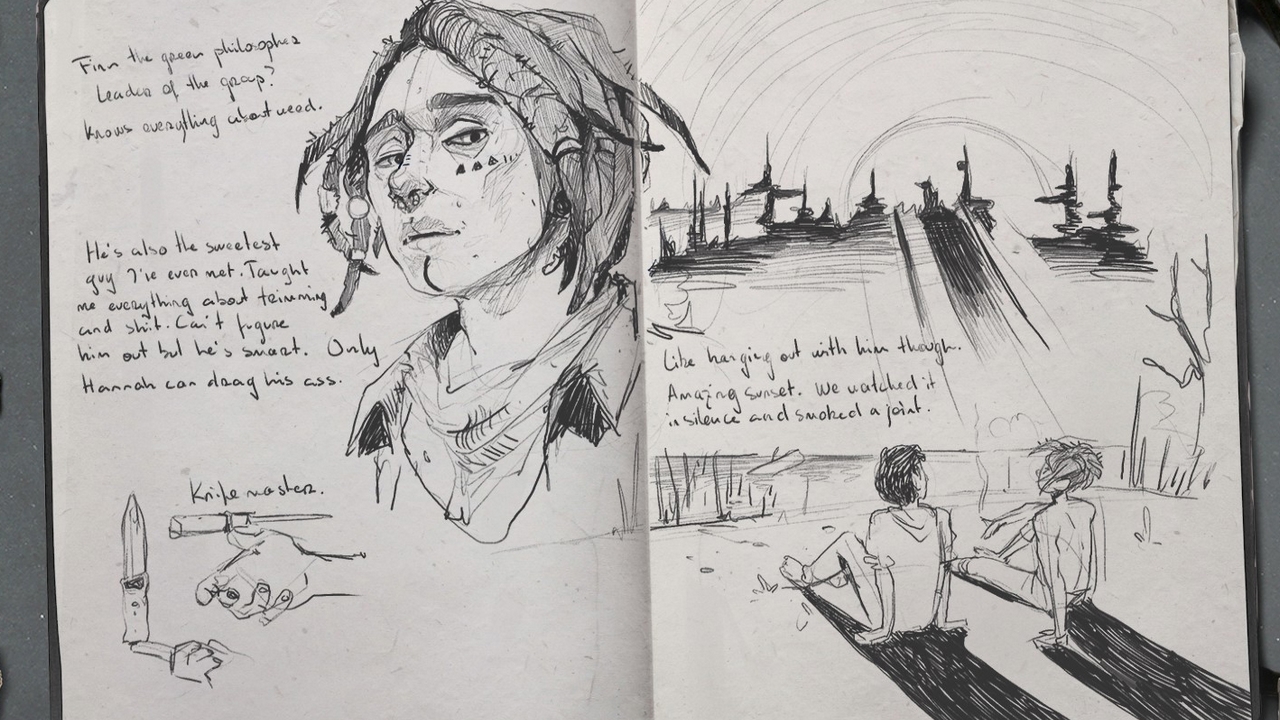
Foreshadowing #25: The last one is not so much a prediction as it is a confirmation, since it happens in reverse; but it may become one if specific decisions are made. If you check Sean's sketchbook in Episode 3, there are two pages dedicated to Finn, and in the second Sean has drawn a sketch depicting the two of them sitting together at the shore of the lake. Sean's note about this sketch says that they watched an amazing sunset in silence while sharing a joint.


Outcome: In Episode 5, after Sean meets his mother, they go to a motel to rest for a while before going back to Lisbeth's church to get Daniel. There, Sean has the chance to speak with Karen and allow her to open up to him. If all goes well, their discussion continues on the porch outside where they may smoke a cigarette. When this happens, Karen tells Sean that this is what she used to do with his father and assures him that "that's when you know someone is good to you, when you can just sit together, shut the hell up and watch the universe do its own thing", literally describing the scene with Finn that Sean had drawn in his sketchbook. No doubt that clever fox Karen took a peek in there while Sean wasn't looking.