Showing posts with label resident evil village. Show all posts

The Gothic and Victorian Affinities of Contemporary Horror Games

Monday, 3 November 2025

In the dark and twisted world of the villains in horror games, of the powerful evil characters who pull the strings from the shadows until they eventually make their grand appearance, there is one very special category that usually stands out, that of the evil masterminds who share a strong and unhealthy attachment to the past of their families. Whether their ancestors were glorious or not, most of the times does not matter, as what these complex personalities do is to appear as living representations of their illustrious past, something that, however, rarely - if not at all - gives justice to their noble past. The environments in which these people live, corrupted both literally and metaphorically, are characterized by the presence of gothic and Victorian-era elements which further support the pomposity of their owners and, occasionally, their sadistic tendencies.

The now iconic Spencer Mansion in the very first Resident Evil and its subsequent remakes is one such memorable case. The vast, intimidating villa, with its hidden passages, secret corridors, locked rooms, secluded gardens and spooky basements, is a most characteristic example of an environment that essentially stars in the story where it appears, as the lead characters, Chris and Jill, find themselves trapped inside the house almost as soon as the game begins, with no obvious way out as the area just outside the main entrance is guarded by bloodthirsty dogs. All other exits seem to be locked and getting out requires a long and suspenseful search for keys, mutli-functional objects and puzzle solving, as well as battling dangerous enemies that roam the mansion's grounds. Everything in the villa is vintagey, including its decoration, furniture and other items, but its most creepy feature is the absence of any other human beings, except for our protagonists.

Somewhere in the twisting corridors of a nearly separate wing, there is a vitraux portrait of a girl who once used to live in that place. This was not many years ago, but the vitraux depicts a woman dressed like she comes from a very distant era, alluring to a nostalgic - significant for the house's once human inhabitants - Victorian style, something that matches the overall atmosphere of the mansion and reaches the limits of tragedy when it is revealed that Lisa, the beautiful girl of the portrait, now wanders around the countryside outside the villa in the form of a terrifying, mutated creature. 

Locked in his vast, mazey castle, Ramón Salazar of the original Resident Evil 4 is a sad remnant of his aristocratic and once distinguished family, contemplating the glory of his ancestors while doing very little to live up to their example. The whole area where the castle is located, together with the village close to it and several other installations, seems to be lost in time altogether: the houses look like they belong to at least half a century back and there are farming systems that are made of defunct materials; but it is in the castle grounds where the whole "lost-in-time" eery feeling is intensified, as the heavy, rich decoration comes to contrast with the corruption that runs in all its halls, creating a chilling, unsettling atmosphere.

Salazar himself likes to dress like a gentleman of centuries back, although his whole attitude is not gentlemanly at all. Just like his residence, his appearance as well is a huge guise, like an attempt to make the other people, whom he basically hates, see him like he would have liked to be: an esteemed aristocrat with an illustrious past and an even more impressive present. Instead, he is a caricature of all this, something that is mostly intensified by his nasty demeanor, his innate sadism and the fact that he never felt accepted by his family. 

This last element was not so evident in the original game, but it is of major importance in the recent remake, where Salazar is presented as much more cruel and sadistic, also carrying a stigma which, apparently, he was never able to get over: it is hinted that he may have been his mother's illegitimate son, if you take notice of certain things that he yells out during Leon's final battle with him, and the fact that there are a few portraits in the castle that may be confusing as to who exactly all these ancestors were and what their relationship to Ramón might have been. Setting aside the tragic aspect of this, as a fact it also relates to stories of the Victorian era, about illegitimate children and lost families.

Equally his revamped castle in the remake features extravagant objects and overwhelming decoration, always inspired by a past where Gothic and Victorian elements were prominent. Notably all the portraits that can be seen on the walls are of people that belonged to past eras; and all the paintings depict dark and gloomy landscapes, and even disturbing, morbid scenes with a strong gothic element as well.

Alfred Ashford of Resident Evil: Code Veronica has some things in common with Ramón Salazar, albeit he is much more dangerous because, thanks to his rank as an army officer, he can additionally handle weapons excellently. Alfred appears dressed in an old-fashioned army uniform with a red jacket adorned with medals and white pants; we can't know for sure if the medals are his or belonged to his ancestors, but it is obvious that he too, just like Ramón, is a delusional, paranoid man who refuses to connect to reality as it is, something that has an explanation, since he may have always been marginally insane, but he completely lost his mind after the "death" of his beloved twin sister, Alexia.

Alfred lives in a lush vintage mansion which, in spite of its undeniable charm, is quite cold and eery, due to the gothic-like decoration which sometimes reaches the limits of grotesque and kitsch. There is too much gold all around, as well as huge, intimidating statues that mostly have negative or unpleasant connotations. Like Ramón's castle, the Ashford Mansion as well is a maze of twisting staircases, hidden passages, secret doors, lethal traps, complete with a well-concealed path to a secluded private manor, the Ashford palace, which used to be the residence of Alfred's family. Both villas share the same eery atmosphere, which makes wandering in their grounds a living nightmare.

When Alexia eventually wakes from her slumber and makes her appearance, we see her dressed in a luxurious but very vintage fashion, with a long purple dress, white silk gloves that go over her elbows and exquisite, precious jewellery, evoking the image of ladies in century-old portraits as well as heroines of Victorian novels and Romantic poetry.

Notably, as can be seen in the screenshot above, the family portrait behind her depicts the patriarch of the family, Alexander Ashford, Alexia herself and Alfred. All three are again dressed in a vintage fashion, and the overall style of the portrait is following guidelines of family portraits of the past.

James Marcus, the twisted scientist from Resident Evil Zero who experimented on his students in the most appalling ways, appears as a young man with long hair who is wearing a long, white gown, pretty similar to those worn by men in the distant past. Albeit operating in the mid-60ties mostly, Marcus has a fascination with the old times, something that is also evident from several objects found in his lab. It is notable that details on his outfit, specifically the shape of the collar, resembles leeches, which were part of his experiments before he became the terrifying Queen Leech himself.

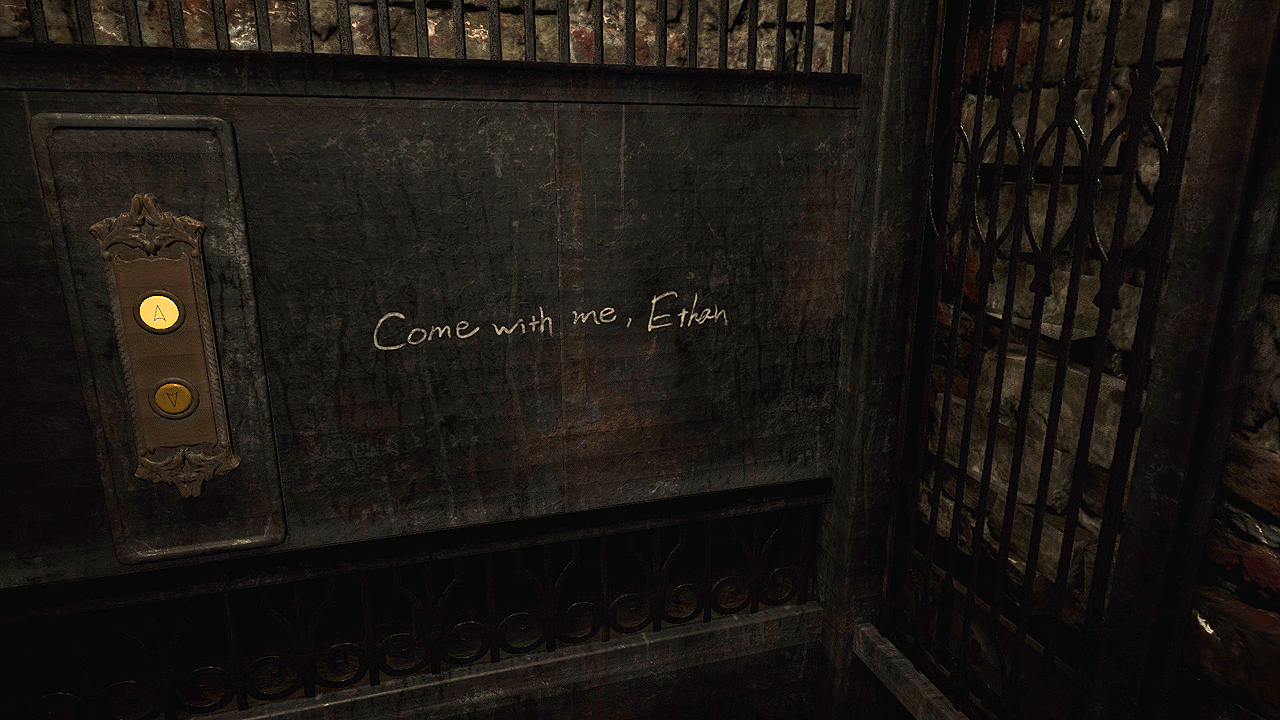
Much less creepy in appearance, but quite unsettling as a personality, Donna Beneviento from Resident Evil: Village walks around dressed exactly like a mourning Victorian lady, a look that is preserved also in the huge portrait that decorates one of the walls of her old-fashioned residence. The house itself has several vintage objects, and even mechanisms that are not particularly modern (like the elevator leading to the basement the technology of which is rather old), but you could say that is more or less a typical village house which has not modernized itself enough yet. Donna herself, however, as a presence and appearance, is the exact incarnation of the gothic and Victorian affinities of horror games, maybe more than any other villain similar to her.

In the same spirit, the coach that the Duke can be seen driving near the end of the game, transporting Ethan to the altar to fight against Miranda and save Rose, looks eerily like a Victorian hearse, complete with its black horse and the lanterns to light the way in the darkness.

Taking place almost entirely inside an insane man's mind, The Evil Within is comprised of images that are mixtures of past and present, of memories and a distorted reality, and as such its environments defy any normal perception of how they truly are, if they even exist for real. Once trapped in Ruvik's twisted game, Sebastian constantly finds himself, scene after scene, in places that do not make sense, as they seem to be lost in time and space. Starting with the village where all the houses are old, derelict and deserted, including the narrow spaces with the vintage mirrors that work as passages back to the safe haven, nearly all the areas that Sebastian has to cross are a tangle of elements that could never co-exist in real time.

As the story approaches its tragic revelation, the environments become more and more unsettling and confusing, as Ruvik's memories get mixed with the memories of his victims, creating a nightmarish and nauseatic space where everything is messed up and which offers no obvious way out. Old buildings, vintage installations, objects from the past, all thrown together in places that seem to carry a significance for the people involved, yet all this is too blurred to even make sense. 

In the heart of all this, Ruvik's family mansion finally comes to the foreground, appearing as a compelling villa with both gothic and Victorian elements which of course come together with the unavoidable atmosphere of fear and disturbing mystery. Drowned in fog, in the center of a rotting garden, Ruvik's home turns out to be the beginning and the end of his life's tragedy.

But most of all, The Evil Within's Gothic and Victorian affinity is shown in the characters themselves: after Sebastian solves one of the phrenology puzzles in the secret room behind the fireplace in the bedroom of Ruvik's parents and gets back out in the room itself, he has a vision of Ruvik standing over the dead bodies of his mother and his father, whom he had just killed with his own hands. Both his parents are dressed in a fashion going centuries back.

And like in Donna Beneviento's case, the Victoriano family showcases all its Gothic and Victorian gloominess in the portrait that depicts its four members, dressed like they come straight out of a novel by Wilkie Collins or Charles Dickens.


This peculiar mix of past and present is one of the most charming elements of horror games, as its roots go back to classic thrillers, both of literature and cinematography. For the environments specifically, think about novels like Rebecca or Bleak House, where the mansions as ambiences play a major role in both the development of the stories and the overall feeling of uncertainty and fear. Such emblematic fictional settings are a constant point of reference in contemporary horror fiction, video games included; and so are their lead characters, equally protagonists and antagonists. As to why in video games it is always the villains who choose to present themselves as figures of the past, maybe it is because for most of them it is by default impossible to exist among people, as they all carry huge traumas that they cannot or are not willing to even try to heal, and their attachment to the old times keeps them secluded in a world of their own, while at the same time distinguishes them from the masses that they usually despise as well.


History and Culture in Resident Evil: Village

Friday, 1 November 2024

Set in a fictional world occupied by terrifying creatures, the story of Resident Evil Village centers in the struggle of its protagonist, Ethan Winters, to find his missing baby daughter Rosemary while at the same time facing and surviving all kinds of dangers and threats. The village of the title is occupied by some of the most fearsome enemies in the whole Resident Evil world, but interestingly enough those are not the most intimidating and frightening when it comes to face-to-face encounters. Those creatures, at least, the Lycans, as well as their variations, are mindless entities that, like the zombies, attack because it is the only thing that they can do. They may have some degree of intelligence, but it is still limited; and although sometimes their reactions show signs of a cunning mind, in reality they are just "programmed" that way as a result of the bad outcome of the experiments to which they had been subjected when they were still humans. The most frightful and, subsequently, most dangerous enemies are those that have a human appearance or behave as humans, because they combine exaggerated physical strength with human intelligence, of course using both features for evil purposes. What is even more interesting in these cases, is that said characters have historical or cultural references, something that is obvious in the way they are depicted and, sometimes, their powers as well.

Miranda in the 1920's with her real daughter Eva

Mother Miranda is the arch-villain of the story, and the one to have caused all the mess and chaos that Ethan encounters. Once a brilliant scientist, she lost her dear daughter during the 1920 pandemic in Spain and from that point and on she became obsessed with bringing her back to life somehow. Subjecting herself to numerous experiments, she managed to maintain her youth and achieve immortality, so as to be able to go on with her research while following the developments in medicine and technology. Naturally all this could not end well, and gradually she became a monster, but she still succeeded in keeping her activities underground, without raising suspicion. A few years before the events in Village, she discovered a strange giant fungus in the caves of a mountainous area in Eastern Europe, which had the ability to store people's memories and could also regenerate itself; Miranda decided this was exactly what she needed so as to finally bring her daughter back to life. Of course this could not happen without further research, processing and experimenting, so she set her new lab close to the source of the fungus, the Megamycete, to be able to carry out her experiments. 

Miranda (third from right) with her team, including Eveline, Alan and Mia

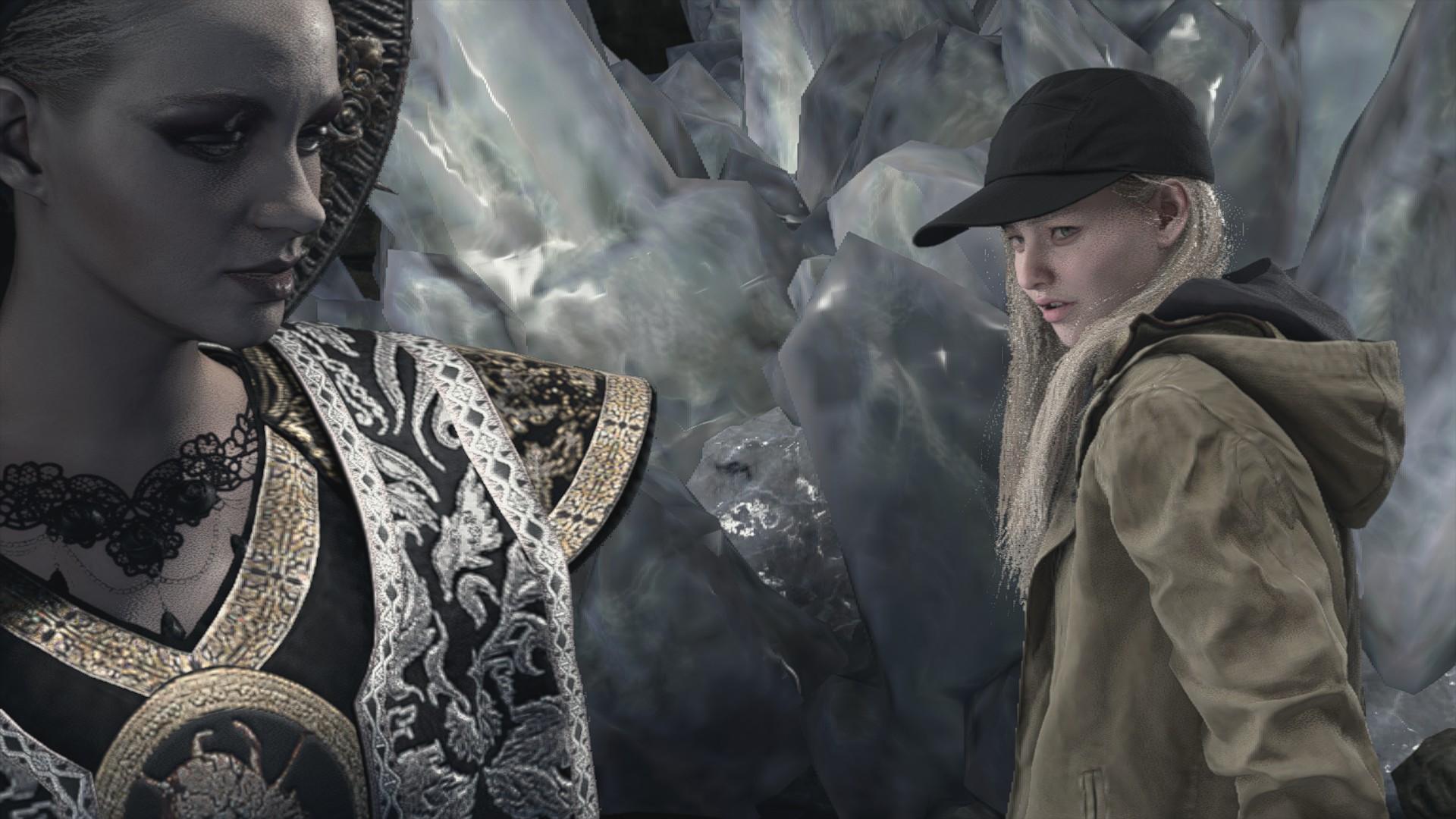
In her "human" appearance which is close to how she once looked, Miranda can be seen wearing an embroidered robe where the black color is prominent, with several golden and silver details. Her hair is combed back, and she has a strange object on her head that looks like a heavily decorated makeshift halo. Although the ornaments on her outfit are in fact symbols directly connected to her and her experiments, her look from a distance deliberately brings to mind a certain depiction of Virgin Mary, where she is shown with an impressive halo around her head. In her attempt to further subdue and intimidate the surviving residents of the village, Miranda would show up in this outfit so as to make them believe she was in fact a saint or, even worse, an incarnation of Virgin Mary herself. It is not random that she has the word "Mother" in her name, clearly identifying herself with the holy figure. This depiction of Virgin Mary is called "Our Lady of the Sorrows"; she mainly represents the stage in Virgin Mary's life when she was grieving for her son and, in extension, symbolizes the sorrows that humans have to endure in their life. It is clear that Miranda not only sees herself as pretty close to the holy figure because she is also in a similar situation, but she additionally believes she is equally holy. Several holy icons can be found in the abandoned village houses, which depict Miranda in her "saint" outfit, hinting that, in spite of the sacrilegious nature of her appearance, she had managed to persuade at least some of the villagers that she was not a simple human, but she had holy qualities and was a protector of their homes.

Miranda (left) and a depiction of Our Lady Of The Sorrows

The Megamycete fungus that Miranda uses in her experiments appears to be also "responsible" for the existence of the Mold back at the Baker residence, in Resident Evil 7. In Village, we are finally able to see the main source inside a cave, as Chris makes his way towards Miranda's secret lab. The fungus appears as a huge pinkish blob attached to the rocky walls of the cave, and what is interesting about it is that its shape resembles that of an embryo, clearly symbolizing both its regenerative power and Miranda's desire to have her daughter born again. The idea of a substance that records and stores human memories is not new; we have seen something similar in The Evil Within, although there the core element was a human brain. The fungus in Village brings to mind a similar idea from Mexican Gothic, a novel by Silvia Moreno Garcia that was published a year prior to Village's release, where members of a family living in an isolated mansion in the mountains are experimenting with achieving immortality after one of them discovered some strange fungi in the caves around the house. The fungi, aided by the existence of a human core, had the ability to multiply in the walls of the house, witnessing and recording the memories of the people that they would affect with their smell and mold, causing weird behaviors and sick hallucinations to them.

The Megamycete in the caves of the village

One of the most impressive villains in the Resident Evil world is undoubtedly Alcina Dimitrescu, the towering hostess of the ominous castle that looms at the outskirts of the village. Apart from being a vampiric creature as a result of Miranda's experiments, alluding to all the bloodthirsty characters of fiction before her, she also seems to have another, far less chilling reference: Mary Ellen Powers, declared in 1868 the tallest woman in the world. At 2,13 cm, Ellen, who was also the tallest among her male siblings, pursued a career in entertainment. She joined a famed circus and toured the world with it, being characterized a great sensation wherever she would appear. As part of her acts, and to make her look even more imposing, she would wear very high heels and top hats decorated with large feathers to further accentuate her impressive stature. She made a lot of money in this business and eventually got married. Her husband was an equally tall man and it was love at first sight for both of them when they crossed paths. A way happier and far less dramatic life than Alcina's, definitely.

Alcina Dimitrescu (left) and Mary Ellen Powers

I have analyzed Donna Beneviento's case in another article, but the character as an image alludes to several cultural and historical elements. An eccentric presence, looking as if she comes straight from Victorian times, Donna is always seen with her face almost entirely hidden by a veil, concealing her half-disfigured face, and being accompanied by a creepy marionette which she calls Angie and she only is able to animate and make her behave like a mischievous child, a power that she gained after taking part in Miranda's experiments. In a loading screen of the game, Angie appears sitting on Donna's lap, while Donna herself is nearly totally camouflaged in the darkness. This pose alludes to the infamous "hidden mother photography" trend of the Victorian era, which was a way to have little children and babies photographed supposedly on their own: the mother would sit completely covered on a chair holding the child in her lap to keep them still and calm, and the resulting photograph was supposed to focus on the child. The final picture however was most of the times marginally disturbing.

Donna and Angie (left) and an authentic "hidden mother photography" sample

Additionally, Donna's obsession with dolls and the way dozens of them can be found in every corner of her house, nods to the classic epic drama Raintree County by Edward Dmytryk where the mentally unstable Suzanna (unforgettably portrayed by Elizabeth Taylor) is a crazed doll collector, insisting on having many of them hanging above her bed.

Donna's dolls in the living room (left) and a scene from Raintree County

Angie herself is a direct reference to Emily, the ghost protagonist/antagonist of Tim Burton's stop motion film Corpse Bride, although the movie's bride was just a victim and in spite of the tricks she did to gain the gullible Victor, in the end she did the right thing and allowed him to live his life happily with his beloved Victoria. Of course Angie, being just a soulless marionette, is not to blame for anything in reality; the only one to blame is Donna and her insane obsessions.

Angie (left) and Emily, the original Corpse Bride

While trapped in Donna's mansion, Ethan is forced to play a sick hide-and-seek game with Angie. There's some discreet music playing in the background, which in fact is a dark nursery rhyme of french origin, titled Promenons-nous dans les bois (many thanks to Anthony Auzy for pointing this out). The lyrics of the song go like this: Promenons-nous dans les bois / Pendant que le loup n'y est pas / Si le loup y était / Il nous mangerait / Loup, y es-tu ? / M'entends-tu ? which means: "Let's take a walk in the woods while the wolf isn't there; if the wolf was there, he would eat us. Are you there, wolf? Can you hear me?" The nursery rhyme also has an english version, as well as a greek version, but the original comes from France. There is no mystery why a song with such theme plays during that specific scene; with her disturbed mind, Donna loves to create hallucinations made from elements of a rickety childhood. In the game that accompanies the nursery rhyme, the "wolf" is supposed to hunt the children. In Angie's version, Ethan takes the role of the wolf, and Angie plays the part of the innocent victim. Which is ironic, to say the least, since in reality Angie (and, eventually, Donna) is the malevolent spirit, while Ethan is not only the innocent one, but moreover the one who is actually being hunted.

Angie forces Ethan to stab her so as to bite him furiously afterwards

With his rather ridiculous mutation and his constant whining, Salvatore Moreau is easily the most deplorable enemy of Village. Although he is as dangerous as his "siblings", and his attacks are quite cunning, in the end you can only feel sorry for him. Once a member of a prominent family of the region, he lurks around the grounds of what once was a clinic, although it is not clear if he was actually a physician himself.

The sign pointing to Moreau's Clinic in the Reservoir

More likely, this must have been the profession of his parents or other close relatives, as among the few remaining human features of his pathetic existence are several tattoos, which may indicate that he might have been a sailor once. A specific one reads "Mother", something that ties well with his obsession with his "mother" Miranda and his desperate struggle to prove himself capable in her eyes. 

Salvatore Moreau's "Mother" tattoo is prominent on his arm

Moreau's mutation is particularly gruesome, alluding to a sea monster or a mutated giant fish. Not randomly, since his territory is a flooded area complete with a dam. He can be seen walking around hunched, as there is a mess of what looks like live tissue blobs on his back. Although his full name is a mix of Spanish and French, his surname is of French origin. Anthony Auzy (thanks again!) pointed out something very interesting about his surname, which I am quoting verbatim: "Moreau sounds a lot like "Morue", which is a French term that carries two meanings: it's the name of a fish species (Cod in English), and it's also a way to call ugly or vulgar people. Both of the meanings of the term "Morue" define Salvatore Moreau pretty well, which is why I'm pretty sure it was done on purpose."

Moreau in his private cabin

The most obvious reference for his name, however, is H.G. Wells' famous novel "The Island of Doctor Moreau". Published in 1896, it was quite innovative for its time, as all sci-fi novels by Wells actually were. The story of the book follows narrator Edward Prendick, a shipwreck survivor, who finds himself stranded on an isolated island where Doctor Moreau, once renowned physician whose reputation was ruined after his gruesome experiments became known, runs a makeshift clinic to keep on experimenting on creating humans from animals. The failed results of his experiments are several monstrous creatures, neither human nor animals, that reside on the island grounds in some sort of settlement that the Doctor has set up for them with his loyal assistants. The game's Moreau looks like such a monstrous creature, a combination of human and fish, who was also a victim of a crazed scientist and ended up a failed experiment himself. The creature from Wells' book named "The Limbless Thing" brings strongly Salvatore Moreau to mind and interestingly enough, certain "species" created by the novel's Moreau carry a vague resemblance to the game's Lycans.

The Limbless Thing (left) and one of the Beast Folk (illustrations by Lawrence Sterne Stevens, 1946)

The most human-looking enemy in the game is notably the most terrifying. Exactly because he looks like a normal human being, without any obvious defects and nothing abnormal in his features, Karl Heisneberg is the most intimidating among his "siblings" because you cannot know what to expect from him. His mutation is limited to a superhuman ability to control electric power and attract metallic objects with magnetism, also being able to project them to any distance at will. Although very specific, this ability allows him to have all sorts of machines, mechanisms, robots and mechanical men under his command, and he has created a factory in which he produces super-powerful machine-controlled soldier robots. The way he manages to use metallic objects around him resembles the power of Magneto, the hero of the Marvel comics, which is pretty similar.

Karl Heisenberg (left) with metallic objects around him, and Marvel's Magneto

Although not one of the bad guys in the game, The Duke is definitely a mysterious figure what with his imposing appearance and his enigmatic words. Showing up for the first time as Ethan makes his way towards the Dimitrescu territory, The Duke acts as Ethan's helper and consultant, providing him also with weapons, ammunition and resources of all kinds. His design is quite impressive: he appears as an obese man who can hardly fit in his armchair, shoeless, due to the swellings around his ankles, and dressed like he belongs to another time and place. His overall appearance resembles Daniel Lambert, a famously obese jail keeper who lived in England from the late 18th to the early 19th century. He was a very strong man whose extreme weight was rather unexplainable, as he did exercise and would not eat nor drink uncontrollably. In 1805, he was registered as the heaviest person in recorded history. Later in his life, driven by poverty, he decided to put himself on exhibition, so that people could come and see him as an attraction, at a fee. As he was very smart and pleasant, he became quite popular, so he managed to make good money from his business. When he died, he weighed 335 kg, and his coffin required 20 men to be carried.

The Duke (left) and real-life jail keeper Daniel Lambert

Unlike all previous characters, The Duke's fate remains a mystery. We can't even be sure if he is real, or just part of Ethan's hallucinations. In any event, the world of Resident Evil Village is a most interesting one, rich with elements that go beyond its gameplay qualities and call for further research and exploration.


BIBLIOGRAPHY

http://www.niagara2008.com/history144.html

https://en.wikipedia.org/wiki/Hidden_mother_photography

https://www.johncoulthart.com/feuilleton/2013/12/17/the-island-of-doctor-moreau/

https://en.wikipedia.org/wiki/Daniel_Lambert

Rosemary's Dad

Monday, 14 November 2022


Shadows of Rose was released recently, as a complementary content for Resident Evil: Village, which, upon ending, informed us that "the father's story is now done", presumably opening the path for the daughter, Rosemary, although whether she will indeed become the lead of one or more games in the future is quite unclear, just as unclear is her role and presence in her own DLC story. Rosemary Winters was introduced to us abruptly as a baby at the start of Village, and we also had the chance to see her as a teenager in the game's ending cutscene. In Shadows of Rose, we get to play as her in third person, while following her in an attempt to get rid of the powers that she had inherited from Ethan. To do so, she needs to mentally travel to another realm where she will have to face monsters of various kinds and finally come face to face with Miranda herself. 


Rosemary, as Lord Heisenberg informed Ethan in the main game, is supposed to be an extremely powerful kid, but what her powers are and what exactly they can do, is as vague as her father's in-game face. When, early in the DCL story, she realizes that she can actually freeze enemies, she gets shocked, which means that up to that point she was unable to do such a thing, which in turn inevitably makes you wonder where exactly her infamous powers did lie until then. In reality, they seem to be literally asleep for most part of the game, and as she is struggling to survive in the most hostile environments, she moreover needs about half a dozen amplifiers, plus the final boost from Ethan, to help her powers reach their full level. This basically means that, in her normal life, her so-called powers must have been rather limited and if she had never traveled to that realm, she would have never been able to develop them and no one, not even her, would have been able to know what she was capable of, something that almost cancels Heisenberg's earlier comment about her. To add insult to injury, she cannot run to save her life (literally). You would expect a slender and swift girl in her mid-teens to be running as fast as the wind but no, why would she? There are sequences where she is hunted by face-eating monsters or evil mannequins or hammer-yielding giants and she can do no more than drag her feet so painfully slowly that you may find yourself desperately looking for a fast-forward button on your controller or keyboard.


That said, the DLC suffers from both technical and fiction-related flaws. From the technical aspect, apart from the extremely slow movement that Rosemary has throughout the whole story (she is even slower than Lara Croft in The Angel of Darkness, and honestly I never thought this was even possible but as it turns out, it is), she is rather clumsly with guns - which may be partly natural since she is a civilian, but growing up under the custody of Chris Redfield with several agents in the training constantly around her, you would expect her to have learned a thing or two. To make things even worse, because she reaches the full level of her powers just before the final boss fight, this is exactly where you get to learn her new moves. It is such a waste of good gameplay options, since you get to use said new moves against the final boss only, minutes before the story reaches its conclusion.

Fiction-wise, the story has several plot holes, and in fact Shadows of Rose was not exactly a necessary addition. The fact that Ethan was the one to offer Rosemary the strongest boost, basically means that he was super powerful himself. Mind you, Miranda had ripped his heart off and he got caught in the grand explosion that he caused himself in the village, yet he was still able to manifest in Miranda's domain, just like she did, therefore he was nearly as powerful as Miranda was. This combined with the regenerative powers that he already had from the mold, made him super-humanly strong, practically nullifying his demise in the main game. Although the DLC is titled after Rosemary, it is actually Ethan who carries the strongest part, both metaphorically and literally, while Rosemary is way too weak until the finale, where her powers may look impressive, but the whole sequence feels more like a quick time event and less like an actual interactive boss fight.

It would have been much more intriguing if, in the main game, we had Ethan, still unaware of his own powers at the start, interacting with those weird amplifiers and gradually becoming stronger, finally understanding that he is not an ordinary human being anymore; and then in that scene where Eveline reveals to him the shocking truth about his death, he would come to realize that he was actually superhuman, rising over all evil in the village and defeating Miranda in a most impressive way. If this was how the story unraveled, there would be practically no need for Rosemary's extra story, which feels nearly unnecessary anyway since she ends up with her powers not only intact but also boosted up, therefore we are back at point zero. The only essential part of the story is her meeting with Ethan, which could have easily been the most interesting plot point of the DLC and would have made our struggle worthwhile but sadly it is void of all emotion because, guess what: again we are unable to see Ethan's face or watch his reactions in what could have been one of the most touching, heartbreaking and memorable scenes of the whole saga. During the most crucial instances, his face is blocked by Rosemary's arm or his own arm, then we get to see his back while he is talking to his daughter, a scene that could have stayed with us forever but instead all we get is a bland-feeling dialogue because we can't even see a hint of Ethan's expressions as he is looking at and speaking to Rosemary.


Other than all that, the DLC feels a lot like a superficial copy of The Evil Within 2 at times, what with Rosemary traveling inside her gray matter via the mutamycete and the evil mastermind wanting to take advantage of the girl's powers. Also if you have read Mexican Gothic, the whole idea of the fungus that is "recording" people's memories will feel familiar to you. Even so, there are some really good sequences in the story, like the painting puzzle in the Castle and the whole House section which is very atmospheric and creepy, although the first half with the diorama puzzles is definitely its best part. The second section, which is basically an extended stealth hide-and-seek, feels and looks very interesting when it comes to avoiding the floating dolls (an intense sequence accompanied by a discreet, creepily beautiful music) but trying to escape the giant Mia mannequins is so exhausting due to Rosemary's slow-motion running, that it ends up more annoying than scary. And I really could have done without Eveline's hysterics. I also loved the Duke's new look, although it is unclear why he is so mean towards Rosemary, while he had been so helpful with Ethan.
 
 
Overall, Shadows of Rose does have its own merit, but it feels more like an unnecessary chore in relation with the main game. And I am not very sure if I will be interested in playing a possible future Resident Evil with Rosemary Winters as the main protagonist, because as much as I generally like her, she is too weak and indifferent as a character of fiction and lacks too much background to hold a story on her own. I would be more keen on playing a game with Jake Muller or Sherry Birkin as leads, for instance, who are not only strongly connected to the saga's core, but they still are literally and directly the new blood of the Resident Evil series.
 
» My playthrough of "Shadows of Rose":

The Psychosexual Subtext of Resident Evil: Village

Tuesday, 9 August 2022


Resident Evil: Village is centered around Ethan Winters's nightmarish journey to find his abducted daughter Rosemary, however there are several other themes explored in the game on a secondary level that, however, add a lot to the story and the development of its characters. While Mother Miranda is the prominent evil mastermind, her four "children", the four lords of the village, are in fact the characters who give the tone of the adventure and the ones who, in the end, are the most memorable. When it comes to sexual imagery in particular, the obvious thought would be Alcina Dimitrescu, but in fact she is a red herring on the matter, as the essence of this subject lies somewhere else.

As Ethan is about to enter the Castle Dimitrescu, he is captured by Carl Heisenberg and brought to a peculiar council consisting of Miranda and her four children. It is the only time when he has the chance to see all the villains gathered together, and moreover while they are arguing about who is going to be the one to carry out his execution. Sounds like an evil child's game, which isn't random if we consider that Miranda, by having condemned these four individuals to be a part of her experiments, she has essentially shattered their personality and their own free will, and while they feel super powerful thanks to their unusual abilities, in fact they are just puppets in the hands of their "mother".

The whole scene looks like a grotesque act performed by a circus of freaks, and it would have been marginally hilarious if it wasn't so chillingly creepy. Alcina and Heisenberg are the most loud; each one of them makes it very clear that they want to be the one to kill Ethan. Their over-confidence is more than obvious and they feel much superior to their other two siblings. The badly disfigured Salvatore Moreau limits himself to getting close to Ethan to have a better look at his potential prey while whimpering like a whiny baby. And then there is Donna Beneviento. She can be seen sitting in a corner, her face covered with a black veil, never speaking a word while her creepy puppet Angie, controlled by her, rushes forward to have a look at Ethan as well, in a bold, unafraid and sadistic way. Donna looks like a silent stalker, patiently waiting for her prey to fall in her hands.

Donna Beneviento is an extremely intriguing character, one that definitely deserved more game time and more details revealed about her past and her family. But even what we do know about her and, mainly, what we see, understand and decipher as the story unfolds, is enough to make her stand out among the villains and end up being one of the most iconic characters in the Resident Evil saga. On first look, she is not easy to read. In her notes, Miranda characterizes Donna as mentally underdeveloped, which is the main reason why she could not be a good host for her daughter, Eva. Donna has the appearance of a grown woman, but mentally and sentimentally she is still a child. An insecure, lonely child, but at the same time a child with vicious, twisted instincts. Donna's backstory is a tragedy, something that can be reflected in her overall appearance and attitude. Born an aristocrat, she lost her parents at a very tender age, when they both committed suicide. Her mental health issues prevented her from becoming more social in her teen and early adult years, finding solace strictly in making dolls, a craft that she had learned from her father. Her only companion was a girl named Claudia, who belonged to Donna's bloodline but no one knew for sure whether she was Donna's sister or maybe her daughter, most probably an illegitimate one, if this was indeed the case. Claudia is buried in the Beneviento Flowerbed, a private cemetery just outside the entrance to the grounds of the residence.

Growing up, Donna's obsession with dolls and doll-making became even stronger. She also studied a lot in her mansion's rich library, and she became an expert on the local plants and flowers, learning to locate those that were poisonous, and use them to create mixtures that caused heavy hallucinations. As a side-effect of Miranda's experiments on her, she developed the ability to control inanimate objects with her mind, something that she took advantage of in order to manipulate her dolls around. She especially became attached to Angie, a very special puppet / doll, which looked like a skeletal figure, was dressed in bridal rags and the architecture of her face resembled a lot the Beneviento family's crest, the sun / moon complex. 

Donna's obsession with dolls is a major element of her character and an axis around which her whole personality revolves. According to Sigmund Freud, children subconsciously use the dolls as a means to indirectly express erotic and aggressive fantasies. The doll is a small object, therefore is much closer, as an image, to what the child sees in the mirror and, subsequently, much easier to identify with. With the dolls, children create an imaginary world where they hope to feel satisfied and happy, while at the same time attempting to explore aspects of the adult world. According to Rainer Maria Rilke, however, the doll acts as a safety belt for the child who would feel lost and alone if cast out in the wild world. But exactly because the doll is an object with which the child can easily familiarize, their identities get mixed and the erotic element becomes prominent again. Sometimes children treat dolls with viciousness and this, from the aspect of psychoanalysis, is an aftereffect of the subconscious, premature yearning for a sexual partner. Donna's attitude reflects all this, adding a most powerful sexual imagery in the story. Alcina and her daughters may look promiscuous and revealing with their seemingly saucy attitude towards Ethan, but in reality they only want blood. Donna, on the other hand, neither speaks nor moves, but the way she traps Ethan in her twisted, morbid game is overloaded with psychosexual nuances.

Dolls were prominent in yet one more Resident Evil game, where again they were linked to a disturbing sexual behavior: Alfred Ashford in Code Veronica had his secret palace filled with vintage dolls, plus one giant and very creepy dismembered one hanging from the ceiling at the entrance hall. Although the house used to be inhabited by a girl as well in the past - Alfred's twin sister Alexia - it is rather clear that, now at least, it is Alfred who is obsessed with dolls, given how he keeps them around the rooms standing like silent guardians: seemingly harmless but not the least terrifying. Being very close to his sister as a young boy, he developed an unhealthy obsession with her as a teenager. After her supposed death, Alfred took on the habit of wearing her dresses and a wig that resembled her hair and strolling around the house pretending to be Alexia. To be more precise, he did not only pretend to be his sister, but he would actually "become" her when in female disguise. The dolls kind of substituted her actual presence in the house, while at the same time they maybe signified Alfred's hidden desire to have his sister as a living doll instead of her obviously being the dominant and omnipotent twin when she was alive.

Being Donna's literal creation, Angie is a medium that is used to express her master's mood and feelings. While Donna is silent and motionless, Angie is talkative, sassy and restless. Here we have a peculiar inversion: the puppet acts like a living person, while the human adapts the attributes of a doll. Donna identifies with Angie on multiple levels and the way that she chooses to express herself through the doll is different every time. For Donna, Angie mainly acts as a substitute for Claudia but on a second - and maybe much stronger - level, the doll represents a complex combination of Donna's primitive maternal instinct and her carnal attraction to the opposite sex. The most obvious manifestation of the combination of these two symbolic attributes in Angie is the doll's appearance: she looks like a little kid, but she wears a grown woman's bridal gown.

In the secluded and spooky Beneviento residence, Ethan becomes the forbidden fruit. He is pretty much like McBurney in the iconic movie The Beguiled (Don Siegel, 1971). Deprived of his weapons, he becomes a victim to whatever sick plans Donna has in mind. She begins by trapping him in her workshop, in the basement of the mansion, and there she creates a haunting string of hallucinations where Ethan's wife, Mia, appears as a giant wooden doll with several items hidden in parts of her body. Ethan hears Mia crying or talking to him, he finds her wedding ring, the music box that was a gift from a relative for their wedding, a photographic film including snapshots connected to his family life, then a baby's cradle, which subsequently breaks, hidden even deeper at the bottom of a well in a second basement. Donna attempts to sentimentally and psychologically break him by bringing up painful memories connected to his family, while at the same time she makes sure that the atmosphere in the house is scary enough to keep him under control. Eventually she creates the hallucination of a giant, cannibalistic embryo, a morbid and horrifying mockery of Rosemary, which is chasing Ethan around the house threatening to kill him. 

And this is when Donna shows up and it's the one and only time when she speaks to Ethan directly, telling him that she can't let him leave. At this point, she still appears with her head covered, although she is on her own grounds and there is a portrait on a wall depicting her holding Angie, where her face fully shows. By choosing to appear like this in front of Ethan, she avoids eye-contact with him which would possibly lead to her not feeling secure enough to go on with her game. Determined to keep him there, she makes him chase her in the residence's rooms, although Ethan is actually seeing Angie floating around and hiding in several places in the mansion, forcing him to take part in a morbid hide-and-seek game. The only thing that Ethan can do to attempt to defeat Donna is to stab Angie with a pair of scissors; but in reality, he is actually chasing and stabbing Donna herself.
 
 
The scissors is again a strong sexual symbol with many nuances and Ethan's action of using it as a tool to overpower Donna works, for her, as a substitute for the sexual act. This sequence can potentially become even more intense if Ethan fails to find Angie in time; if this happens, the dolls around him grow blades which make them look like mechanical spiders, and stab him with mania, and of course it is in fact Donna again who attacks and stabs him, once more creating a hallucination involving the dolls. Notably, the first time that Ethan finds and stabs Angie, the doll bites him. Knowing that it is actually Donna who does this, the whole scene takes a completely different perspective, seen through the prism of Freud's theory about children using the dolls to express aggressive erotic fantasies. Donna may not be technically a child anymore, but her psyche is stuck in a problematic and sad childhood, something that obviously keeps defining her actions even in her adult life.

Up to the point where Ethan arrives at Donna's house and after he escapes from there, his role is standard and specific: he is the protective father figure and Rosemary's rescuer. But for the time that he spends inside the Beneviento mansion, his role changes dramatically. He becomes a potential game partner for Donna who, due to her emotional clinging to childhood, employs childish tricks (the hide-and-seek game) and objects (the dolls) in order to lure him towards her, which subsequently leads to Ethan acquiring one more role: that of the object of Donna's sexual desires. Donna's sick inner child views Rosemary as an antagonist, something that is intensified by Angie's reactions every time that Ethan grabs her and stabs her, but Donna as a grown woman also views Mia as an antagonist, and this is manifested mainly in the way that she chose, in the workshop hallucination, to present Mia as a grotesque giant puppet. After Ethan kills Donna by stabbing Angie with the scissors and all hallucinations are gone both inside and around the Beneviento estate, the basement of the mansion still remains off-limits to him. From a freudian aspect, the basement represents the memory storage: a place where past images are stacked and remain there abandoned and seemingly forgotten but still affecting the person involved.

The whole stage that takes place in the Beneviento residence is on a much different pace from the  rest of the game, and it is several levels creepier and scarier because it is built around psychological horror. It is pretty similar to The Evil Within's chapter "The Cruelest Intentions", not only as far as its atmosphere and setting are concerned but also because in both cases the memories of the protagonists are mixed with those of their stalkers. This is a feature that is always present in The Evil Within, but in that specific chapter it reaches its climax because memories become more personal for the stalker, just as is the case with Donna in Village. Story-wise, Donna  has many things in common with Ruben Victoriano, Sebastian's stalker in The Evil Within. She is playing with Ethan's memories by infiltrating them and placing herself in them by force. By presenting to him the human-sized Mia doll, it is as if she is implying that she, being a doll-maker, actually created Mia for him, and because it was her (Donna) who, as the creator, would breathe life into the doll, she would turn Mia into a host for her own manifestation and, indirectly, her own suppressed and undeveloped sexuality. From the moment when Donna appears in front of Ethan and establishes her own role as Angie's puppet master and, in a wider sense, as the one who pulls the strings in her domain, the child's play begins to transform to a sexual game, at which point Ethan stops being Donna's game partner and his role as the object of her sexual desire is the one that prevails in the end.


BIBLIOGRAPHY

Uncanny Dolls: Images of Death in Rilke and Freud