
If you have played even a few video games of the Action / Adventure kind (and not only), you will most definitely have noticed that there are certain environments that are encountered more frequently than others. Libraries and bookstores are among the most popular of those, and what is even more interesting about them is that many times they are not only just a tasteful way to decorate a map but moreover are an important part of the plot.
Something that we should always keep in mind is that many of the heroes in video games are extemely intelligent - which makes the presence of libraries or bookstores in their stories even more fitting: Lara Croft (Tomb Raider) is an educated archaeologist, Sebastian Castellanos (The Evil Within) has a Bachelor degree, Leon Kennedy (Resident Evil) is a genious, Malachi Rector (Moebius: Empire Rising) has knowledge on almost everything, Elizabeth (Bioshock Infinite) is a human encyclopedia.

Although most of the aforementioned heroes and heroines are men and women of action, with the majority of them being professionally trained for combat of all kinds, they never neglected their education. This is something that we get to know about them by consulting their backgrounds, but it also becomes evident from their eloquence, the way they express their thoughts and feelings, their social skills and sometimes also from random comments that they make at given times.

The appearance of environments such as libraries and bookstores in Action video games in particular is an element of great interest. An epic battle taking place in the streets or in the open field is something common - but just imagine an epic battle taking place in a library or a bookstore. The contrast is so striking that it inevitably leads you to become aware of the setting around you. In purely Adventure games, the libraries and bookstores have a more practical use most of the times, but this does not make their presence less important.
The setup, the decoration, even the choice of colors in these sceneries are always notable. But most of all, the space that they cover in a game's map. Definitely one of the biggest libraries that can be seen in a video game is the one in Skool Daze from American McGee's Alice. Occupying several floors, with bookshelves even in the most impossible places and books floating in the air, it is almost literally immersive, albeit inhabited by evil playing cards.

The several library rooms of Tall Oaks University create a creepy atmosphere with their vintage bookcases and their hundeds of old books in Resident Evil 6. They are located in a section of the campus beyond the yard, and when Leon and Helena arrive there, naturally they are not alone.

The zombies, which are still dead on their way in, miraculously wake up as soon as Leon and Helena grab the exit key card from the very last room. On their way out of the library rooms, they have to face a number of zombies, although most of them (if not all) can be avoided by just dashing past them and running to the exit - assuming your partner will follow you soon enough for both of you to make it safe outside.
Dr Vaclav Koller's bookstore in Deus Ex: Mankind Divided, aptly named "The Time Machine", is a tall building with huge rooms, dominated by brown colours and filled with old books literally from top to bottom. It is hard to believe that a man like Koller, who is so devoted to his science, actually has the time to go through all these books and catalogue them. In fact he is using the bookstore as a front for his secret workshop in the basement. Nonetheless, he seems rather annoyed when Botkoveli's men trash the place while looking for him.

A three-storey vintage house with more than one entrances, with a couple of them being secret, Koller's bookstore is an essential environment in the game. Located in a somehow isolated part of Prague, which is heavily guarded by an angry mob, can only be accessed safely if Adam passes unnoticed from the nasty goons. The hidden elevator leading down to Koller's secret workshop is on the upper floor, and it is revealed once Adam pulls a red book from a shelf. It is very tricky however to slip under the noses of the gang and reach the doctor completely unharmed.
This is not the only case where a bookstore or library becomes the field of a violent battle. In Resident Evil 6, after Jake and Sherry manage to escape from their 6-month captivity in a chinese lab, they find themselves in a super luxurious mansion that, among its other rooms, has a very stylish library which, except for the books, also hosts a horde of bloodthirsty and relenstless goons.

What is worth noting about this library is that it is almost entirely red: its walls are red, the main motif of the carpet is also red. Obviously the living quarters of the research facility offered all kinds of recreation to their staff - in another room there is a piano and pool tables, somewhere else there is an idyllic pool with pink water - but the goons Jake and Sherry have to fight do not seem to be exactly book lovers. That said, the whole setup of the library offers some really good chances for an effective fight.
Same goes for the vintage Venetian library in the Bartoli's Hideout section of Tomb Raider 2. It is a well-guarded room, that Lara can only access at first after locating a gate in the sewers, which can be opened with a special key. Albeit not very big, the library has its share of goons who, just like their colleagues in Resident Evil 6, never thought about opening a book to sharpen their minds a bit.

The tall bookshelves of the library give Lara the advantage that she needs so as to climb up and she is also able to jump out through a window on the upper section so as to reach a different part of Venice.
Of course Lara Croft came across several libraries in her adventures, the most iconic being, naturally, the Lost Library of Alexandria in Tomb Raider: The Last Revelation. Lara disovered the secret path leading to the legendary ancient construction, and we can only imagine how a passionate archaelogist like her felt when she arrived at the main hall.

The Lost Library looks different from the others because it comes from centuries ago. Instead of bookshelves with books, it hosts pedestals with papyruses, as well as a magical-looking Planetarium, the complicated puzzle of which is something that Tomb Raider gamers can never forget. Unfortunately, Lara has no time to study all the knowledge that is hidden in those old documents; she can only use one of them to trigger a door open. Moreover, there are random uninvited guests (namely: skeletons and ghost warriors), more than willing to destroy this one-of-a-kind experience in her renowned career. Let's hope she remembered to take some photos before leaving.
A few years before that, she found herself in a different kind of library, when she visited a mysterious Cathedral in Tomb Raider 3. The interior of the church, complete with impressive vitraux, imposing chandeliers and the necessary traps and hidden passages, also hosted a quite big library which, just like the Venetian library in Tomb Raider 2, was fully climbable.

This place, belonging to the secret level All Hallows, is available at the end of the game, if certain conditions have been met. It is a brief but particularly interesting chapter, in the atmosphere and feel of Lara's London adventure.
That said, Lara's library in the Croft Manor is also worth mentioning. Always present in the Lara's Home training levels in almost all the classic Tomb Raider games and gaining a reasonable boost in Legend and Anniversary, it reaches a well-deserved degree of prominence in Rise of The Tomb Raider. There, in the extra level Blood Ties, not only we are able to admire Lara's library in all its intellectual glory, but moreover we have the chance to explore every nook and cranny of this exceptional room, which is packed with riddles for us to solve, and memories to ponder for both us and Lara.

Similar with Lara's library in Blood Ties, is Ruben Victoriano's library in The Evil Within. Ruben, being the genious that he was, devoted many hours in studying, so it comes as no surprise that his library is so impressive. The Victoriano library, which we visit in the chapter The Cruelest Intentions, constists of one main room which is very big and filled with books, and an upper balcony with more books all around its wall perimeter. One important item, needed for a puzzle, can be found in the library, as well as several Haunted which roam about, ready for trouble.

Although there are several individual bookcases found in various rooms in Resident Evil 4, we only come across a full library room while playing with Ashley in Chapter 3-4. After Leon frees her from the wall trap, she has to go through a series of rooms in the basement so as to be able to meet with him again. One of the first rooms that she enters is a library.

What is interesting in this case is that the library is actually buried in the dungeons. Given that there is no other room in the whole castle that hosts books apart from a few random copies here and there, we could assume that Ramon Salazar paid little to no attention to the cultivation of his spirit. It is very possible that he inherited the books from his predecessors and had them transported down in the basement, where he barely ever went - in a room closeby, he also has a portrait depicting himself from before he became infected with the Plagas, so we can safely say that he only cared to send down there all those items that were of no interest to him. If we take into consideration as well that he was so absurdly and ridiculusly obsessed with power, it becomes more than clear that mental cultivation and intellectuality meant nothing to him. Which automatically makes him the exact opposite of Leon, who not only has a brilliant mind, but also loves reading.
A man equally brilliant as Leon and similarly keen on taking action despite coming from a different professional field, Malachi Rector in Moebius: Empire Rising has the chance to visit libraries twice. The first time is in Paris, where he goes to the public Library accompanied by his bodyguard and assistant, David Walker. That library plays a clearly practical role in the game, as Malachi wants to search its computer archives for some important info. There is a rather enjoying and saucy activity that you have to carry on here, as Malachi urges his gorgeous blond assistant to flirt with the sour secretary, so that they are able to obtain a passcode for the archives.

The library in Paris is a huge setting with impressive decoration, imposing with its numerous books and computers. There is a lot of detail in the room, although unfortunately you can only explore a small part of the visible scenery.
Later on, while investigating the case of Helene Bernadotte, a distinguished socialite, in her family's mansion in Zurich, Malachi has to solve a complex astronomy puzzle which involves some studying. For that reason, he must go down to the mansion's library and locate a specific book.

Helene's library is very stylish, located in a small living room which is tastefully decorated with paintings, statuettes and other interesting items. The books on the built-in shelves are as colourful as the rest of the room. Although it is obvious that the library is not very big, it is clear that it has books on several uncommon subjects, as Helene is a smart lady with lots of intellectual interests, in spite of her very young age.
Another smart young lady who is also prone to trouble is Samantha Everett in Gray Matter. Samantha has a mildly goth look, an inventive mind, a talent for magical tricks and a huge heart. Once she gets almost accidentally hired as the assistant to Dr David Styles, she will do anything to help him out, even if that means snaffling a student card from another girl so as to be able to get inside the Bodleian Library in Oxford.

Just like the Paris Library in Moebius: Empire Rising, here too the Bodleian Library serves a practical purpose, with Samantha accessing its archives to learn stuff about David Styles. This Library is a huge room where the yellow and orange colours dominate. It is imposing in its space and presented in impressive detail, although there is not much interaction with the objects, except for an instance when you have to set up a magic trick so as to distract someone away from the entrance.
Gabriel Knight, the protagonist of the homonymous game series, is the owner of a bookstore specializing in old books. In the remake of Sins of the Fathers, we have the chance to marvel at his revamped bookstore, which is located in the French Quarter of New Orleans.

"St George's Books", as it is called, is a vintage-looking shop with limited space, but has a quite big collection of old and rare books. There is also an upper section with a balcony, but we have no access there - we can assume that it maybe hosts a storage attic, where Gabriel puts his unsorted books. Gabriel is an intelligent young writer and amateur detective with a metaphysical past and present. Running a bookstore seems to be his ideal job, however he somehow manages to be penniless most of the time because he gets bored quickly and spends too much time flirting. The setup of the bookstore reflects his laid back and joyful personality, with its bright colors and fancy retro decoration.
A different style characterizes his uncle's private library in Germany, which Gabriel visits during an investigation. This library is in the family castle-like mansion, but its whereabouts are covered with mystery. Gabriel must go through a specific ritual so as to be able to locate and unlock it.

The stone walls, decorated with hanging flags, the imposing arcs and the flickering lights of the chandelier create a spooky atmosphere in the library, although the colourful books on the shelves do bring Gabriel's bookstore to mind.
When Booker arrives at the Monument Tower looking for Elizabeth in Bioshock: Infinite, he follows her around in a series or rooms and finally catches up with her in the library. It is a long-shaped room with numerous books on its shelves that cover all the walls around.

Elizabeth lives secluded in the tower, and reading books is almost her only recreation. By the time that Booker finds her and helps her escape, she has already studied almost every subject and has gathered knowledge on almost every science and activity. When Booker first has eye contact with her, she is seen holding a copy of "Odyssey". Seconds later, aware of Booker's presence but still ignorant about his intentions, she attempts to hit him with a book called "The Principles of Quantum Mechanics". Of course, the choice of both titles is not random. "Odyssey" symbolizes Booker's adventurous journey, during which he comes across all sorts of literal and metaphorical monsters before he is able to return back to his "home" - which is the reunion with his own self, and the other book is the imaginary research written by Rosalind Lutece, the scientist who worked on the quantum mechanics to create Columbia, the floating city.
Libraries and bookstores hold their own secrets, and several times revealing them is not that easy. When Booker and Elizabeth arrive in Emporia, the wealthy suburb of Columbia, they visit "Founder's Books", a luxurious bookstore which also sells vintage toys.

It is a cozy-looking store, set on two floors. Its colours are generally warm and friendly, although the windows and lower shelves somehow look a bit creepy with all the giant toys sitting on them. Its fancy basement has a more bookshelves and a small sitting room space, as well as a pile of books near the stairs. The basement is the setting of yet one more battle among books, as Booker and Elizabeth get unexpectedly attacked by a few guards when they arrive downstairs. Once the battle is over, however, they can explore the place and locate certain items which open the path to otherwise inaccessible areas.
A library with much trickier secrets that require finding is the one of the Raccoon Police Department in Resident Evil 2. It is a large room with one main section and an upper balcony, and it also has a back room where a bizzare painting hints at the solution of a puzzle which involves four bookcases in the main room.

Like the rest of the building, the library looks vintage and has a vague aristocratic air of the past. It always struck me as rather weird that a place like Raccoon - a relatively small city located in a mountainous area - should have such a large and labyrinthal police station. If you examine the rooms more closely, it becomes evident that this building must have been much older than the modern city - given its complex architecture and certain decorative details like statues and engravings, as well as its several locked rooms. Moreover, it is full of symbols and paintings depicting scenes that many times have a meaning connected to the story.
In a similar tradition, the library in the Umbrella facility in Resident Evil Zero looks like it comes from ages ago. It also has a side room, which is locked at first and where more secrets await. The library itself, with its vintage tapestry, the lit lamp and its undoubtedly interesting collection of old books, could have been a warm, welcoming room if it weren't for all the zombies roaming outside.

The big and messy library rooms in the monster-inhabited ships of Resident Evil: Revelations do not feel any more friendly. The destroyed grandfather clock at the end of one corridor - a sad reminiscent of the one in the Spencer mansion's dining room - only adds more to the atmosphere of decadence and decay.

What is interesting here is the very existence of these library rooms. The ships may be large and luxurious, but even so it is rather unusual to have two big rooms full of old books on board. We can only guess that whoever equipped those ships was one hell of a bookworm.
Vast, spooky and eery, the isolated library of the Spencer Mansion in Resident Evil 1 is a very special room which can be accessed only after Chris and Jill have done specific things. Located in an uppermost section of the mansion, beyond a lethal trapped corridor and unlocked with a very unique key that can be obtained after lots of trials, the library holds yet one more surprise for our heroes.

It is the last hiding place of Yawn, the giant snake, one of the most dreaded B.O.W.s that Umbrella had created. Although Yawn's size is anything but insignificant, the strategically placed bookcase at the back of the room offers a great advantage for Chris and Jill as they can lure it around and shoot it as it attempts to take a turn. We could interpret this as some kind of allegory, which implies that the human mind - represented by the library and the books - and, subsequently, intellectuality and spirituality, can outsmart any kind of danger, as immense as it may seem.
Books are not simple objects; they carry whole worlds in their pages. Libraries and bookstores have that very special atmosphere that makes them unique places in real life; and it is not random that this feature is depicted so successfully in video games. Obviously some developers are book lovers, and same goes for their game characters. As incombatible as action and intellectuality may seem in theory, sometimes they do go hand in hand.
Something that we should always keep in mind is that many of the heroes in video games are extemely intelligent - which makes the presence of libraries or bookstores in their stories even more fitting: Lara Croft (Tomb Raider) is an educated archaeologist, Sebastian Castellanos (The Evil Within) has a Bachelor degree, Leon Kennedy (Resident Evil) is a genious, Malachi Rector (Moebius: Empire Rising) has knowledge on almost everything, Elizabeth (Bioshock Infinite) is a human encyclopedia.

Although most of the aforementioned heroes and heroines are men and women of action, with the majority of them being professionally trained for combat of all kinds, they never neglected their education. This is something that we get to know about them by consulting their backgrounds, but it also becomes evident from their eloquence, the way they express their thoughts and feelings, their social skills and sometimes also from random comments that they make at given times.

The appearance of environments such as libraries and bookstores in Action video games in particular is an element of great interest. An epic battle taking place in the streets or in the open field is something common - but just imagine an epic battle taking place in a library or a bookstore. The contrast is so striking that it inevitably leads you to become aware of the setting around you. In purely Adventure games, the libraries and bookstores have a more practical use most of the times, but this does not make their presence less important.
The setup, the decoration, even the choice of colors in these sceneries are always notable. But most of all, the space that they cover in a game's map. Definitely one of the biggest libraries that can be seen in a video game is the one in Skool Daze from American McGee's Alice. Occupying several floors, with bookshelves even in the most impossible places and books floating in the air, it is almost literally immersive, albeit inhabited by evil playing cards.

The several library rooms of Tall Oaks University create a creepy atmosphere with their vintage bookcases and their hundeds of old books in Resident Evil 6. They are located in a section of the campus beyond the yard, and when Leon and Helena arrive there, naturally they are not alone.

The zombies, which are still dead on their way in, miraculously wake up as soon as Leon and Helena grab the exit key card from the very last room. On their way out of the library rooms, they have to face a number of zombies, although most of them (if not all) can be avoided by just dashing past them and running to the exit - assuming your partner will follow you soon enough for both of you to make it safe outside.
Dr Vaclav Koller's bookstore in Deus Ex: Mankind Divided, aptly named "The Time Machine", is a tall building with huge rooms, dominated by brown colours and filled with old books literally from top to bottom. It is hard to believe that a man like Koller, who is so devoted to his science, actually has the time to go through all these books and catalogue them. In fact he is using the bookstore as a front for his secret workshop in the basement. Nonetheless, he seems rather annoyed when Botkoveli's men trash the place while looking for him.

A three-storey vintage house with more than one entrances, with a couple of them being secret, Koller's bookstore is an essential environment in the game. Located in a somehow isolated part of Prague, which is heavily guarded by an angry mob, can only be accessed safely if Adam passes unnoticed from the nasty goons. The hidden elevator leading down to Koller's secret workshop is on the upper floor, and it is revealed once Adam pulls a red book from a shelf. It is very tricky however to slip under the noses of the gang and reach the doctor completely unharmed.
This is not the only case where a bookstore or library becomes the field of a violent battle. In Resident Evil 6, after Jake and Sherry manage to escape from their 6-month captivity in a chinese lab, they find themselves in a super luxurious mansion that, among its other rooms, has a very stylish library which, except for the books, also hosts a horde of bloodthirsty and relenstless goons.

What is worth noting about this library is that it is almost entirely red: its walls are red, the main motif of the carpet is also red. Obviously the living quarters of the research facility offered all kinds of recreation to their staff - in another room there is a piano and pool tables, somewhere else there is an idyllic pool with pink water - but the goons Jake and Sherry have to fight do not seem to be exactly book lovers. That said, the whole setup of the library offers some really good chances for an effective fight.
Same goes for the vintage Venetian library in the Bartoli's Hideout section of Tomb Raider 2. It is a well-guarded room, that Lara can only access at first after locating a gate in the sewers, which can be opened with a special key. Albeit not very big, the library has its share of goons who, just like their colleagues in Resident Evil 6, never thought about opening a book to sharpen their minds a bit.

The tall bookshelves of the library give Lara the advantage that she needs so as to climb up and she is also able to jump out through a window on the upper section so as to reach a different part of Venice.
Of course Lara Croft came across several libraries in her adventures, the most iconic being, naturally, the Lost Library of Alexandria in Tomb Raider: The Last Revelation. Lara disovered the secret path leading to the legendary ancient construction, and we can only imagine how a passionate archaelogist like her felt when she arrived at the main hall.

The Lost Library looks different from the others because it comes from centuries ago. Instead of bookshelves with books, it hosts pedestals with papyruses, as well as a magical-looking Planetarium, the complicated puzzle of which is something that Tomb Raider gamers can never forget. Unfortunately, Lara has no time to study all the knowledge that is hidden in those old documents; she can only use one of them to trigger a door open. Moreover, there are random uninvited guests (namely: skeletons and ghost warriors), more than willing to destroy this one-of-a-kind experience in her renowned career. Let's hope she remembered to take some photos before leaving.
A few years before that, she found herself in a different kind of library, when she visited a mysterious Cathedral in Tomb Raider 3. The interior of the church, complete with impressive vitraux, imposing chandeliers and the necessary traps and hidden passages, also hosted a quite big library which, just like the Venetian library in Tomb Raider 2, was fully climbable.

This place, belonging to the secret level All Hallows, is available at the end of the game, if certain conditions have been met. It is a brief but particularly interesting chapter, in the atmosphere and feel of Lara's London adventure.
That said, Lara's library in the Croft Manor is also worth mentioning. Always present in the Lara's Home training levels in almost all the classic Tomb Raider games and gaining a reasonable boost in Legend and Anniversary, it reaches a well-deserved degree of prominence in Rise of The Tomb Raider. There, in the extra level Blood Ties, not only we are able to admire Lara's library in all its intellectual glory, but moreover we have the chance to explore every nook and cranny of this exceptional room, which is packed with riddles for us to solve, and memories to ponder for both us and Lara.

Similar with Lara's library in Blood Ties, is Ruben Victoriano's library in The Evil Within. Ruben, being the genious that he was, devoted many hours in studying, so it comes as no surprise that his library is so impressive. The Victoriano library, which we visit in the chapter The Cruelest Intentions, constists of one main room which is very big and filled with books, and an upper balcony with more books all around its wall perimeter. One important item, needed for a puzzle, can be found in the library, as well as several Haunted which roam about, ready for trouble.

Although there are several individual bookcases found in various rooms in Resident Evil 4, we only come across a full library room while playing with Ashley in Chapter 3-4. After Leon frees her from the wall trap, she has to go through a series of rooms in the basement so as to be able to meet with him again. One of the first rooms that she enters is a library.

What is interesting in this case is that the library is actually buried in the dungeons. Given that there is no other room in the whole castle that hosts books apart from a few random copies here and there, we could assume that Ramon Salazar paid little to no attention to the cultivation of his spirit. It is very possible that he inherited the books from his predecessors and had them transported down in the basement, where he barely ever went - in a room closeby, he also has a portrait depicting himself from before he became infected with the Plagas, so we can safely say that he only cared to send down there all those items that were of no interest to him. If we take into consideration as well that he was so absurdly and ridiculusly obsessed with power, it becomes more than clear that mental cultivation and intellectuality meant nothing to him. Which automatically makes him the exact opposite of Leon, who not only has a brilliant mind, but also loves reading.
A man equally brilliant as Leon and similarly keen on taking action despite coming from a different professional field, Malachi Rector in Moebius: Empire Rising has the chance to visit libraries twice. The first time is in Paris, where he goes to the public Library accompanied by his bodyguard and assistant, David Walker. That library plays a clearly practical role in the game, as Malachi wants to search its computer archives for some important info. There is a rather enjoying and saucy activity that you have to carry on here, as Malachi urges his gorgeous blond assistant to flirt with the sour secretary, so that they are able to obtain a passcode for the archives.

The library in Paris is a huge setting with impressive decoration, imposing with its numerous books and computers. There is a lot of detail in the room, although unfortunately you can only explore a small part of the visible scenery.
Later on, while investigating the case of Helene Bernadotte, a distinguished socialite, in her family's mansion in Zurich, Malachi has to solve a complex astronomy puzzle which involves some studying. For that reason, he must go down to the mansion's library and locate a specific book.

Helene's library is very stylish, located in a small living room which is tastefully decorated with paintings, statuettes and other interesting items. The books on the built-in shelves are as colourful as the rest of the room. Although it is obvious that the library is not very big, it is clear that it has books on several uncommon subjects, as Helene is a smart lady with lots of intellectual interests, in spite of her very young age.
Another smart young lady who is also prone to trouble is Samantha Everett in Gray Matter. Samantha has a mildly goth look, an inventive mind, a talent for magical tricks and a huge heart. Once she gets almost accidentally hired as the assistant to Dr David Styles, she will do anything to help him out, even if that means snaffling a student card from another girl so as to be able to get inside the Bodleian Library in Oxford.
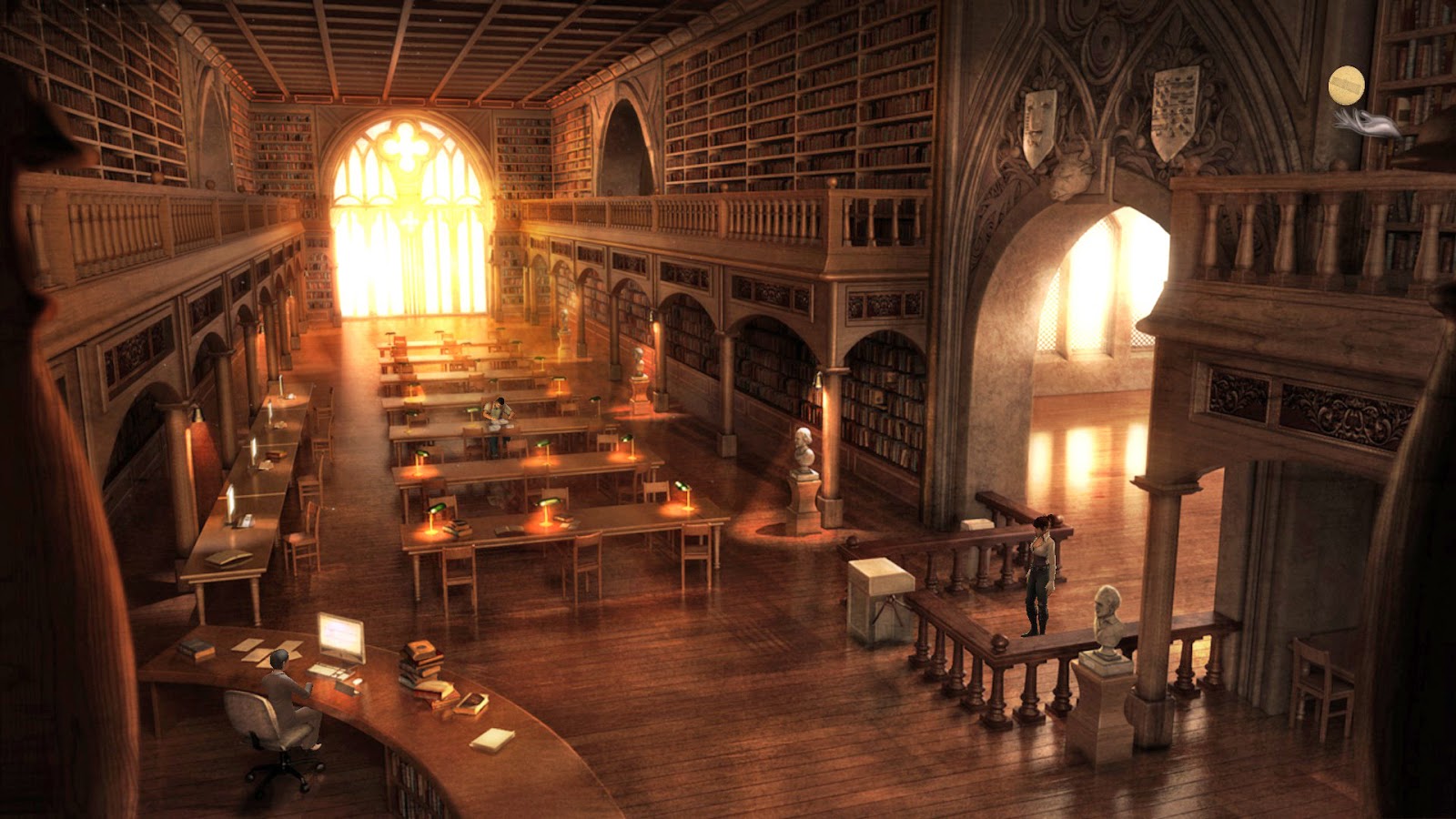
Just like the Paris Library in Moebius: Empire Rising, here too the Bodleian Library serves a practical purpose, with Samantha accessing its archives to learn stuff about David Styles. This Library is a huge room where the yellow and orange colours dominate. It is imposing in its space and presented in impressive detail, although there is not much interaction with the objects, except for an instance when you have to set up a magic trick so as to distract someone away from the entrance.
Gabriel Knight, the protagonist of the homonymous game series, is the owner of a bookstore specializing in old books. In the remake of Sins of the Fathers, we have the chance to marvel at his revamped bookstore, which is located in the French Quarter of New Orleans.

"St George's Books", as it is called, is a vintage-looking shop with limited space, but has a quite big collection of old and rare books. There is also an upper section with a balcony, but we have no access there - we can assume that it maybe hosts a storage attic, where Gabriel puts his unsorted books. Gabriel is an intelligent young writer and amateur detective with a metaphysical past and present. Running a bookstore seems to be his ideal job, however he somehow manages to be penniless most of the time because he gets bored quickly and spends too much time flirting. The setup of the bookstore reflects his laid back and joyful personality, with its bright colors and fancy retro decoration.
A different style characterizes his uncle's private library in Germany, which Gabriel visits during an investigation. This library is in the family castle-like mansion, but its whereabouts are covered with mystery. Gabriel must go through a specific ritual so as to be able to locate and unlock it.

The stone walls, decorated with hanging flags, the imposing arcs and the flickering lights of the chandelier create a spooky atmosphere in the library, although the colourful books on the shelves do bring Gabriel's bookstore to mind.
When Booker arrives at the Monument Tower looking for Elizabeth in Bioshock: Infinite, he follows her around in a series or rooms and finally catches up with her in the library. It is a long-shaped room with numerous books on its shelves that cover all the walls around.

Elizabeth lives secluded in the tower, and reading books is almost her only recreation. By the time that Booker finds her and helps her escape, she has already studied almost every subject and has gathered knowledge on almost every science and activity. When Booker first has eye contact with her, she is seen holding a copy of "Odyssey". Seconds later, aware of Booker's presence but still ignorant about his intentions, she attempts to hit him with a book called "The Principles of Quantum Mechanics". Of course, the choice of both titles is not random. "Odyssey" symbolizes Booker's adventurous journey, during which he comes across all sorts of literal and metaphorical monsters before he is able to return back to his "home" - which is the reunion with his own self, and the other book is the imaginary research written by Rosalind Lutece, the scientist who worked on the quantum mechanics to create Columbia, the floating city.
Libraries and bookstores hold their own secrets, and several times revealing them is not that easy. When Booker and Elizabeth arrive in Emporia, the wealthy suburb of Columbia, they visit "Founder's Books", a luxurious bookstore which also sells vintage toys.

It is a cozy-looking store, set on two floors. Its colours are generally warm and friendly, although the windows and lower shelves somehow look a bit creepy with all the giant toys sitting on them. Its fancy basement has a more bookshelves and a small sitting room space, as well as a pile of books near the stairs. The basement is the setting of yet one more battle among books, as Booker and Elizabeth get unexpectedly attacked by a few guards when they arrive downstairs. Once the battle is over, however, they can explore the place and locate certain items which open the path to otherwise inaccessible areas.
A library with much trickier secrets that require finding is the one of the Raccoon Police Department in Resident Evil 2. It is a large room with one main section and an upper balcony, and it also has a back room where a bizzare painting hints at the solution of a puzzle which involves four bookcases in the main room.

Like the rest of the building, the library looks vintage and has a vague aristocratic air of the past. It always struck me as rather weird that a place like Raccoon - a relatively small city located in a mountainous area - should have such a large and labyrinthal police station. If you examine the rooms more closely, it becomes evident that this building must have been much older than the modern city - given its complex architecture and certain decorative details like statues and engravings, as well as its several locked rooms. Moreover, it is full of symbols and paintings depicting scenes that many times have a meaning connected to the story.
In a similar tradition, the library in the Umbrella facility in Resident Evil Zero looks like it comes from ages ago. It also has a side room, which is locked at first and where more secrets await. The library itself, with its vintage tapestry, the lit lamp and its undoubtedly interesting collection of old books, could have been a warm, welcoming room if it weren't for all the zombies roaming outside.

The big and messy library rooms in the monster-inhabited ships of Resident Evil: Revelations do not feel any more friendly. The destroyed grandfather clock at the end of one corridor - a sad reminiscent of the one in the Spencer mansion's dining room - only adds more to the atmosphere of decadence and decay.

What is interesting here is the very existence of these library rooms. The ships may be large and luxurious, but even so it is rather unusual to have two big rooms full of old books on board. We can only guess that whoever equipped those ships was one hell of a bookworm.
Vast, spooky and eery, the isolated library of the Spencer Mansion in Resident Evil 1 is a very special room which can be accessed only after Chris and Jill have done specific things. Located in an uppermost section of the mansion, beyond a lethal trapped corridor and unlocked with a very unique key that can be obtained after lots of trials, the library holds yet one more surprise for our heroes.

It is the last hiding place of Yawn, the giant snake, one of the most dreaded B.O.W.s that Umbrella had created. Although Yawn's size is anything but insignificant, the strategically placed bookcase at the back of the room offers a great advantage for Chris and Jill as they can lure it around and shoot it as it attempts to take a turn. We could interpret this as some kind of allegory, which implies that the human mind - represented by the library and the books - and, subsequently, intellectuality and spirituality, can outsmart any kind of danger, as immense as it may seem.
Books are not simple objects; they carry whole worlds in their pages. Libraries and bookstores have that very special atmosphere that makes them unique places in real life; and it is not random that this feature is depicted so successfully in video games. Obviously some developers are book lovers, and same goes for their game characters. As incombatible as action and intellectuality may seem in theory, sometimes they do go hand in hand.


