We reach a point sometimes during the gaming adventures of our life where we find ourselves cursing at the computer screen, babbling unacceptable things while getting so close to throwing our controller or keyboard out of the window or right on the screen itself. This may happen more than once, depending on how experienced a gamer you are or not, on how difficult and demanding are the games that you like to play and, maybe mostly, on how their gameplay is structured, something that quite often does not have much to do with how hard the game in question may be overall. What I am describing is those points in video games that tortured us enough to be considered as the banes of our existence; be it a nasty jumping sequence, an evil timed run, an insane boss fight, sometimes all such things combined.
I started playing video games in the early 2000's, and have played quite a few since then; and I recall always wanting to complete the highest difficulty levels when they were available. I am mentioning this in order to highlight that a game sequence turning into a bane does not always have to do with the difficulty level; most of the times, it is a result of design and setup, and although how much experience a gamer has is also very important, it is not a number one factor in every case. The very first games that I played were third person shooters (Blake Stone, Wolfenstein 3D and Duke Nukem 3D), and a bit later I discovered the iconic third person adventures of Lara Croft in the Tomb Raider series. Up to now, I have played and loved games of various genres and gameplay styles, and naturally I have my fair share of banes, ranging from my first gaming years until recently.
Von Beck's Revenge (Tank Chase Sequence), from Indiana Jones and The Emperor's Tomb
Released in 2003 by Lucas Arts, Indiana Jones and The Emperor's Tomb was sensational for its time, and it still is, for that matter. Classic third person, with fancy action, smart puzzles and wonderful sceneries, its only serious flaw (well, if you can call it such, but from a practical point of view, it kind of was) being the lack of checkpoints in the course of the levels. Each chapter was divided in several levels, at the end of which the game would make an automatic save; but there was no way to save your progress while in those levels. I do not remember experiencing any issues with this, however, until I reached a point very close to the finale, the infamous tank chase sequence in Hong Kong, in the level "Von Beck's Revenge". Von Beck was the villain of the story, an annoying and persisting German military man, who had been pursuing Indy throughout the whole adventure. So in Hong Kong he made his most grand entrance in a nasty tunnel full of abysmal gaps, driving a huge tank with a drill at its front. Not the least impressed with his artillery, Indy must run along said tunnel, jumping over the small gaps and taking care to swing over the biggest ones with the aid of his trusty whip, while Von Beck's drill is literally down his neck, creating even more gaps on the ground as it moves. It is a sequence that requires timing, speed and reflexes, and although it lasts less than 3 minutes, it is guaranteed to leave a mark. When I first played the game, it took me one whole week of retries until I finally made it, and I remember that when I gave the game another go a bit later, because I liked it so much, when I got to the accursed level I stopped and quit without even trying again. Just recently, I decided to go back to it and record it, to see how it would be after all this time; it now took me only a few reloads until I succeeded, and it was mainly because of the different control system which I was not used to. To be fair, however, I cannot blame my younger self for having such a hard time with this sequence, because back then I was playing with keyboard and mouse, and admittedly it is way easier to do with a controller, with which I played it now.
Brother Obscura aka The Red Ghost Boss, from Tomb Raider: The Angel pf Darkness
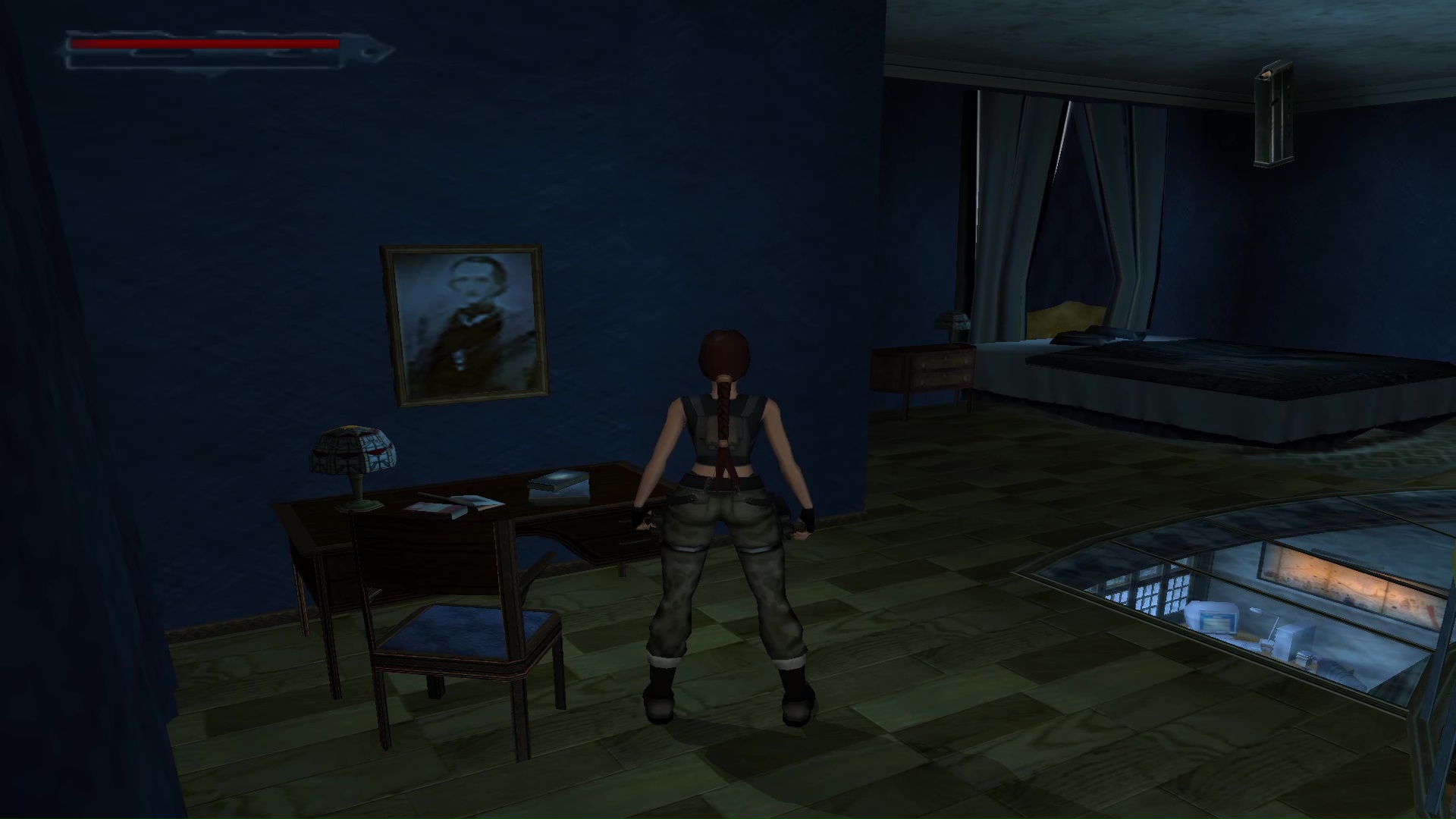
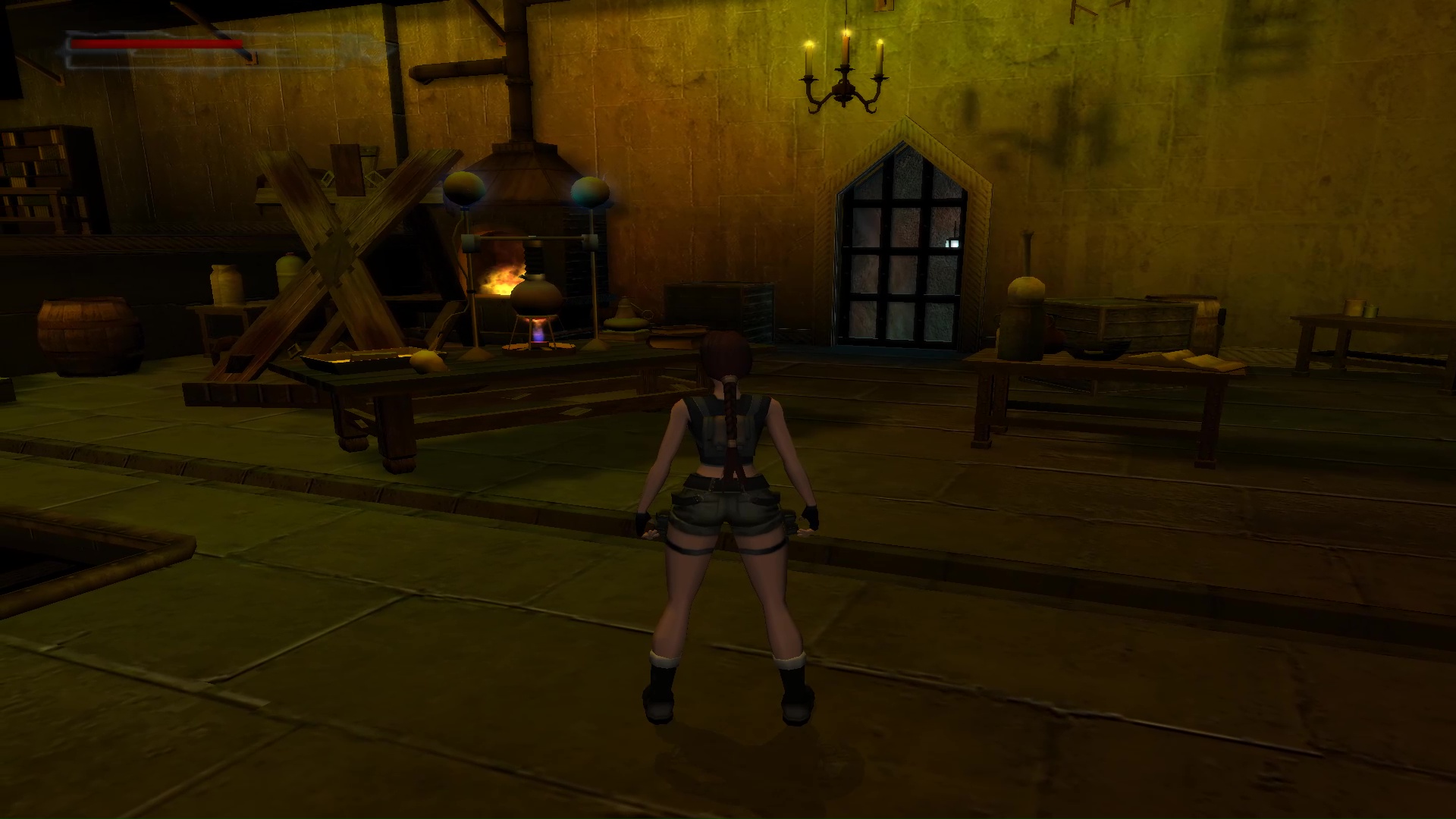
Technically this is not a boss fight, as you do not literally fight the enemy in the actual sense, but as a sequence per se, it is set up in such a way as to be justly classified as such. Concluding a rather well-structured sequence in an underground archaeological site, this part of the Angel of Darkness is clearly one of its most notorious moments. Released in 2003, the last game of the now historical Core Design was a charming tangle of fascinating elements and problematic gameplay. In an attempt to evolve the well-known and lauded features of the classic Tomb Raider games, the developing team decided to implement a few new mechanics which, however, could never work as they were supposed to. And not only that; they affected the overall gameplay so badly, that even the simplest task, running from one spot to another just a few steps away, would end up being nothing less than a struggle. The main and most infuriating problem of the game was Lara's inexplicably slow movements, a number one obstruction in instances when she was called to do things quickly and with perfect timing. One such instance was the sequence in the attic of the Hall of Seasons where Brother Obscura, the infamous Red Ghost, was guarding a painting, the artifact that Lara had been looking for since the beginning of the adventure. In a small room with several identical statues, the Red Ghost keeps floating around, moving the painting from statue to statue, thus preventing Lara from taking it. The task here is to shoot the Red Ghost enough times so as to immobilize it for a few seconds, which will then give you time to run and grab the painting. Needless to say the conditions need to be perfect for the task to succeed: you need to stand close to the statue that holds the painting, but not too close because in this case the artifact will fly off to another statue; additionally, you need to stay there in the crawl position, so as to not get hit by the Red Ghost; and shoot it with a powerful gun so as to stun it quickly. Moreover, you need to holster the gun as soon as the Ghost gets stunned, and then stand up to run to the painting. With Lara's slow motion movements and her needing practically ages to change positions and holster her guns, all this becomes an instant and never-ending nightmare. Even now, I found it quite nasty, although not even half as bad as in my first runs.
Boaz Returns, from Tomb Raider: The Angel of Darkness
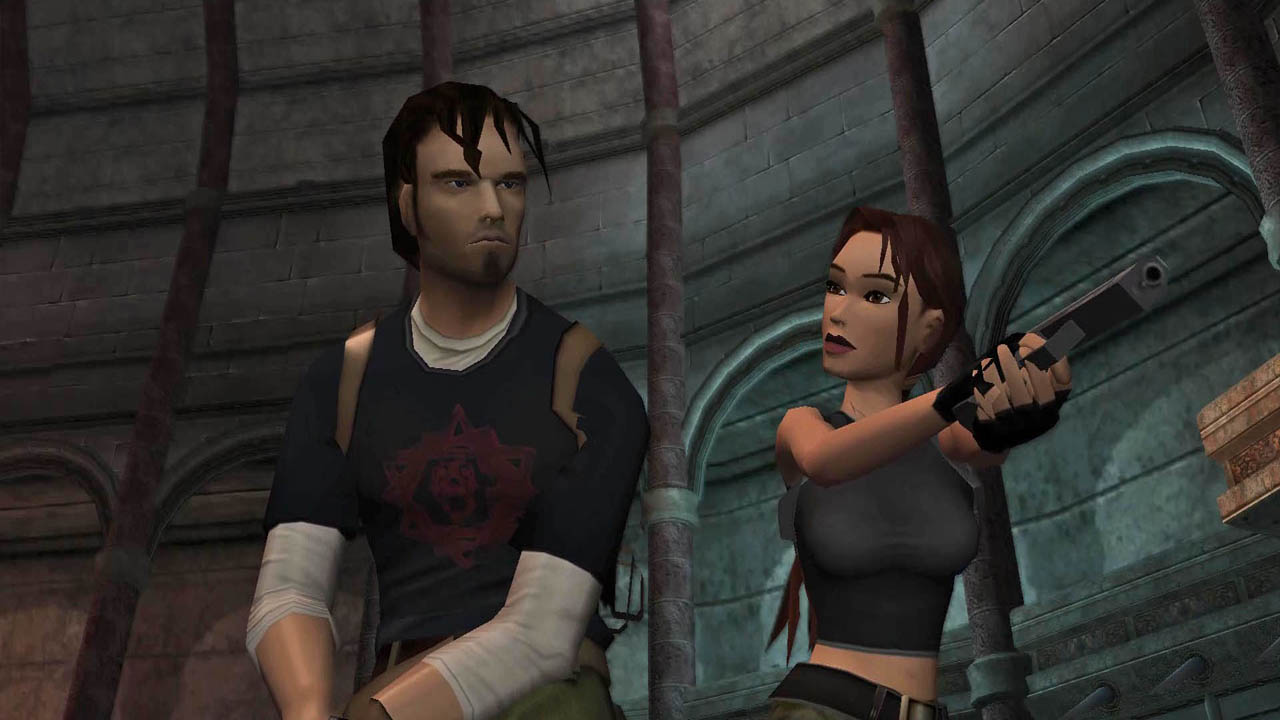
Another nasty highlight from The Angel of Darkness was undoubtedly the boss fight with Cristina Boaz, the scientist who mutated into a hideous giant spider-like creature and was "tasked" to rid off Kurtis Trent, the secondary protagonist of the story. Designed almost the same way as Lara in this game, Kurtis however was at the same time better and worse as far as his movements were concerned: he was able to run a bit faster, but certain moves, like stepping backwards for instance, seemed to be a pain for him to execute. On top of that, although he was carrying his cool, sharp and shiney chirugai, it remained a precious gem hanging from his belt, as he could use it only during cutscenes. On the other hand Boaz, although being even more awkward than him, was able to attack him with a variety of ways, the worst being those that made him fall, because then, just like Lara, he needed ages to stand up on his feet. In addition, the aiming system was not on Kurtis's side either, resulting in most of us succeeding in hitting the targets (the four pods on Boaz's body) almost entirely by chance.
The Great Pyramid Shaft, from Tomb Raider: Anniversary
Timed events are always a highlight in games; in fact the tighter, the better. Or maybe not. Sometimes the line between challenging and infuriating is so thin, it can easily become invisible. One such case is the sequence with the timed jumps in the shaft of the Great Pyramid, from Tomb Raider: Anniversary. The game was released in 2007, created by the developing team of Crystal Dynamics as an admittedly impressive remake of the original, classic first Tomb Raider game. For the most part, Anniversary was a blast; fantastic graphics, immersive, interactive environments and ambience, beautiful music, a smoothly moving Lara, an easy and comprehensive control system - and then there were the retractable poles. I can't even attempt to understand the logic of adding retractable poles in nearly every room in Egypt, but regardless it was something you eventually got used to after a point; until you reached that demonic shaft in the Great Pyramid in Atlantis. The room consists of several levels going upwards, that you need to reach after performing sets of timed jumps. Said jumps involve, guess what: retractable poles, as well as retractable rings to which you must grapple and swing from. After the first two sets which are rather easy, there comes the third set - the actual bane of my existence in this game. That third set is, no doubt, the work of demonic forces combined, moreover since there is a workaround there in plain sight which, however, is nearly impossible to acknowledge due to the deceiving complex "official" route that you are supposed to follow while running out of time in the most unforgiving fashion. When I first played the game, I literally quit at that point after I don't know how many retries. Then I downloaded a save file from right after that part, so as to be able to at least complete the game. I admit it was a most traumatic experience, because it is not like me to quit a game like this; let alone a Tomb Raider game which, moreover, I loved. And now, nearly 20 years later, the time came for me to make amends and give it a try again. Again, it was pure nastiness, but now, after having played several difficult and challenging games meanwhile, I knew how to deal with it; and I knew that when something in a game seems impossible, there is always another way around it. Of course it can also be done the official, long way, but the shortcut I am going for in the video is pure work of art - and yes, I see it this way since, thanks to it, I was finally able to complete this part after all these years.
The Final Execution Chamber, from the Executioner DLC of The Evil Within
I have very fond memories of The Evil Within, which proves how a game can be as difficult as it gets, but if it is wisely designed, it can offer a most entertaining experience. Created by Shinji Mikami, the mastermind behind the first Resident Evil games, The Evil Within was released in 2014 by Bethesda and it still carries its peculiar, undeniable charm. There are no flaws in its DLC The Executioner either, just an extremely difficult extra level / room in NG+. Luckily, you have very strong weapons at your disposal at that point, but this does not make the Final Execution Chamber less challenging. In the DLC, you play as the Keeper, and you pass through a series of rooms where you have to fight all sorts of monsters and enemies from the main game. The Final Execution Chamber is naturally the toughest of all, as there are that many enemies whom you must defeat, and on top of that, in the end you are forced to fight a very badass Sebastian and a crazed, enraged Joseph at the same time. I like to call them The Murder Husbands at that point because, let's face it, they kind of look like they are that. Needless to say they are insanely tough bosses, and more so since they attack together. I remember reaching my wits end in this frustrating mess of a battle, so I decided to start recording it to give me a motive and keep trying. I was victorious eventually, but I admit that, as much as I enjoyed it, I don't think I will ever touch that DLC again.
Lucas Baker Boss Fight in Professional difficulty, from the Not A Hero DLC of Resident Evil 7
From Resident Evil 7 and onwards, most games in the Resident Evil franchise took a different approach as far as their levels of difficulty would differ from each other. Its DLC episode "Not A Hero" was no exception in its Professional difficulty, its main problem being the rather stingy drops of ammo that you find and the insane number of super-strong enemies you have to deal with until you reach the arena of the boss fight. Lucas Baker becomes a nasty, infuriating mold monster in the finale of the episode, and at first he may seem impossible to defeat in Professional difficulty. I remember arriving at the last room of the game with as much ammo as I could get, and still running out of all of it before he would even reach his last phase. The "secret" to beat him is in fact using several weapons in some kind of cycle, something that the game does not make clear during the fight. You can easily decipher that his weak point is his heart whenever it gets exposed, but to be able to shoot it enough times while preventing him from fatally attacking Chris requires a series of strategic moves that, once understood, can really make the battle in Professional end within minutes. Stunning him with incendiary grenades just before he lands an attack, then immediately shooting him to eventually expose his heart which, in turn, gets a dramatic amount of damage when shot with a specific kind of ammo, puts an end to his miserable existence faster than you would expect. This fight was a nightmare for me when I first got to play the DLC, and I remember not being able to finish it back then; I did so years later, and again now for the sake of this article. This time it felt way easier; I don't know if it was because I got a better computer now, thanks to which the game had better performance, or because meanwhile I had become more experienced after having played several demanding games; maybe it was a combination of both.
Nemesis Boss Fight in Nightmare and Inferno difficulty, from Resident Evil 3 Remake
Jill Valentine's iconic adventure in Raccoon City saw an interesting remake in 2020, which was a pretty atmospheric game with nicely developed characters, and one very nasty boss: the infamous Nemesis could only be even more evolved in his revamped version, made even more stressing due to Jill having to move in tight and limited spaces while being chased by her ferocious stalker. There are several boss battles that you have to carry out with this monster, plus one crazy chase through town; and although all of these sequences can easily become a gamer's banes, it is the last boss fight that shines as the absolute winner. The finale of the game finds Jill trapped in a room with the heavily mutated Nemesis covering half of it. The boss cannot move around, but it is able to attack Jill with a series of deadly ways, while she must shoot several blobs on its "body" and at the same time fix the super-powerful weapon which is conveniently placed in the same room and with which she will be eventually able to destroy the monster. In the first three difficulty levels this fight is a breeze; the Nemesis has very few blobs on it, its attacks are fewer and much slower, and Jill has all the time in the world to succeed in her mission. But in Nightmare and, worse, in Inferno difficulties, fighting the final form of the Nemesis is exactly that: a nightmare and Hell incarnate. This is one of the cases where the difficulty level truly makes a difference. The boss has way more blobs on it, which, moreover, are more resilient; its attacks are incessant, literally the one after the other, and capable of sending you to the You Are Dead screen far more times than you can count; and the time that you are given to fix the weapon whenever the monster is stunned, is marginally a nasty joke. The first time that I finally made it, I could not believe my own eyes, and I admit it is a sequence that I never look forward to when playing the game.