Ramón Salazar's arc in the remake of Resident Evil 4 is an intense and stressing game of cat and mouse, which takes place in one of the most impressive and memorable environments of the story, with its evil antagonist rising as a major villainous force, serving also as a determinant character with a crucial role in the
development of the plot. Locked in his luxurious castle, contemplating glories of the past among rare treasures and brainwashed minions, Ramón Salazar goes through a
complex development himself; a development that gradually unfolds his already evil persona, making him much more powerful as an enemy than his original version.

Osmund Saddler's ominous presence may be looming over the Village in the first part of the story, but it is not until the last sequences of the Island section that he appears physically on screen. Salazar shows up almost as soon as the Castle arc begins, making himself more than obvious and reassuring the intruders about his evil intentions. While Saddler hides in the shadows for most of the story, Salazar makes sure that Leon understands very well who is the boss in the Castle, never missing a chance to pester him by calling him through the technically modern but visually retro monitoring system of his residence.

Salazar first shows up in the Audience Chamber as a grotesque diminutive aristocrat, dressed in an extremely retro style and a white wig, and accompanied by his two faithful guards who are already mutated and covered with robes. Both of them are compelling and intimidating; it is clear that Salazar relies almost entirely on their terrifying presence so as to be able to bully his potential victims without hesitation. The fact that Leon talks back to him, most probably being the sole person in a long time to dare to do so, is one first strike against his pride, which is already fragile enough even though he prefers to not acknowledge it. He becomes furious, although at this point he is still able to control his rage and simply orders his zealot minions to attack Leon and kill him. He does so calmly, marginally succeeding in keeping himself collected; but it is an attitude that will not last for very long.

To better understand Salazar's emotional state and attempt to comprehend his mentality, it is essential that we explore his extravagant residence, which is the exact equivalent of him in terms of architecture and decoration. Although the magnificent Salazar castle had been built many centuries before Ramón's time, it seems to reflect his personality and twisted mind as if it was made by the villain himself. Imposing, eery and marginally intimidating from the outside, it is revealed to be a complex of lush living quarters, deadly battlements, gory dungeons and unworldly halls on the inside.

The interior of the castle unfolds little by little as Leon, either alone or with company, moves deeper and deeper towards its "heart" which is in fact the place where he finally confronts Salazar. Before this happens, however, the various rooms, halls and gardens of the castle are gradually unlocked to him, revealing interesting facts about Ramón in the process, either via scattered journal pages and files or via details in the decoration and structure of the environments. The exterior of the main castle grounds is a multi-leveled area complete with catapults, an old but fully functioning cannon and several towers overlooking its yards. It also features a chapel, guarded by a monk who undergoes one of the creepiest mutations in the game, and a horde of zealot warriors who are determined to not allow anyone go beyond the gates. It is interesting, however, that the castle's drawbridge gate is fully open when Leon arrives with Ashley, implying that the path to Salazar's residence, being the only way out of the village after the ambush at the Villa, was cleverly turned into a trap so as to drag him inside. The drawbridge is closed shut after Leon and Ashley enter the yard of the castle, specifically to lock them in without any obvious escape route ahead of them. Considering that Salazar had become Lord Saddler's puppet, he had apparently received detailed instructions from him after Leon defeated Bitores Mendez in the Slaughterhouse, in order to lure Leon and Ashley in the castle and subsequently attempt to kidnap Ashley and lead her to him. The fact that so many people were enlisted against Leon so that Ashley could be eventually brought to Saddler, says a lot of things about how Leon's skills and intelligence would always obstruct the Lord's evil plans.

After Leon breaks open the main gate with the cannon, the story's action is transferred in a series of interior environments which comprise the actual residence of Ramón Salazar. The first room that we see is the Audience Chamber, a vast two-leveled hall with sparse but luxurious decoration, on top of which Ramón makes the aforementioned first appearance. The chamber is partly drowned in fog, something that further highlights the eery, chilling atmosphere of the setting. Heavy chandeliers are hanging from its tall ceiling, and several candelabras holding lit candles are scattered all around, giving off the spooky vibe of a sacrilegious church of sorts. There is also one very unsettling decorative detail in the lower part of
this room - big statues hanging upside down from the ceiling, which may
be slightly swinging due to subtle gusts of air. It is either a twisted
concept adding to the overall extravagant style of the castle, or an
equally disturbing warning hinting at what will happen to all unwanted
or disobedient intruders.

The next area we get to explore is the dungeons, as Leon falls down a suspicious part of the floor in the prison cells. Unlike the gold and luxury of the previous room, this new environment reeks of blood and rot and hosts the Garrador, one of the most terrifying enemies in the Castle section. In his past life, he worked for the masters of the castle as a torturer; apparently he was later infected with the Plagas and became that lethal monster. The dungeons are dirty, forsaken grounds, a private hell obviously reserved for all the unlucky souls who dare to doubt Ramón's authority. Next up is the Water Hall, a vast room with many levels that are connected together with hidden stairs and are riddled with over-the-top unlocking mechanisms. In gameplay, it is one of the most challenging and hostile areas of the whole castle, featuring a large number of enemies that attack in groups and including the infamous double crank sequence during which Leon has to protect Ashley from the zealots as she is struggling to raise two platforms in one of the pools so as to make way for the exit.
The next part of the castle consists of a series of rooms that would once cover the side-activities of the residents: a garden with fountains, a wine cellar, a Bindery Room and a small study are all grouped together in a rather limited, mostly narrow wing which, in its turn, leads to the Battlements, a heavily guarded section with a mazey structure and gates that open and close by operating levers marked with sun and moon symbols. There are several towers and narrow corridors, with a horrific armored and extremely hostile Gigante on one of its terraces. Next up is the Courtyard, hosting the infamous hedge maze with the Plaga dogs, leading to the lavish living quarters of the castle.

The living quarters consist of the Grand Hall, a dining room and a Gallery, featuring also an elaborate wagon - lift which connects this part of the castle with the Audience Chamber via a private train track. This area of the castle features brightly lit rooms with luxurious furniture and precious antiques for decoration, impressive chandeliers and numerous paintings and portraits on their walls. After Leon solves the Chimera statue puzzle, a locked door frees the way to the basement where there is the Library and the Mausoleum, which is the area that we first explore with Ashley and later Leon can visit so as to collect treasures and complete requests given by the Merchant.
This same door also leads to one of the most chilling and at the same time charming environments of the castle, which is the Ballroom; a hall that is particularly interesting both as a presentation and as a carrier of semantic significance in relation to the story. Unlike all the rooms and quarters in the castle before it which are in perfect or at least decent condition - the Grand Hall and its side-rooms even look like they are regularly inhabited by human beings - the Ballroom is partly ruined; its ceiling is collapsed, as are several of its columns. Fallen chandeliers, ripped curtains and broken windows, in an eery, round hall with large sections of its floor missing, gigantic mushroom colonies hemmed in its walls and a seemingly endless army of Novistadores, Saddler's horrifying giant insects, floating around its thick, foggy air.

Of all the areas in the castle, the Ballroom is where you can literally
see the source of the infection, with the fungus having crept over the
hall, the corridor leading to it and - as we are able to see later - its
exterior walls as well; which is exactly why this very room is of
crucial semantic importance for the story and its development. The
infectious fungus has violently invaded the specific hall of the castle
that would normally be filled with people and associated with happy
times. Now it is has become a nest of deadly giant insects and its
obvious decadence is a direct reflection of Salazar's mental and
emotional wretchedness. Of a similar semantic importance is also the Clock Tower, the section of the castle where Leon confronts Salazar in a most dramatic finale. Known also as the Tower of Death, this narrow construction hosts a giant stone statue depicting Ramón, which in fact is a death trap, breathing fire out of its mouth (in the original game, the statue would come to "life" thanks to a hidden mechanism and chase Leon in a most memorable quick-time event).
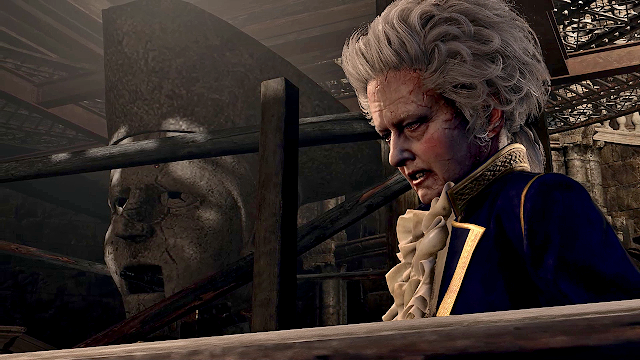
In the original game, Salazar's castle was equally luxurious and impressive, but his persona, albeit undoubtedly evil and cunning, was relatively toned down, also because he was rather clear as a villainous character, the obsession with his glorious family line and his inferiority complex making him a dangerous but nevertheless ridiculous enemy. In his revamped version, he is a threatening being with a very complex psyche, who carries an unfathomable amount of rage towards every breathing soul around him, who hated his father with a venom and teamed up with Lord Saddler agreeing to serve his evil machinations. The new persona, when placed in his lush castle's environment, gains an extra level of grotesquerie; the castle complements Salazar's overweening attitude, and there are signs of Salazar's insanity in every nook and cranny of his extravagant residence.

This new complexity of Salazar's character transforms him from the supporting caricature villain that he was in the original game, to a super powerful entity that may have a human appearance but even before his mutation he is almost as terrifying as his monster form. After defeating him, you leave the Castle grounds with an overwhelming haunting feeling that cannot go away even when you reach the extremely dangerous and hostile island where Saddler's sanctuary lies. Saddler himself is not half as intimidating; before his mutation, all you see is an obsessed lunatic who is convinced that he serves a divine cause. And after he mutates, he becomes a disgusting, marginally ridiculous spider-like monster which goes on babbling the exact same way as before, without the slightest sign of inner struggle. As for Krauser, he maintains his human traits even after his mutation, but although there are stings of bitterness in his words and a good deal of personal grudge against Leon, he remains in a brainwashed state until his very last moments, when he finally snaps out of his delusion and asks Leon to kill him in an unexpected twist of dignity and humility.

Contrary to all boss villains before and after him, the terrifying thing about Salazar is that, while in his monster form, his delirium is one-hundred-per-cent human as he floats around, including vulgar swearing, disturbing death threats and blood-chilling curses that, obviously, were being directed at him in the past. Because when he calls Leon "tiny, ugly, sickly half-wit", it is more than clear that he spits onto Leon the insults that he was once receiving, as Leon is the exact opposite of all these attributes: he is a tall, devastatingly handsome young man with a brilliant mind and full of health. And when he goes on: "You should never have been born, you
demon child! I will send you back to the hell you came from!" it is obvious that these had been words that were once being directed at him, when he was too weak and powerless and unable to defend himself. Salazar is a delusional, brainwashed puppet while in human state, trying - and, to a degree, succeeding - to keep himself together, albeit in his own distorted way, but he abruptly reverts to his deranged, uninhibited and hysterical human self as soon as he mutates into a monster. At some point, he starts listing the parts of Leon's body that he will rip out or maybe even eat, notably screaming that he will leave his eyes for last. This creepily cannibalistic threat concerning one of Leon's most graceful features, his lovely blue eyes, is most indicative of Salazar's venomous hate towards anything that is beautiful.

Salazar's evolution in the remake of Resident Evil 4 results in him playing a far more important part now, similar to that of Stefano Valentini in The Evil Within 2. The analogy is not random, as the two characters have common traits and their roles in the stories they are involved in have more or less the same dynamic. They were both used by a lunatic to achieve a so-called higher goal, but somewhere in the way they got to claim something bigger for themselves. But each one's development is unique: unlike Stefano, who almost completely diverted from his original role after a pivotal moment, Salazar remained faithful to the orders he had received, but for him the big twist was the realization of his personal tragedy which was triggered when he met Leon for the first time. It is safe to say that he had been evil all along, but from that moment and on his limited self-control completely vanished and he became a monster long before his actual transformation.

Escaping the castle now becomes a far more stressing and difficult task; in the original, Salazar was just one minor unit, placing obstacles here and there that might have been challenging but were somehow functioning as stand-alone threats, mostly and mainly controlled by Saddler. Now, however, every danger and obstruction that Leon comes across in the castle grounds seems to carry Salazar's stamp of sadism and cruelty, and the castle, albeit under Saddler's influence still, is Ramón's absolute reign of terror where noone else is allowed to roam. It is notable that, while in the original the infamous throne room was on the Island and the actual throne where Leon could teasingly sit and pose charmingly was Saddler's, is in the castle in the remake, and it is the same throne that now belongs to Salazar. This change may not look significant, but in fact it is extremely important and emphatic in relation to how the interactions between Leon and Salazar develop until the climactic finale with the boss fight.

Albeit optional, visiting Salazar's throne room is a crucial side-path in the story. The first time that the throne room is seen in the game is near the end of Chapter 10, right after the Ballroom, during the scene in which Leon witnesses Ashley's forced initiation and Salazar's subsequent attempt to kill him by having one of his guards push him in the abysmal pit that is one of the many man-made death traps in the castle. Although all this is a cutscene and we can do nothing at that point, it marks a pivotal moment in which Salazar's attitude completely changes: he abandons the disturbingly playful manner that he had from Leon's first meeting with him until that very moment and gets serious, instantly becoming a no-nonsense, ruthless threat.
Leon may be able to make it safe from the fall due to his survival instinct and his skills, but there was no way he could have landed alive at the bottom of that pit otherwise. The rotting corpses down there in the sewers say it all. So when Leon returns to the throne room in Chapter 12, at which point we are free to explore that previously unreachable wing of the castle, there is some kind of payback that he can give in return: fulfilling one of the Merchant's requests, he can pick up a freshly laid egg from one of the hens that wander around the room and throw it on Salazar's portrait, defacing it in the most humiliating way.

In addition, he can sit on Salazar's throne with all the grace that his gorgeous figure generously allows him to have, further humiliating Ramón and ridiculing the obsession that he has with his bloodline which at the same time he also despises because he never truly felt any real connection with his family. Quite possibly these two actions are the most powerful strikes against Salazar, hurting him way more than the bullets and knife stabs that he will later receive during the boss fight.

Leon's sitting pose mocks the one that Salazar has in the aforementioned cutscene (also pictured in the first image of this article), but it is even more hurtful for Ramón that the sight of Leon on the throne, although mockery, is still eye-candy. Leon could very well be the "king" of that castle, because he is a gifted and good-hearted young man and he is essentially noble without being an aristocrat by title, unlike Salazar who drags around his miserable existence, gaining satisfaction by making his poor victims suffer. In reality however, Salazar is a pitiable human being, emotionally traumatized beyond repair and thus incapable of ever coming to his senses.

The huge contrast between Leon and Salazar is one parameter of great significance for all the Castle chapters. Salazar calls Leon the noble knight who has arrived to rescue the fair princess, very obviously with much sarcasm and a good dose of bitterness. Although he is very past the point where he would literally be interested in offering his aid to a damsel in distress, as he is too absorbed in his own ego in the irreversibly distorted world that is partly a result of his developing mutation, in theory he would have liked to be acting like a knight himself. As long as he is surrounded by brainwashed zealots and mutated guards, he feels that he is at an advantage; but the moment that Leon arrives and he sees him for the first time, all his illusions disappear in the blink of an eye. Because just then he comes face to face with the realization that the world is not like he wants to fantasize in his golden quarantine, being now forced to deal with someone who has all the attributes that would form a knight as he perceives him. Leon is brave, beautiful, strong, kind and intelligent; and although the new Ashley is not as helpless as the original one, therefore not anymore the typical damsel in distress, she still relies on him for her survival, which is far more essential than her actual rescue.

From a technical point of view, the boss fight with Salazar is the most
well-structured and balanced of the game. Salazar is an extremely tough
and violent boss, making the battle against him a demanding challenge;
but every single element comprising it makes total sense, something that
allows room for building a strategy, while at the same time offering
Salazar enough space to shine as a terrifying and unforgettable
high-rank enemy. While in the original game's final confrontation with him Salazar's
lines are limited to only two phrases that are clearly connected to the
story alone, in the remake his mutation and the battle that
follows it shoot up his paranoia, revealing a venomous and lethal hate
towards Leon personally. This variation is indicative of his overall
evolution as a demonic, devilish force that consciously causes harm and
brings death and gloom everywhere around him.

At some point during the
fight, he mentions that Leon reminds him of his father, and that the
likeness, being so uncanny, makes him want to strangle the life out of Leon. He literally spits out these words with hysterical fury, and it is
notable that, although his delirium progressively grows out of control
with the battle lasting longer anyway, this declaration further reinforces his
descend into an uncontrollable berserk mode. In the throne room, there is a portrait of a man and a woman left and right of the throne; on that of the man, there is a Boot Knife that Leon can take, but notably the weapon sits right on the man's heart. The person that the portrait depicts could be Ramón's father, because as we read in one of the files, the latter was murdered "by the devil" (either Saddler himself, or Ramón under Saddler's influence); so the knife that is stuck on the portrait could mean just that.
However, there are two other portraits, one in the small sitting room overlooking the Courtyard and one in the Grand Hall, which depict two different men that both share a striking resemblance with Leon. Since Ramón uses this exact word, "resemblance", therefore physical likeness, we could guess that the man in the throne room with the knife on his portrait is probably one of Ramón's older ancestors (a grandfather, maybe), and the knife is placed there as a red herring; because if the battle with Ramón ends quickly, he will not have the time to say the comment about Leon looking like his father, and the player (and Leon) could easily miss it. If that is indeed the case, Ramón's father is either the man in the sitting room portrait or the one in the Grand Hall portrait.

The man in the sitting room portrait, shown in the screenshot above, looks way too much like Leon to be a coincidence. Ramón's hysteria when he mentions that the resemblance between Leon and his father is striking truly says something. The other man, the one in the Grand Hall portrait, shown in the screenshot below, also looks a lot like Leon but this is not very apparent when our hero has his regular look; it becomes more evident when he has the Hero outfit on, in which his hair is styled differently, pretty much like the man's in the Grand Hall portrait whose outfit, incidentally, also resembles Leon's Hero one.

Whichever the case might be, Ramón's daddy issues are revealed to be an important driving force for his character development and subsequently his attitude after he goes through his mutation and becomes completely unhinged and uninhibited. In his human days, after he took over the castle following the demise of his family, he would choose to live in a fantasy world, as is hinted by his words before the final confrontation begins: he would see everything as a theatrical play, where both him and people around him had a specific role.

This view of life and the world would ease his insecurities and make him see himself as someone who mattered. Born with a degenerative illness that also affected his physical growth and would sooner or later lead to his death, Ramón would find moral satisfaction in making people suffer. As we read in the files found in the castle, once he threw vitriol on the face of a servant who teasingly called him "Pulgarcito" (which is "Tom Thumb" in Spanish, the little hero of the well-known folk tale that narrates the story of a diminutive boy). This explains why during the boss fight he "casts" Leon in the role of Pulgarcito for his imaginary play: he is making a projection, in a desperate and vain attempt to rid off his own physical disadvantage.

In fact Ramón's transformation did not happen just at the time of his final mutation. Long before this, he made a pact with Saddler so as to unleash the Plagas that had been sleeping for centuries in the dark depths of the castle's underground after one of his ancestors discovered them and sealed them. According to the castle's files, his mother agreed to have Saddler infect Ramón with the Plagas, because she knew that his illness would lead him to an untimely death and wished to save his life. Of course this could only go wrong. After his mother's death and his father's murder, Ramón remained the sole heir of the castle being also the end of his illustrious family line. He unsealed the underground of the castle, making way for the excavation of the Plagas in the mines that were set up specifically for this purpose - during the final mine cart ride in Chapter 11, Luis shows Leon the source of the Plagas down there in the depths. Several people from the nearby village were employed to work at the excavation site, but all of them were gradually infected, turning into Lord Saddler's puppets.

Given his traumatic childhood and the unavoidable physical, mental and emotional corruption that came with his infection, Salazar eventually became the disgrace of his noble family. The fact that he can be killed with two golden eggs as an alternative to the regular long and tough boss battle, may hint that the people of the region, knowing him as the degenerate and corrupt aristocrat that he was, would occasionally throw eggs at him whenever he would walk out of the castle, so as to ridicule him (it is believed by part of the gaming community that his sensitivity to eggs is due to an allergy that he is supposed to have, but there is no report or evidence anywhere to support this claim). There are only two golden eggs in the whole game, and are always found in two specific places: the first is at the shores of the lake in the village, found as early as in Chapter 4, and the second is in the throne room, locked in a safe which can be opened only with an elaborate unlocking mechanism involving a cube key that is found somewhere else in the castle.

Just like he is mostly humiliated and defeated when Leon defaces his portrait and then sits on his throne, getting hit with something as mundane as an egg, albeit golden, hurts him way more than the weapons hurt his body, because it is a strike against his dignity and his pride. The egg being golden signifies his own high-society status which, however, means nothing in his case as he is unable to do justice to it. From a literary point of view, we could say that when Leon kills him with regular weapons, he kills his physical side, and when he defeats him with the two golden eggs, he causes his symbolic death, depriving him of his pride by humiliating him so easily.

After he dies, Salazar leaves behind his Lip Rouge, a bright pink cosmetic powder that he apparently used on a regular basis so as to cover up the ghostly paleness and the notable signs of the infection on his face. This partly tragic and partly humorous detail is yet one more remain of his aristocratic background, as it nods to the rouge pomade that members of high-society in the Baroque era used to apply on their faces. Salazar had all the material elements that would make him a member of nobility: the title, the castle, the luxury, even the lip rouge; but in his real essence he was rotten to the core. In a not so unexpected twist, given the events leading up to Salazar's ending, as the Castle section reaches its finale with the boss fight at the Clock Tower chamber, Leon turns out to have been Ramón's rival awe all along and therefore the most appropriate to seal his fate.
» Salazar's Castle: A Comprehensive Gallery
» Salazar Boss Fight Dialogue Lines in Resident Evil 4 Remake
» Salazar Boss Fight Full Dialogue Version Gameplay


.png)


.jpg)


