Showing posts with label theories. Show all posts

Jill's Lobster

Sunday, 20 February 2022

There has been a lot of speculation and theories about Jill Valentine's love life, as is the case anyway with most fictional heroes and heroines who do not appear to have a predetermined or potential partner or match; although Jill has always been a very special case, since she has more often than not been depicted as someone who mostly focuses on her work and her duties, leaving little - if at all - space for anything else in her life. There is a general conception, which is extremely popular among fans - and quite possibly this also appeals to members of the Resident Evil development teams - that Jill has feelings for Chris Redfield and vice versa; Chris, however, always seems even more focused on duties and work than Jill, and we never had the chance to see him dealing with anything directly connected to the game of love, at least as far as his female partners are concerned. 
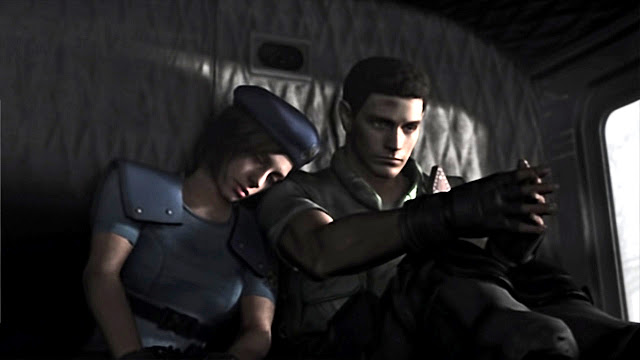
Jill is the main protagonist of Resident Evil 3, a game that recently underwent a revamped remake which may have failed to do justice to certain aspects of the original, what with the omission of emblematic puzzles and iconic environments, but on the other hand it offered a lot of character-related insight, focusing on its protagonists, deuteragonists and antagonists in a way that shed light on their personalities, thus highlighting their motives, intentions and actions a lot more. The game itself, as concept, story and development, seems rather straightforward and easy to follow, but in fact it has traits that give it an identity that is quite different from other titles of the saga. Jill finds herself in a nightmarish, zombie-ridden Raccoon City, just having lost Brad, her only ally, in an overall hostile environment. She is forced to work with a group of soldiers who belong to Umbrella, the company that Jill knows very well and is aware of their evil doings. As the story proceeds, Jill realizes that most of the soldiers are clean and completely ignore the truth about Umbrella - except for one. 
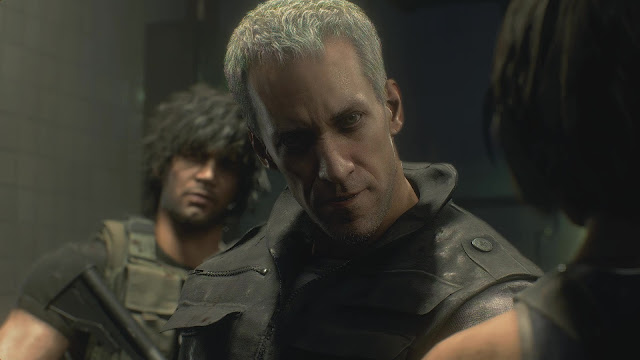
If you think about it, the condition in Resident Evil 3 is the opposite of Resident Evil 1, the other game where Jill was a protagonist: in the first game, Jill had to work with her team mates, all of whom she unquestionably trusted until one of them turned out to be a traitor. In Resident Evil 3, she begins by mistrusting and hating her unlikely partners, until she finds out that most of them are trustworthy. In both cases, she is part of a group of people one of whom at the end proves to be a traitor, but while in Resident Evil 1 they are all innocent until one of them stands out as the bad guy, in Resident Evil 3 they are all guilty until the innocent ones become known and only one of them remains on the antagonist side. Before all this happens though and she learns to respect and trust the soldiers that deserve it, Jill has to fight alone, always reminding herself that what she is doing is for the sake of the civilians whom she wants to secure. It is one of the not so usual cases in the Resident Evil saga where the protagonist is completely by themselves, in a setting where they believe everyone is working against them. Claire in Code Veronica had Steve as an ally right from the start; Leon in Resident Evil 4 had Ashley, Luis, and even Ada in the background. Claire and Leon in Resident Evil 2 had each other, Chris in Resident Evil 5 had Sheva and Josh, Ethan in Resident Evil 7 had Zoe Baker. It is not before several unfortunate events happen that Jill realizes she can actually trust the three out of the four people in her group - although sadly one of them is killed as soon as she finds out that he is clean. 
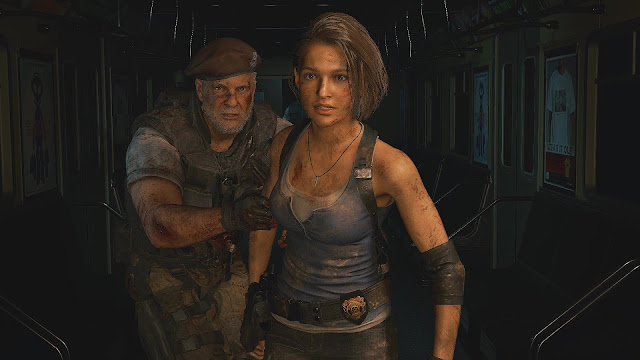
This takes place in a very pivotal sequence of events, where in fact more revelations also are made. Jill goes with Carlos down to the subway platform, after having restored the power and temporarily defeated the ferocious Nemesis. This instance is the one and only in the whole game where all the members of Jill's group appear together, so technically it is the best time for everything to come into place. Earlier, Jill had found out by chance that Nikolai is a ruthless, cruel man, and she probably suspected already that his role in the group was anything but honest. But as soon as the train departs, she witnesses a brief dialogue among him and Mikhail, the leader of the group, which reveals two things: one, it proves that Nikolai is indeed a traitor, and two, it clearly shows that Mikhail is on the side of the good guys, therefore one more that could be trusted.


Mikhail's subsequent and violent death, however, sadly limits that side to only two people, Carlos and Tyrell. The latter, being a good friend and partner for Carlos, gained Jill's respect almost automatically, during the aforementioned pivotal scene, moments before the train set off its dramatic route, thanks to the more than obvious friendly and trusty interaction between Carlos and him. As for Carlos, Jill had already changed her heart about him; surely her unmistakable instinct had made her trust him soon enough, but on the one hand she did not want to admit it to herself and on the other, she definitely wanted to be one hundred per cent sure before allowing him to see that she viewed him in a positive light. 
 

For a character like Jill, who goes through such tough and morale-challenging situations on a regular basis, things like flirting and romancing are more or less secondary. Carlos's early attempts to awkwardly flirt her, albeit out of time and place, all fall through because, like he confesses to Tyrell at some point, Jill "is not like anybody", probably referring to all the girls he had known up to then, who would easily fall for a silly, stereotypical flirting. Quite possibly Jill's view of a romantic lover filters through his overall attitude concerning loyalty, trust and bravery, but even after this "test" is clear, maybe it is not enough to own her heart. In Carlos's case, though, this unorthodox, atypical test has double value. Not only he proves that he is clean and trustworthy, but he is also someone his employers can rely on, since, until he has blatant proof that they are rotten, remains loyal to them, something that, however, does not prevent him from going against their wishes when he realizes their evil intentions. 
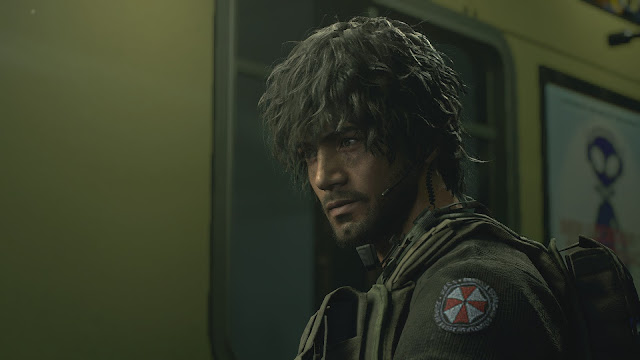
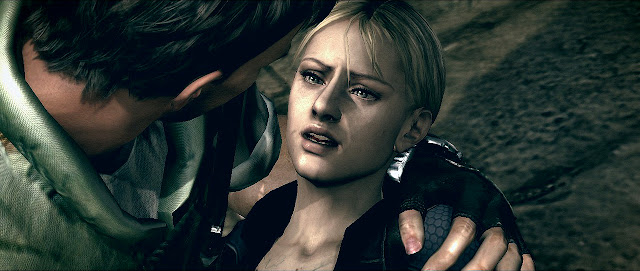
We never had the chance to know what happened in Jill's life after the events in Raccoon City, until we unexpectedly learned about her presumed death in Resident Evil 5. Through a dramatic flashback story, we got to know that, during a nasty encounter with Wesker in Spenser's estate, Jill attempted to save Chris's life by pushing her former captain out of a high window, but she fell all the way down together with him in the process. She remained presumed dead for a while, but Chris found her later alive and heavily brainwashed by Wesker. He was forced to fight with her before finally being able to release her of Wesker's control and bring her back to her senses. After that incident was over, however, we lost her again - save for an appearance in the overcrowded and rather chaotic Revelations. 
The remake of Resident Evil 3 ends with Jill and Carlos leaving the bombarded Raccoon City for good on a helicopter, and Jill giving an oath to herself to stop Umbrella's evil plans. In the original, however, there is a bonus end screen showing Jill and Carlos gazing at the ocean from a ship, at what could probably be an off-duty holiday escape for the two of them. Could this mean that, after the events in Raccoon City, they met again and maybe bonded romantically together? This could have been an indication back then, which may have not been included in the remake, but there is something else to consider in the new version of the game, that has a similar nuance.

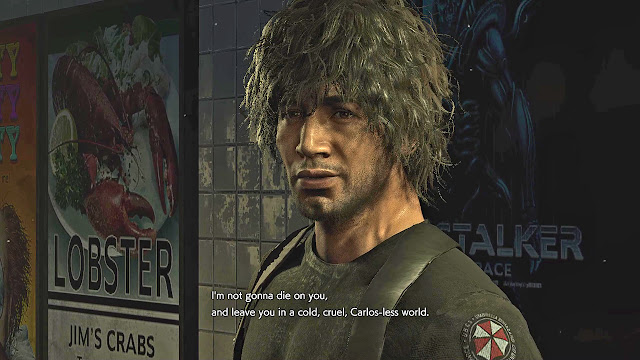
In one episode of the popular sitcom Friends, Phoebe, a character who is notorious for her outrageous way of thinking, tries to prove to the others that two of their common friends, Ross and Rachel, are in fact destined to be together. To do so, she describes how the pairs of lobsters mate, getting tied to each other with unbreakable bonds until the end of their lives, concluding later that Ross is Rachel's lobster. Although this whole lobster theory has little to do with reality, it soon became a standard joke in popular culture, being often featured in media as an easter egg, like so many things today. In the pivotal scene on the underground platform in Resident Evil 3, just as the train is about to depart, Jill expresses her worries about this maybe being the subway's last route. Mikhail then assures her that the train will be back again to collect more civilians. Although Jill is honestly concerned about the latters, part of her worries are directed towards Carlos, who has orders to go to the Police Department with Tyrell. Carlos tells her that he doesn't plan to leave her "in a cold, cruel Carlos-less world", while just to the side of him there is the poster of a local restaurant, Jim's Crabs. The poster depicts a huge lobster, with the name of the species in big lettering below it. This could be random, but it could very well be an easter egg, hinting that Carlos is in fact Jill's lobster.
Under that light, we can see Jill's long absence with a different perspective. Obviously she did take part in missions and went on with her police work, but maybe she did find love with Carlos, after all. Given that we haven't heard of Carlos all this time either, it could be that Jill helped him free himself from Umbrella and offered him shelter for a while, before he would be safe again to go on with his life, this time by her side.

Yukio Mishima and The Evil Within

Friday, 16 October 2020


Some other time in this blog, I mentioned how the backstories of the characters in video games give us a rich insight concerning the research that the developers went through while shaping them. Sometimes, said backstories involve details that may be offered randomly and thus pass unnoticed, until you get a clue to put them together: then it is like puzzle pieces that are placed in the right spots to form an image, thanks to which the character that they concern is set under a new, revealing light.

In The Assignment, one of the extra episodes of The Evil Within, where we get to play as Juli Kidman, we have the chance to view parts of the main game's story through her eyes. While literally floating in a state between reality and nightmare, Juli comes across some particularly nasty surprises in her way. The most revealing of them is having to fight Joseph Oda, who appears before her as a Haunted, determined to kill her. In her attempt to distract him so as to perform her attacks against him, Juli can resort to several diversions, one of them being turning on a film in a small cinema, which depicts Joseph as a Samurai, yielding a katana.


It is interesting that, although we are already aware from the main game that Joseph is the descendant of a historical family of Samurais, this is the first and only time that we see him literally paying homage to his heritage, and it is through an indirect means, in the distorted reality created by Ruvik in STEM. As Ruvik is exploiting the memories of his victims, blending them with his own so as to be able to control them, it becomes clear that the appearance of this specific film comes straight from Joseph's memory stash, serving as a way to confuse him at that point (because he is a Haunted, therefore not himself), while offering Juli the chance to stealthily attack him.

Joseph is described as a considerate and composed man, but it is hinted that he is constantly suppressing himself in order to comply to the norms and stereotypes of society. Coming from a strict upbringing, he feels forced - partly by his environment and partly by his own self - to keep his sensitivities and weaknesses hidden. This is something rather typical of the Samurai upbringing, so it is natural that Joseph, due to his family's historical past, had it too, to some degree at least. The film that we have the chance to see in The Assignment shows that he had been through Samurai training as part of his celebrated family's tradition.

Mostly known for his ritualistic suicide via "seppuku" (or harakiri), Yukio Mishima was nonetheless a multi-talented writer, considered one of the most important Japanese authors of the 20th century. Both as an artist and a personality, he was obsessed with beauty, eroticism and death, as well as their becoming one. Mishima was a homosexual, but growing up in the extremely strict Japanese society of the 1930ties made it particularly tough for him to accept and express himself as far as his sexuality was concerned. In 1949, he wrote his now considered iconic novel "Confessions of a Mask" which, although not entirely autobiographical, narrates episodes and memories of its protagonist that are greatly connected to the author himself. Written in first person, the novel explores a young man's continuous agony as he struggles with his ever-growing and forbidden sexual desires while evolving in a society and a family environment that are not only particularly strict, but moreover guide their members towards very specific, predesignated paths from which it is quite hard - if not impossible - to divert.


The young narrator starts his confessions going back to his childhood and early teens, during which time he had his first sexual awakenings triggered by random visual experiences. Although not the very first, the strongest, most memorable and critical one was an image of Saint Sebastian that he saw in a book, a painting by Guido Reni which depicted the saint during his torture, tied on a tree with his body pierced with arrows. The hero describes with both precision and subtlety all the emotions that rushed through him while looking at that painting, resulting in a rather intense first experience of culmination which defined his subsequent view of people and the world and made him more than conscious of his sexual identity. However, living in a society that condemned such deviations from the accepted norms, he knew that he would be forced to live his life in disguise, always putting on a mask that would hide his true self from the rest of the world.

Joseph of The Evil Within has grown up in a similar environment - probably not so strict, but still the values and beliefs that characterized old-time Japan should have been ever present in the life of his family and surrounding environment. Apparently he took some important education, then trained to become a detective. We can see from his attitude and approach that he likes to dig into things, examine them deeper and he also has a notable combinatorial mind. He has a small notebook where he writes down everything that he sees or thinks that can be related to a crime case. He got married at a relatively young age and made his own family, but he still seems to be quite vulnerbale socially, despite his smartness and the choice that he made to follow a dangerous line of work. But maybe he chose the specific line of work for this reason: so as to give him inner strength and help him overcome his fears and anxieties.
 

Teaming up with Sebastian was a turning point in both his professional and personal/social life, as Sebastian was quite different as a person, and came from an equally different environment and background. Although he was not too open as a character either, he was much more free sentimentally and spiritually and, unlike Joseph, obviously not hunted by strict rules and norms. The two partners formed a close bond and became good friends, always caring for and helping each other. From a symbolic aspect, Sebastian was for Joseph what Saint Sebastian was for Mishima, a new force in his life which brought forward a mental strength that he always had but kept suppressed and maybe woke up in him some darker and forbidden desires (maybe towards Sebastian as well). Sebastian, aptly named after the saint, was in a similar way tortured - not literally like him, but psychologically broken - but he was also a hot-blooded, passionate man who would always show his feelings and never suppress himself. Although he too was positively affected by Joseph's presence in his life - the calmness and love for order that were due to Joseph's upbringing helped Sebastian have better control - the biggest influence was the one that he had on Joseph, something that the latter obviously came to realize while being trapped in STEM, during which time his subconscious took over and brought him face to face with new revelations about himself.

There are several instances in the game, where we can see a progression of this newfound self-awareness, albeit they all occur in the dream-like sequences that STEM creates. What triggers the initiation of this development is his succumbing to Ruvik's power and becoming a Haunted for the first time. This transition could very well symbolize the awakening of his darker side and all those elements that he kept hidden in the real, "civilized" world. During the sequences when Joseph is a Haunted, he seems to possess an insane power which makes him become extremely violent and lethal. Unlike any other random Haunted, however, he is totally aware of this transformation and seems to be able to control it, as he can go back to normal and vice-versa. In a most revealing scene at the start of Chapter 7, after he and Sebastian found refuge in an abandoned church, he acknowledges that he does like it when he turns, since this transforms him into someone that he cannot be in real life. Although it scares him, it also fascinates him, and this is one more reason why, in the previous chapter, he tried to put an end to his life. Embracing his dark side would mean accepting all that would come along, and this is something that can also be applied to his normal, real life. Just like Mishima, Joseph is in a constant struggle between faithfully following the rules with which he grew up and freeing himself from everything that keeps him enslaved

A Love Undercover

Tuesday, 18 February 2020


Contrary to popular Resident Evil fandom, according to which Leon Kennedy has an incurable crush on Ada Wong since the beginning of time (or rather, since the original Resident Evil 2 when he first met her), I always had the impression that things were never that simple for our fearless hero, as far as love matters were concerned. If you ask me, Leon probably swings both ways, tasting the best of both worlds when it comes to it, but always being selective; and since he is such a smart and good-hearted guy, he likes people and is liked in return thanks to his great looks and big heart, never feeling jealous or competitive, which is why he has made good friends throughout his adventurous life.

I have to make it clear first that I am not part of the fandom, although I like (most) Resident Evil games very much and I enjoy playing them again and again. But the term "fandom" implies a rather hardcore obsession that I don't have, so I prefer to say, when speaking for myself, that I simply love the series and I find several of its characters quite interesting, fascinating even. As I have mentioned a few times in this blog, the video games of our times are like interactive movies; therefore their characters are like heroes from a film or a book. They have depth, background, and are as "real" in their imaginary world as their counterparts from cinema or literature. So character analysis is not only legit in the gaming universe, but also a must, if we want to dig a bit deeper and understand motives, actions or decisions that our digital heroes are called to do or make in the course of their quests.

That said, although I plead guilty of having my own "ships" in several games (I think it's inevitable nowadays that video games have evolved so much and their heroes are so powerful character-wise), I do not blindly stick to them, as I want to be able to fully explore a character's potential. In other words, I do not mind if two characters that I like seeing together as lovers, for example, are simply friends in someone else's shipping realm, or vice versa. I once had a rather entertaining (well, at least for me it was) discussion with another person, who was so fanatic about a certain ship, that they could not bear even hearing a different view. That person obviously was missing the very important point that we were talking about fictional characters, therefore anything could be considered canon in their world. It was impossible to make that person understand that it is not an insult to "pair" video game characters in the combinations that you want, since there are basically no limits to imagination. I would strongly advise people with such stiff brains to read some classic literature or watch good movies to maybe widen their perspective a bit.

So according to fandom, Leon is in love with Ada, or at least is infatuated with her; something that, however, never prevented him from setting his eyes on other girls - and boys, for that matter. He has so far flirted with Angela Miller, his co-protagonist in the movie Degeneration, a little bit with Helena Harper, his partner in Resident Evil 6, even with Ingrid Hunnigan, his overseas guide in Resident Evil 4 - to name a few. Regardless, it is not hard to get those strong metaltango vibes in his scenes with Jack Krauser in both Resident Evil 4 and The Darkside Chronicles (especially in the former, both their fights should be X-rated); not to mention that, so many years later in Resident Evil 6, Leon obviously hadn't undergone any corrective surgery to remove the pretty much visible and very deep scar that Krauser's knife left on his cheek during their duel in Resident Evil 4. There is clearly a rather strong connection between him and Alexander Kozachenko in the movie Damnation, and he has the time to form a suspiciously close bond with Luis Sera in Resident Evil 4, despite their very brief and violently cut acquaintance.


But when it comes to girls, there is a part in Leon's life (and heart, in my humble opinion) that belongs to a very special lady, who is no other than our lovely Claire Redfield. This has nothing to do with shipping Leon and Claire as lovers (I will always ship Leon and Krauser above all other ships), but it is a conclusion based on specific facts. Leon's unrequited crush may have actually been Claire all this time - and vice versa, as Claire seems to be rather smitten as well. It was not that obvious (if at all) in the original Resident Evil 2, because the character design was very simple and the cutscenes focused more on the action and less on the heroes themselves. Moreover, in the original Leon was supposed to have broken up with his girlfriend the night before he arrived at Raccoon City, therefore his character was more or less outlined in a very specific way. His meeting with Claire was very brief and rather typical, cleverly giving room to the possibility of a romance between him and Ada.

In the remake, however, things are quite different. To begin with, we have a jaw-droppingly attractive Leon and a very pretty Claire. When they share the screen for the first time at the gas station, they look like a match made in Heaven (see what I did there?). They are almost the same age (Claire is 19 and Leon is 21), and they are both as sweet as cupcakes. In the brief scenes that follow before they split up, they have an interesting dialogue where, after the necessary introductions, Leon attempts to comfort Claire, seeing how she is worried about the fate of her brother. One could say that this is something anyone would do - show humanity towards a fellow survivor in such a wild situation; but honestly I don't think so; most people tend to save themselves and they do not give a penny for other souls, let alone strangers. But just consider Leon's situation: he finds himself stranded in a store overrun by zombies, and suddenly he stumbles upon another living person who also happens to be a pretty girl. And now consider it from the other point of view: Claire finds herself in the exterior of a gas station, chased by zombies, when she unexpectedly bumps onto another living person who happens to be a handsome boy. You only need a simple knowledge of mathematics to put facts together and reach a conclusion that makes so much sense.


In the fascinating universe of fiction, all fields included, there have been great stories about people who met under extreme circumstances and subsequently formed a close bond because of this. Robinson Crusoe from the eponymous novel is a classic archetype, with how he bonded with the native Friday on the island where he found himself alone; and the Atlanta survivors from The Walking Dead series are another good example as well, from contemporary fiction. Leon and Claire both found themselves in a hostile city, where they were initially the only living souls. It is quite clear that neither of them could have survived those first terrifying moments if they hadn't met each other; let alone be able to safely escape from that living Hell. Leon and Claire's chemistry is so evident and strong in the remake, that it almost eliminates Ada's dynamic as a love interest for Leon. Although Ada appears as a very charming woman, bathed in mystery, she looks way too distant compared to the earthly, hot-blooded Claire. Through the progression of the story, we can see Leon growing an interest towards Ada while being separated from Claire whom he will eventually meet again only at the very end. But just like he bonded with Claire at the beginning because the two of them clung on each other in order to survive, in a similar way coming across a woman like Ada wandering alone in the spooky, zombie-infested town, intrigued Leon because on the one hand it was a rather unexpected encounter, and on the other, Ada came from a world that was obviously unknown to Leon - simply put, he had never seen someone like Ada before. But Leon generally has a tendency to get impressed by people that stand out from the crowd and carry an aura of mystery and danger about them, independently of their gender. Ada may be one such case, but something similar happened also when he met Krauser, Luis and Alexander.

In the remake, there is no ex-girlfriend for Leon; and as far as Ada is concerned, she seems rather wooed with him right from the start and does not manage to hide it very well. In the scene where Leon is about to leave her wounded in the cable car outside the Nest and she kisses him just before he enters the lab, he doesn't look particularly thrilled; it is more like he was taken by surprise, as he obviously wasn't expecting something like that to happen. For what it's worth, he never loses his focus or his morality, and he proves to be much smarter than Ada in the end, as it is revealed during their last scene together that he had sensed she was attracted to him to such a degree as to lose her self-control and risk to mess up her dangerous mission. 
 
Unlike Claire, who is always crystal-clear and honest towards Leon, Ada is constantly lying, hiding things, bluffing and coming up with tricks in order to gain his trust and make him help her. But her tricks and her ways in general are rather old-fashioned; just like her appearance, they seem to come out of an old spy movie. She walks around on her high heels, sporting those huge Jackie O sunglasses in the middle of the night, lurking in the shadows while waiting for Leon to do all the hard work and face all those monsters by himself so as to clear the path for her, showing off her bravery only by threatening to kill Kendo's little daughter in front of her father's eyes. In the meantime Claire fights all sorts of monsters on her own, saves Sherry, manages to fix the broken relationship between her and Annette even if this happens minutes before Annette dies, and cares about Leon in a genuine, unconditional way. Leon is too smart to just ignore all this, since a comparison between the two girls is unavoidable to happen.
 
There is a scene a bit after the beginning, when Leon and Claire meet again at the back of the police station, separated by a wired fence. Their dialogue at that point is very brief but quite warm and touching, while the smiles that light up their faces while looking at each other say a lot more than words. As far as I am concerned, hadn't Leon crossed paths with Ada and hadn't Claire gotten involved in helping and saving little Sherry, things would have evolved a whole lot differently for the two of them.


The most interesting part is that Leon never flirts with Claire - at least not in the way he does with other girls - and in fact Claire is the only female character (except Ashley, who was his responsibility and he saw her strictly as a person he had to protect, and Sherry, whom he knew since she was little and always considered a kind of little sister) that Leon meets that does not get involved in a courtship with him at any point. It may be considered canon that he has a crush on Ada, but if you think about it, the way he flirts with her is the same way he flirts with every other girl. The reason their courtship went a bit further was only practical: Ada had the chance to bump onto Leon way more times than his other partners or companions. Their relationship never got more intimate (at least there is no mention of anything of this kind in the Resident Evil universe), and in the long run their stagnant love game became rather quaint. So Leon doesn't flirt with Claire because, in his eyes, she is different; she doesn't belong to the crowd of pretty girls that he would easily court. It is not a matter of just liking a girl in this case, but one of a budding feeling of real love. Of course life (aka the Capcom guys) had other plans for them, so sadly those sparkles never had the chance to flare up.

According to a saying, children and fools tell the truth; and little Sherry in the end, when the three of them finally escape from the Raccoon City hell, asks Leon and Claire if they are boyfriend and girlfriend. Sherry is a wise girl; both her parents were highly intelligent, therefore she carries their genes of brilliance. She certainly felt the love vibes in the air, although she was too young to understand that such issues are far more complicated in the adult world. Regardless, more interesting evidence that Leon had feelings for Claire can be found back in his epilogue card from the original Resident Evil 3 (Nemesis). In the brief passage that is featured on that card, we get an idea about how he and Sherry parted ways with Claire right after they escaped from Umbrella's secret lab: he must have been rather upset and marginally disappointed while urging her to leave and go find her brother.


You don't have to read between the lines to realize that Leon sounds like a spiteful man in love here. I wouldn't go as far as considering Claire the love of his life (that title will always belong to Jack), but facts show she clearly came very close to becoming one.